Top Split Rail Fence Brands & Materials Guide 2026
Compare top split rail fence brands for 2026. Deep dive into Western Red Cedar, Illusions vinyl, and hybrid composite systems with costs and specs.
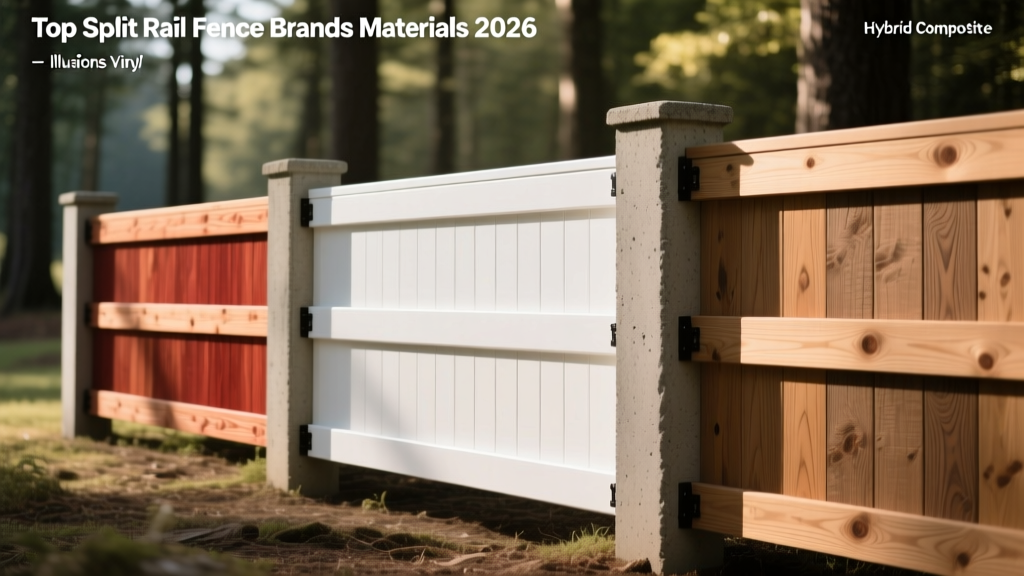
The Material Matrix: Wood vs. Vinyl vs. Hybrid Systems
When specifying a split rail fence for rural estates, equestrian properties, or suburban boundary lines, the aesthetic appeal of the rustic profile must be balanced against structural longevity and 2026 material economics. Unlike privacy fencing, split rail systems rely heavily on the structural integrity of the posts and the tensile strength of the rails, as they lack the lateral wind-load distribution of solid panels. A standard 2-rail fence stands 36 to 42 inches tall, while a 3-rail configuration reaches 48 to 54 inches. For 10-foot spans, rails must resist mid-span deflection, requiring precise material selection.
This deep-dive analyzes the three dominant split rail material categories available in 2026: traditional Western Red Cedar, co-extruded architectural vinyl, and the emerging composite-hybrid systems. We evaluate specific brand lines, exact dimensional tolerances, and real-world failure modes to help contractors and property owners make engineered decisions.
Deep Dive: Western Red Cedar (The Traditional Standard)
For authentic rustic aesthetics, Western Red Cedar (WRC) remains the undisputed benchmark. However, not all cedar is equal. The market is currently flooded with Incense Cedar and lower-grade hem-fir marketed as "cedar," which lack the natural thujaplicins required for decay resistance.
Brand & Product Focus: WRCLA-Certified #1 Grade WRC
When sourcing wood, specify products certified by the Western Red Cedar Lumber Association (WRCLA). The ideal split rail configuration utilizes #1 Grade or Clear Heartwood posts and rails. Heartwood contains the highest concentration of natural preservatives, whereas sapwood will succumb to fungal decay within 3 to 5 years when exposed to soil moisture.
- Post Dimensions: 4x4x60 inches (actual 3.5" x 3.5" x 60").
- Rail Dimensions: 2x4x10 feet (actual 1.5" x 3.5" x 120"). For 10-foot spans, 2x4 rails are prone to warping; upgrading to a true 3x4 profile significantly reduces cupping and bowing.
- 2026 Installed Cost: $14.50 to $19.00 per linear foot (3-rail configuration).
The most common failure point in wood split rail fences is the post-to-soil interface. Never encase WRC posts in a concrete collar at the grade line. Concrete traps moisture against the wood, accelerating rot. Instead, use a 6-inch base of 3/4-inch crushed angular gravel, set the post, and backfill with a 50/50 gravel-soil mix. This allows hydrostatic pressure to dissipate, extending the life of a #1 Grade WRC post from an average of 12 years to over 20 years.
Deep Dive: Co-Extruded Vinyl (Illusions Grand Illusions)
For property owners demanding the split rail silhouette without the maintenance of staining and sealing, architectural vinyl has evolved significantly. Mono-extruded PVC fences of the past suffered from UV degradation and chalky oxidation. Today's premium systems utilize advanced co-extrusion technology.
Brand & Product Focus: Illusions Grand Illusions Woodgrain Series
The Illusions Fence Grand Illusions line represents the pinnacle of vinyl split rail design. These systems feature a rigid PVC substrate capped with an ASA (Acrylonitrile Styrene Acrylate) acrylic layer. This ASA cap is heavily pigmented and UV-stabilized with titanium dioxide (TiO2), ensuring the woodgrain texture does not fade or chalk, even in high-UV environments like the American Southwest.
- Structural Specs: 5x5 inch routed posts with a minimum 0.165" wall thickness. Rails feature internal aluminum stiffeners to prevent sagging over 8-foot or 10-foot spans.
- Compliance: Fully compliant with ASTM F964-21 standards for rigid PVC fencing, ensuring impact resistance and structural load-bearing capabilities.
- 2026 Installed Cost: $26.00 to $34.00 per linear foot.
Vinyl Split Rail: Pros and Cons
| Advantages | Limitations |
|---|---|
| Zero maintenance; no staining or sealing required. | Higher upfront material cost (approx. 80% more than wood). |
| Immune to wood-boring insects and fungal decay. | Routed posts require precise hole digging; rails cannot be easily trimmed on-site. |
| ASA cap layer resists UV fading and thermal expansion. | Can become brittle in extreme sub-zero temperatures if struck by heavy machinery. |
Deep Dive: The Hybrid Approach (Composite Posts + Cedar Rails)
A growing trend in 2026 is the hybrid split rail system, which pairs the structural permanence of composite posts with the authentic texture of natural wood rails. Brands like Trex Fencing offer 4x4 composite posts that are impervious to moisture, insects, and rot. By utilizing Trex posts with routed channels or specialized metal brackets, contractors can insert standard Western Red Cedar rails.
This system eliminates the ground-line rot issue entirely while reducing the overall cost compared to full-vinyl or full-composite systems. The wood rails will eventually weather to a silver-gray patina and may need replacement after 15 to 20 years, but swapping out the rails is a simple, low-cost maintenance task since the structural posts remain permanently intact.
Contractor Insight: When building a hybrid system, always use hot-dipped galvanized or stainless steel brackets to attach the wood rails to the composite posts. Standard zinc-plated screws will react with the natural tannins in the cedar, causing unsightly black streaks down the composite post face within a single season.
2026 Pricing & Performance Comparison Matrix
The following matrix synthesizes current market data for a standard 3-rail, 100-linear-foot split rail installation.
| Material System | Brand / Line Example | Cost per Lin. Ft. (Installed) | Expected Lifespan | Maintenance Level |
|---|---|---|---|---|
| #1 Grade WRC Wood | WRCLA Certified Mills | $14.50 - $19.00 | 15 - 25 Years | High (Stain/Seal every 3-5 yrs) |
| Co-Extruded Vinyl | Illusions Grand Illusions | $26.00 - $34.00 | 30 - 50+ Years | Very Low (Occasional washing) |
| Composite Hybrid | Trex Posts + Cedar Rails | $22.00 - $28.00 | Posts: 50+ / Rails: 20 Yrs | Moderate (Rail replacement) |
| Pressure-Treated Pine | Southern Yellow Pine (MCA) | $11.00 - $14.00 | 10 - 15 Years | High (Prone to severe warping) |
Engineering the Post-Base: Where Split Rail Fences Fail
Regardless of the rail material chosen, a split rail fence is only as strong as its post foundation. Because split rail fences have a high center of gravity and lack the continuous support of a privacy fence, lateral leverage from wind or leaning animals places immense torque on the post base.
Frost Heave and Soil Mechanics
In climates with freeze-thaw cycles (USDA Hardiness Zones 3 through 6), frost heave is the primary enemy of fence alignment. If the bottom of the post hole does not extend below the local frost line, the expanding ice lenses in the soil will push the post upward. Over three to four winters, this results in a severely undulating fence line.
- Determine Frost Depth: Consult local building codes. In regions like the Midwest or Northeast, this typically requires a minimum depth of 36 to 42 inches.
- Bell-Bottom Excavation: Dig the bottom 6 inches of the hole wider than the top (creating a bell shape). When backfilled with gravel or concrete, this creates an anchor that resists upward frost pressure.
- Hydrostatic Drainage: Always place 4 to 6 inches of washed, angular gravel at the bottom of the hole before setting the post. This prevents the post base from sitting in pooled water, which accelerates both wood rot and the spalling of concrete footings.
Because split rail fences follow the natural topography of the land, maintaining a consistent visual line is difficult. Run a mason's string line exactly 36 inches above the grade at every 50-foot interval. Use this string to mark your cut-lines on the posts, ensuring the top of the posts follow a smooth, rolling contour rather than jaggedly mimicking every minor dip in the soil.
Decision Framework: Which System Should You Specify?
Selecting the right split rail fence material depends heavily on the property's functional requirements and the owner's maintenance tolerance.
- Specify Western Red Cedar if: The project is for a rural, equestrian, or heavily wooded property where natural aesthetics are paramount, and the owner is willing to apply a penetrating oil-based sealer (like TWP or Ready Seal) every 3 to 5 years. Avoid pressure-treated pine for aesthetic applications, as it is highly prone to twisting and checking as it dries.
- Specify Co-Extruded Vinyl (Illusions) if: The fence is for a suburban property line, a commercial frontage, or an HOA where maintenance-free longevity is required. The internal aluminum stiffeners in premium vinyl rails ensure the fence will not sag over time, even with 10-foot spans.
- Specify the Hybrid System if: You want the authentic texture of real wood rails but refuse to deal with the structural failure of wood posts rotting at the ground line. This is the ultimate compromise for modern farmsteads and high-end residential properties.
By prioritizing material grade, precise dimensional tolerances, and engineered post-base drainage, a split rail fence can transition from a temporary boundary marker to a permanent, structurally sound architectural feature.