2026 Cost to Build a Fence Per Foot: Material and Labor Price Guide
Discover the exact cost to build a fence per foot in 2026. Compare wood, vinyl, aluminum, and composite pricing, plus hidden labor and terrain fees.

The Baseline: National Average Cost to Build a Fence Per Foot
The national average cost to build a fence per foot ranges from $18 to $55 for standard residential installations. However, relying on a single national average is a critical estimating error. The true per-foot cost is a composite metric driven by three distinct variables: raw material grade, regional labor rates dictated by local frost lines, and site-specific terrain modifiers. A pressure-treated pine fence in Florida will cost drastically less per linear foot than the exact same fence in Minnesota due to the concrete yardage required to meet structural frost-line codes.
Quick Cost Snapshot (2026 Data)
- Lowest Cost: Chain Link ($12 - $18 per linear foot)
- Mid-Range Standard: PVC Vinyl & Cedar ($28 - $45 per linear foot)
- Premium/High-End: Composite & Wrought Iron ($55 - $85+ per linear foot)
- Labor Average: $12 - $25 per linear foot (highly dependent on soil and depth)
Material Cost Matrix: Price Per Linear Foot by Fence Type
When calculating the cost to build a fence per foot, you must separate material costs from labor. The table below breaks down the 2026 market rates for a standard 6-foot-tall privacy or semi-privacy fence. Material costs include panels, posts, fasteners, and standard concrete footing.
| Material Type | Material Cost / Ft | Labor Cost / Ft | Total Cost / Ft | Expected Lifespan |
|---|---|---|---|---|
| Pressure-Treated Pine | $10 - $18 | $12 - $20 | $22 - $38 | 15 - 20 Years |
| Western Red Cedar | $18 - $30 | $12 - $20 | $30 - $50 | 20 - 30 Years |
| PVC Vinyl (Privacy) | $20 - $35 | $15 - $25 | $35 - $60 | 30 - 50 Years |
| Composite (e.g., Trex) | $35 - $55 | $20 - $30 | $55 - $85 | 25 - 40 Years |
| Powder-Coated Aluminum | $25 - $40 | $15 - $25 | $40 - $65 | 50+ Years |
| Wrought Iron / Steel | $30 - $50 | $20 - $35 | $50 - $85 | 50+ Years |
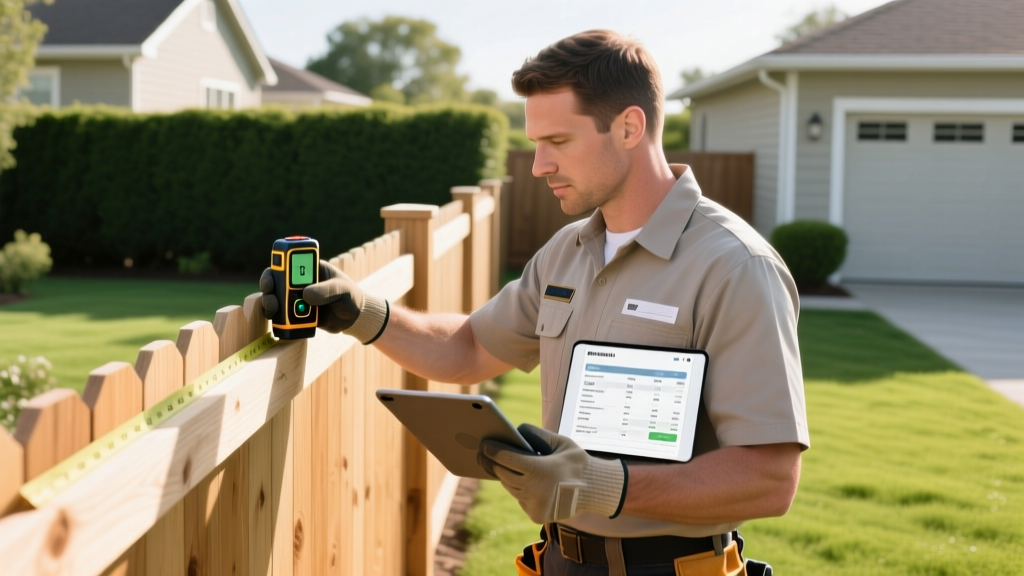
Labor Variables: Why Terrain and Frost Lines Dictate Your Price
According to Angi's fencing cost database, labor accounts for 30% to 50% of your total project cost. However, labor is rarely a flat per-foot rate. Contractors adjust their per-foot labor pricing based on the physical resistance of your property and local building codes.
The Frost Line Multiplier
The most significant hidden labor variable is the local frost line. Building codes require fence post holes to extend below the frost line to prevent winter ground heaving from pushing the posts out of plumb.
- Southern States (e.g., Florida, Texas): Frost lines are shallow (6 to 12 inches). Post holes are typically 24 inches deep. A standard 4x4 post requires roughly one 80lb bag of concrete.
- Northern States (e.g., Minnesota, Maine): Frost lines can reach 48 to 60 inches. Post holes must be dug 5 feet deep. This requires specialized augers, significantly more time, and up to three 80lb bags of concrete per post. This structural requirement can increase the labor and material cost by $4 to $8 per linear foot compared to southern installations.
Soil Composition and Auger Limits
Standard per-foot labor quotes assume loamy, easily diggable soil. If your property line sits on heavy clay, shale, or bedrock, contractors will apply a terrain surcharge. Hitting bedrock requires either switching to a core drill (adding $15 to $25 per hole) or bringing in a jackhammer attachment for a skid steer. Furthermore, properties with dense root systems from mature oak or pine trees will slow down manual digging, often triggering a 15% to 20% labor premium on the affected linear footage.
Long-Term ROI: Wood vs. Vinyl vs. Composite Over 20 Years
When evaluating the cost to build a fence per foot, the initial installation price is only half the equation. The 20-year lifecycle cost reveals the true financial impact of your material choice. While pressure-treated pine is the cheapest upfront, the cumulative cost of staining, sealing, and replacing rotted pickets often surpasses the initial investment of a PVC vinyl fence. The American Fence Association frequently notes that homeowners who choose premium vinyl or composite break even on their investment around year 12 when factoring in avoided maintenance costs.
| Material | Initial Cost (150 ft) | 20-Yr Maintenance | Total 20-Yr Cost |
|---|---|---|---|
| Pressure-Treated Pine | $4,500 | $2,400 (Stain/Repairs) | $6,900 |
| PVC Vinyl | $7,125 | $200 (Power washing) | $7,325 |
| Wood-Grain Composite | $10,500 | $150 (Basic cleaning) | $10,650 |
Hidden Costs That Inflate Your Per-Foot Estimate
Contractor quotes often exclude site-prep and finishing variables that will appear on the final invoice. Budget for these specific line items to avoid per-foot sticker shock:
- Old Fence Demolition and Haul-Away: Tearing down an existing 150-foot wooden fence and paying landfill tipping fees typically adds $6 to $10 per linear foot to the project.
- Utility Marking (811): While calling 811 is free, if utility lines are marked shallow or run directly through your fence line, contractors may need to hand-dig around them instead of using a mechanical auger, adding $3 to $5 per foot in those specific zones.
- Gate Hardware and Automation: A standard manual gate adds $250 to $400 to the total project. However, if you opt for an automated swing-gate opener (like the Ghost Controls TSS1XP), expect to add $1,200 to $1,800 to the final bill, which drastically skews your overall per-foot average.
- Permitting and Surveys: Municipal fence permits range from $50 to $250. If your property pins are missing or disputed, hiring a land surveyor to mark the exact boundary will cost $400 to $800, a mandatory step to avoid encroachment lawsuits.
Framework: How to Calculate Your Exact Project Cost
To generate a highly accurate estimate for your specific property, follow this calculation framework based on Home Depot's fence installation guidelines and current contractor pricing models:
- Measure the True Linear Footage: Do not guess. Use a laser measure or a 100-foot fiberglass tape to measure the exact perimeter. Add 5% to account for waste, off-cuts, and measurement errors.
- Select Your Base Material Rate: Choose the mid-point of your desired material from the matrix above (e.g., $45/ft for PVC Vinyl).
- Apply the Terrain Multiplier: If your yard has a slope greater than 15%, add 15% to your labor estimate to account for stepped panel installation. If your soil is heavy clay or rocky, add 20% to the labor rate.
- Factor in Frost Line Concrete: Calculate the number of posts (Total Linear Footage / 8 feet). Multiply the post count by the number of 80lb concrete bags required for your local frost depth (e.g., 2 bags per post at $7.50/bag = $15 per post). Add this to your material total.
- Add Fixed Ancillary Costs: Add the flat costs for gates, demolition, and permits to the final sum, then divide by your total linear footage to find your true, fully-burdened cost to build a fence per foot.
By isolating material, labor, and site-specific variables, you can negotiate with contractors using precise data rather than accepting inflated, generalized per-foot quotes.
Written by
David NakamuraDavid Nakamura is a licensed architect (AIA) and construction technology writer focused on sustainable building methods, mass timber engineering, and high-performance building envelopes. He holds a Master of Architecture from the University of Washington and is a certified Passive House Consultant (CPHC). David spent eight years at the Seattle firm Mithun, where he led the design of three LEED Platinum projects, before founding his own practice specializing in net-zero residential design. He serves on the editorial advisory board of GreenBuilder Magazine and has authored peer-reviewed papers on cross-laminated timber (CLT) connections for the Journal of Structural Engineering. In his spare time, David teaches woodworking at Pratt Fine Arts Center and kayaks the Puget Sound.
More from David Nakamura
View all
Construction Cost
Labor Cost to Build a Deck Per Sq Ft: 2026 Installation Guide
Discover the exact labor cost to build a deck per sq ft in 2026. This installation guide breaks down contractor rates, complexity factors, and hidden fees.
Aug 4, 2026

Construction Cost
How Much Does It Cost to Build a 3 Bedroom House? Financing Guide
Learn exactly how much it costs to build a 3 bedroom house and explore 2026 financing options, construction loan types, and budget frameworks for your build.
Aug 4, 2026

Construction Cost
Cost to Build a Tennis Court: 2026 Guide
How much does it cost to build a tennis court in 2026? Breakdowns for asphalt, concrete, and synthetic surfaces plus fencing and lighting.
Jul 30, 2026