Matching Fence Posts to Soil, Wind, and Gate Load Scenarios
Match fence posts to specific soil, wind, and gate scenarios. Learn exact material specs, footing depths, and AWPA wood grades for lasting stability.
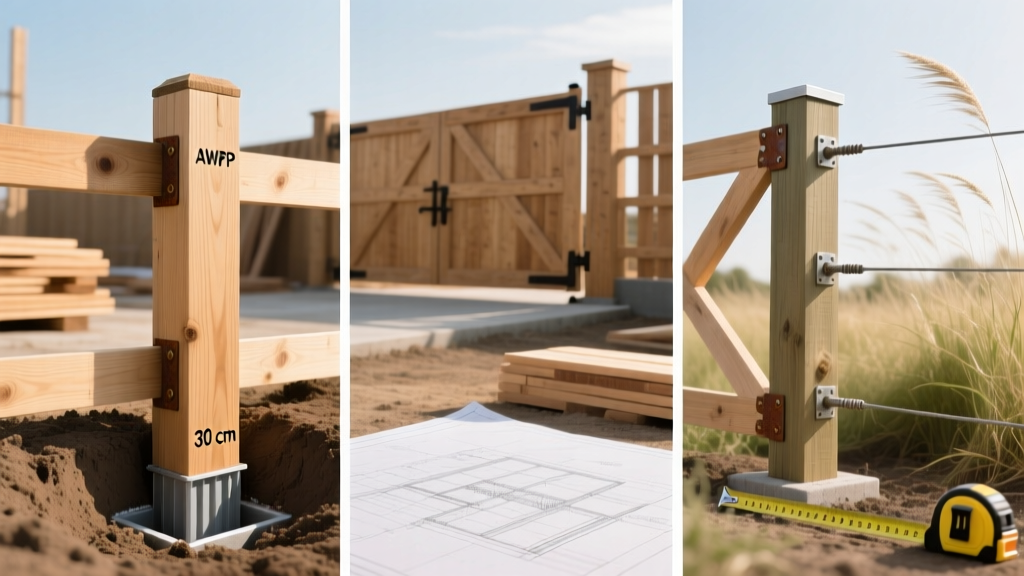
The Physics of Fence Post Failure
When a fence collapses, the pickets or rails are rarely the culprit. Industry data shows that over 80% of structural fence failures originate at the post or the footing. A fence post acts as a cantilever beam; wind pushing against a 6-foot privacy fence generates immense lateral force, creating a bending moment concentrated exactly at the ground line. If the post material lacks the shear strength to resist this moment, or if the footing lacks the mass to counteract the rotational leverage, the system fails.
Matching the correct fence post material, dimension, and footing specification to your specific environmental scenario is not a matter of preference—it is a structural requirement. A standard 4x4 pressure-treated pine post set in a 12-inch concrete collar might survive a decade in mild, sandy soils, but it will snap or heave within three years in expansive clay or high-wind coastal zones. This guide breaks down exact material specifications, American Wood Protection Association (AWPA) retention grades, and footing geometries required for the most demanding residential and commercial scenarios in 2026.
Many local building codes dictate setting posts 6 inches below the frost line. In regions with severe freeze-thaw cycles and expansive clay, simply digging deeper is insufficient. Frost can grip the sides of a smooth concrete cylinder and exert up to 5,000 pounds per square foot (psf) of vertical uplift pressure. Depth alone will not prevent heave; footing geometry and surface friction management are mandatory.
Scenario Matching Matrix: Post and Footing Specifications
The following matrix provides baseline specifications for 6-foot tall privacy fencing across four distinct environmental and structural scenarios. Pricing reflects average material and concrete costs per post as of early 2026, excluding labor.
| Scenario | Post Material & Grade | Dimensions | Footing Specification | Est. Cost/Post |
|---|---|---|---|---|
| High Wind (110+ mph) | Galvanized Steel (e.g., PostMaster Plus) | 2-3/8" OD, 16-gauge | 36" depth, 10" diameter, 4000 PSI mix | $55 - $75 |
| Expansive Clay / Frost Heave | UC4B Pressure-Treated Southern Yellow Pine | 4x4 or 6x6 nominal | 42" depth, bell-bottom base, gravel drainage | $35 - $50 |
| Heavy Gate (6ft+ width) | UC4C Treated Wood or Concrete-Filled Steel | 6x6 Wood or 4x4 Steel Tube | 48" depth, pinned with #5 rebar | $70 - $110 |
| Agricultural / Wire Tension | Galvanized T-Post or Round Wood | 1.33 lb/ft T-Post | 24" driven depth, no concrete required | $9 - $14 |
Deep Dive: High-Wind and Coastal Applications
In coastal zones or open plains where sustained winds exceed 90 mph and gusts top 110 mph, traditional wood posts face two fatal threats: sheer snap at the ground line and accelerated rot from salt-laden moisture trapped in concrete collars. According to structural guidelines referenced by the American Fence Association, a solid 4x4 wood post presents a wide surface area that catches wind, amplifying the lateral load transferred to the footing.
Steel vs. Wood in 110+ MPH Zones
For high-wind scenarios, 16-gauge galvanized steel fence posts (such as the PostMaster Plus system) are the superior application fit. These posts feature an aerodynamic, U-shaped profile that allows wind to pass through the fence plane rather than pushing solidly against the post. When set 36 inches deep in a 10-inch diameter footing of 4,000 PSI concrete, a steel post can withstand lateral wind loads that would snap a 6x6 wooden post. Furthermore, the galvanized coating (minimum G90 standard) provides a sacrificial zinc layer that resists coastal salt corrosion far longer than standard pressure-treated lumber.
Deep Dive: Expansive Clay and Frost Heave
Expansive clay soils absorb water and swell significantly, then shrink during dry periods. When combined with freezing temperatures, this soil type acts like a hydraulic jack, pushing fence posts upward. To defeat this, you must alter the footing geometry and manage surface water.
- The Bell-Bottom Footing: Dig the hole to the required depth (minimum 6 inches below the local frost line), but use a sonotube that is 2 inches narrower than the hole. Before pouring concrete, flare the bottom 6 inches of the hole outward to create a 'bell' shape. This subterranean anchor resists vertical uplift because the soil must physically shear to push the wider base upward.
- Gravel Drainage Base: Never pour concrete directly onto bare dirt. Place 4 to 6 inches of washed, angular gravel at the bottom of the hole. This allows water migrating down the post to drain away, preventing the concrete collar from acting as a bucket that traps water and accelerates frost heave.
- Surface Sloping: The top of the concrete collar must be sloped away from the post at a minimum 15-degree angle to shed surface runoff. Use a concrete trowel to form this slope before the mix fully sets.
Deep Dive: Heavy Gate and Hinge Loads
A standard 6-foot cedar privacy gate weighs between 120 and 160 pounds. When opened, the center of gravity shifts away from the hinge post, creating a massive moment arm that attempts to pull the top of the post inward and push the bottom outward. Standard 4x4 posts will deflect, causing the gate to drag on the ground within months.
Expert Insight: Never rely on lag screws for heavy gate hinges. The repetitive dynamic loading of a gate swinging open and closed will elongate the wood fibers around the lag screw threads, leading to pull-out. Always use 5/8-inch galvanized through-bolts with large fender washers on the backside to distribute the shear load across the entire post.
For gate posts, upgrade to a 6x6 pressure-treated post rated for UC4C (Heavy Duty Ground Contact) by the American Wood Protection Association. UC4C lumber retains a higher concentration of copper-based preservatives (minimum 0.60 pcf for Southern Pine) compared to the UC4A (0.25 pcf) typically sold at big-box retailers for general above-ground use. If a 6x6 wood post is unavailable or cost-prohibitive, use a 4x4 steel tube post filled with concrete and capped with a welded steel hinge plate.
Understanding AWPA Wood Treatment Grades
When specifying wood fence posts, the stamp on the lumber is your only guarantee of longevity. The USDA Forest Products Laboratory and AWPA categorize treated wood based on its intended exposure. Misapplication of these grades is the leading cause of premature post rot.
- UC4A (General Ground Contact): Suitable for fence posts in well-drained, sandy soils with low termite pressure. Retention level: 0.25 pcf.
- UC4B (Heavy Duty Ground Contact): Required for posts in poorly drained soils, areas with high termite activity, or where the post is in contact with freshwater. Retention level: 0.40 pcf. This should be your baseline standard for all residential wood fence posts.
- UC4C (Extreme Duty): Mandatory for critical structural posts (like heavy gate hinges), posts embedded in saltwater environments, or permanent wood foundations. Retention level: 0.60 pcf.
Quick-Reference Decision Flowchart
Use this logical sequence to finalize your fence post specification for any new installation:
- Assess Wind Load: Is the site exposed to open plains or coastal gusts >90 mph? If YES, specify 16-gauge galvanized steel posts. If NO, proceed to step 2.
- Assess Soil and Frost: Does the site have expansive clay or a frost line deeper than 24 inches? If YES, specify UC4B wood or steel, paired with a bell-bottom footing and gravel base. If NO, standard 36-inch cylindrical footings are acceptable.
- Assess Gate Loads: Are you hanging a gate wider than 4 feet or heavier than 100 lbs? If YES, the hinge and latch posts MUST be upgraded to 6x6 UC4C wood or concrete-filled steel, anchored 48 inches deep with rebar pins. If NO, standard 4x4 UC4B posts are sufficient.
By rigorously matching the post material, treatment grade, and footing geometry to the specific physical forces of your site, you eliminate the primary vectors of fence failure, ensuring a structure that remains plumb and secure for decades.