Selecting Picket Fence Pickets: A Scenario-Based Material Guide
Match picket fence pickets to your property's specific needs. Compare wood, vinyl, and composite materials, spacing math, and wind-load scenarios.
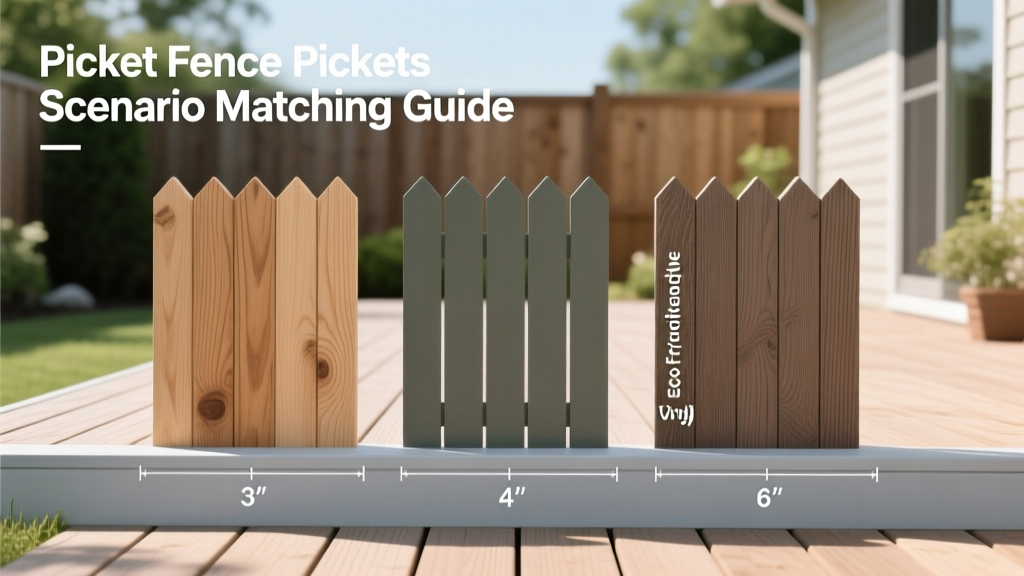
The Anatomy of Picket Fence Pickets: Dimensions & Profiles
Selecting the correct picket fence pickets requires moving beyond aesthetic preferences to evaluate structural dimensions and profile geometries. Lumber yards and home centers sell pickets in nominal sizes, but the actual milled dimensions dictate your spacing math and wind-load resistance.
- 1x4 Pickets: Actual dimensions are 0.75 inches thick by 3.5 inches wide. Best for decorative boundaries and low-wind zones. The narrower profile reduces material costs but offers less lateral rigidity.
- 1x6 Pickets: Actual dimensions are 0.75 inches thick by 5.5 inches wide. Ideal for semi-privacy applications and high-wind scenarios. The wider face provides greater surface area for wind deflection and requires fewer pickets per linear foot.
- Thickness Variations: Standard pine pickets are often milled to 0.625 inches (5/8 inch) to reduce shipping weight. For high-impact areas or regions with severe weather, source true 0.75-inch (3/4 inch) rough-sawn or premium milled pickets to prevent bowing between rails.
Profile shapes also dictate application fit. Dog-ear pickets (flat top with angled corners) shed water efficiently and prevent splintering at the top edge. Gothic (pointed) pickets offer traditional aesthetics but pose laceration risks in high-traffic pedestrian zones. French Gothic pickets feature a rounded point, bridging the gap between traditional aesthetics and pedestrian safety.
Scenario Matching Matrix: Which Picket Fits Your Property?
Use the following decision matrix to align your picket specifications with your property's functional requirements.
| Property Scenario | Recommended Profile | Optimal Material | Spacing Requirement | Key Engineering Consideration |
|---|---|---|---|---|
| High-Wind Coastal / Plains | Dog-Ear or Flat-Top | KDAT Pressure-Treated Pine | 2.5 to 3.5 inches | Wind-load dissipation; requires 3 horizontal rails |
| Pet Containment (Small Dogs) | French Gothic | Cellular PVC or Cedar | 1.5 inches max | Prevents head entrapment; bottom rail 2 inches off grade |
| Child Safety / Play Areas | Flat-Top | Composite or Sanded Cedar | 2.0 to 2.5 inches | Eliminates sharp points; prevents splinters; smooth finish |
| Purely Decorative / Curb Appeal | Standard Gothic | Select Tight Knot (STK) Cedar | 3.0 to 4.0 inches | Aesthetic rhythm; minimizes material cost per linear foot |
| Saltwater / Marine Environment | Dog-Ear | Marine-Grade Cellular PVC | 3.0 inches | Zero moisture absorption; stainless steel fasteners mandatory |
Deep Dive: Critical Scenarios & Picket Selection
Scenario 1: High-Wind Coastal or Plains Properties
In regions subject to sustained winds exceeding 40 mph or frequent gusts, solid fencing acts as a sail, transferring massive sheer force to the fence posts. Picket fence pickets naturally mitigate this through spaced gaps. A 3-inch gap between 3.5-inch wide pickets reduces the overall wind load on the fence structure by approximately 45% compared to a solid privacy fence. For these scenarios, specify 1x6 pickets installed with three horizontal rails (top, middle, bottom) rather than the standard two. The middle rail, placed precisely at the 50% height mark, prevents the wider pickets from bowing under lateral wind pressure.
Scenario 2: Pet Containment & Child Safety
When containing small dogs (under 25 lbs) or securing toddler play areas, the gap spacing and profile geometry are critical. Standard 3-inch spacing allows small dogs to push their heads through, leading to entrapment or escape. Reduce the gap to 1.5 inches. Furthermore, avoid standard gothic pickets; the sharp points can cause severe lacerations if a child falls against the fence or a dog jumps near the boundary. Specify flat-top or French gothic pickets. If using wood, ensure the pickets are sanded smooth or opt for extruded vinyl, which eliminates splinter risks entirely.
Material Science: Wood vs. Cellular PVC vs. Composite
Western Red Cedar: The Premium Wood Standard
Western Red Cedar remains the benchmark for wood picket fence pickets due to its natural thujaplicins, which provide inherent resistance to decay and insect infestation. According to data from the Wood Database, Western Red Cedar has a low shrinkage factor, meaning it is significantly less prone to warping, cupping, or twisting after installation compared to pine. When purchasing, specify Select Tight Knot (STK) grade. STK allows for small, tight knots that add character without compromising structural integrity, whereas 'Clear' grades are prohibitively expensive for fencing, and 'Construction' grades contain large, loose knots that will eventually fall out, leaving holes in the pickets.
Pressure-Treated Southern Yellow Pine: The Budget Workhorse
Pressure-treated pine is the most cost-effective option, but it carries a high risk of warping if installed while wet. To mitigate this, you must source KDAT (Kiln Dried After Treatment) pine pickets. The American Wood Protection Association (AWPA) outlines specific retention levels for treated wood; for pickets that will not have direct ground contact, a UC3B (Above Ground) retention level is sufficient. However, if your pickets will extend all the way to the soil line, you must upgrade to UC4A (Ground Contact) rated lumber to prevent premature rot at the base.
Never install standard UC3B (Above Ground) pressure-treated pickets flush with the soil. Capillary action will draw moisture into the end-grain, bypassing the surface treatment and causing the bottom 4 inches to rot within 3 to 5 years. Always maintain a minimum 2-inch clearance between the bottom of the picket and the finished grade, or use UC4A Ground Contact rated pickets if flush installation is architecturally required.
Cellular PVC and Composite Alternatives
Cellular PVC pickets (such as those from Azek or CertainTeed) are manufactured through a micro-cellular foaming process that mimics the density and workability of wood while absorbing zero moisture. Unlike hollow vinyl pickets, which can crack under impact in freezing temperatures, solid cellular PVC can be routed, shaped, and painted with standard acrylic latex paints. Composite pickets (a blend of wood fibers and recycled polyethylene) offer superior rigidity but are heavier, requiring closer post spacing (maximum 6 feet on-center) to prevent rail sagging under the added dead load.
The Spacing Formula: Eliminating the 'Leftover Gap' Error
The most common installation error in picket fencing is failing to calculate spacing before nailing the first board, resulting in an awkward, oversized gap at the end of a run. Professional installers use a dynamic spacing formula to distribute the fractional remainder evenly across the entire section.
The Calculation Framework:
- Measure the exact distance between the inside faces of your two end posts (e.g., 92 inches).
- Add the width of one picket to your desired gap (e.g., 3.5-inch picket + 3.0-inch gap = 6.5-inch pattern).
- Divide the total run by the pattern: 92 / 6.5 = 14.15 pickets.
- Round UP to the next whole number to ensure you don't run short: 15 pickets.
- Calculate the total width of the pickets: 15 pickets x 3.5 inches = 52.5 inches.
- Subtract the picket width from the total run to find the total gap space: 92 - 52.5 = 39.5 inches.
- Divide the total gap space by the number of gaps (which is number of pickets minus 1): 39.5 / 14 gaps = 2.82 inches.
Set your spacing jig to exactly 2.82 inches (or 2 13/16 inches). This guarantees perfectly even spacing from post to post, eliminating the 'leftover gap' error entirely.
Fastener Selection: Preventing Tannin Bleed and Corrosion
The longevity of your picket fence pickets is heavily dependent on the fasteners used. Cedar and redwood contain high levels of tannic acid. When exposed to the zinc in standard galvanized nails or screws, a chemical reaction occurs that causes black streaks (tannin bleed) to run down the face of the pickets, while simultaneously corroding the fastener.
- For Cedar and Redwood: You must use Type 304 or Type 316 stainless steel fasteners. Hot-dipped galvanized fasteners are insufficient for long-term cedar applications.
- For Pressure-Treated Pine: Modern ACQ and CA-C preservative treatments are highly corrosive to standard steel and aluminum. Use hot-dipped galvanized (ASTM A153 Class D) or stainless steel fasteners. Never use uncoated steel or basic electroplated zinc screws.
- For Cellular PVC / Composite: Standard exterior-grade coated deck screws (such as polymer-coated star-drive screws) are acceptable, provided they feature a bugle head that can be countersunk slightly below the surface without blowing out the PVC material.