Choosing Steel Fence Posts: Scenario Matching & Load Guide
Match steel fence posts to your exact project scenario. Compare gauges, wind load capacities, and costs for residential and commercial installs.
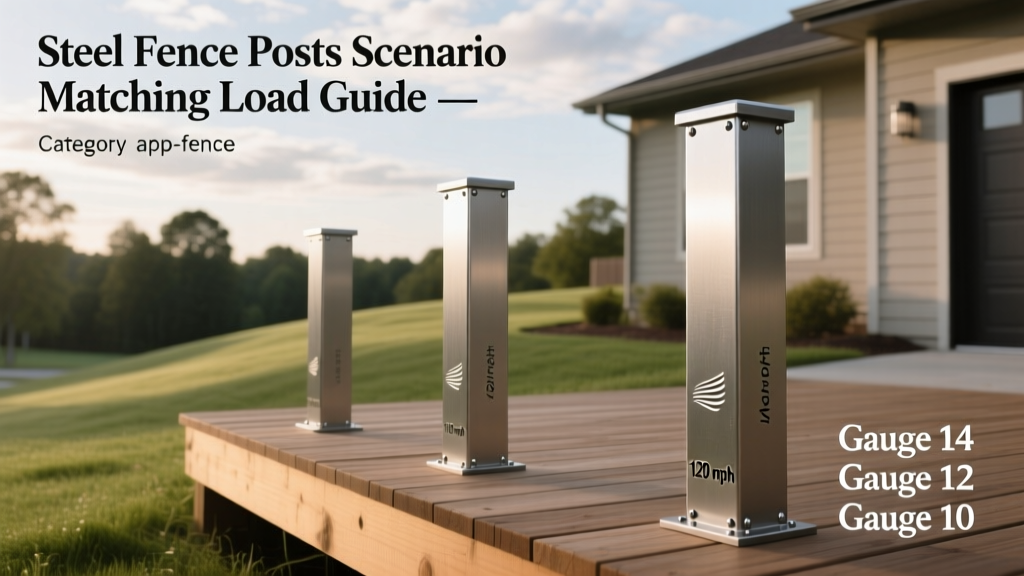
The Physics of Fence Failure: Why Material Selection Matters
Fence failure rarely occurs because the pickets break; it happens because the posts yield, snap, or pull out of the ground under lateral load. When evaluating steel fence posts for residential or commercial applications, treating them as a monolithic category is a critical error. A 16-gauge galvanized tube designed for a lightweight chain-link perimeter will catastrophically buckle if tasked with supporting a 6-foot solid composite privacy fence in a 70-mph wind event. Application-fit requires matching the post’s wall thickness, yield strength, and coating to the specific mechanical and environmental demands of the site.
Quick Scenario Matcher
- Lightweight Chain Link / Wire Mesh: 16-gauge or 14-gauge (Schedule 20) round tubing.
- Standard Wood Privacy (Cedar/Pine): 14-gauge (0.083") or 12-gauge (0.109") square tubing.
- Heavy Composite / Solid Hardwood: 12-gauge or 9-gauge (0.148") structural square tubing.
- High-Wind Coastal / Commercial Security: 9-gauge or 7-gauge hot-dip galvanized (HDG) with deep concrete collars.
Decoding Steel Gauges and Yield Strength
The structural integrity of a steel fence post is dictated by its gauge (wall thickness) and the metallurgical yield strength of the steel. Most architectural fence posts are roll-formed from carbon steel sheet or coil. For structural applications, you must specify tubing that meets ASTM A500 Grade B standards, which guarantees a minimum yield strength of 46,000 to 50,000 psi. Below is the engineering breakdown of common post sizes used in modern fencing.
| Gauge | Wall Thickness (Inches) | Typical Profile | Max Recommended Privacy Height (115 mph Wind) | Approx. Cost per 8ft Post (2026) |
|---|---|---|---|---|
| 16-Ga | 0.065" | 1.625" Round | N/A (Wire/Mesh Only) | $12 - $16 |
| 14-Ga | 0.083" | 2" x 2" Square | 5 Feet | $18 - $24 |
| 12-Ga | 0.109" | 2.5" x 2.5" Square | 6 Feet | $28 - $36 |
| 9-Ga | 0.148" | 3" x 3" or 2.5" Round | 8 Feet (Terminal/Gate) | $45 - $65 |
Scenario 1: High-Wind and Coastal Environments
In hurricane-prone or high-wind coastal zones, a solid privacy fence acts as a massive sail. The lateral force exerted on a fence is not linear; it scales with the square of the wind speed. According to FEMA Building Science guidelines for wind-resistant design, a 6-foot tall solid wood fence subjected to 90-mph winds generates approximately 15 pounds per square foot (psf) of lateral pressure.
The Bending Moment Calculation
For an 8-foot span of 6-foot tall fencing, the total lateral force is 720 pounds (6 ft x 8 ft x 15 psf). Because this force is distributed evenly across the height of the fence, the center of pressure is at 3 feet above grade. This creates a bending moment at the base of the post of 2,160 foot-pounds (720 lbs x 3 ft). A standard 14-gauge 2x2 steel post will permanently deform (yield) under this load. For high-wind scenarios, you must step up to a 12-gauge or 9-gauge steel post, paired with a concrete footing that extends below the local frost line and features a minimum 12-inch diameter bell at the base to resist overturning.
Scenario 2: Supporting Heavy Composite and Hardwood Privacy Fences
Composite fencing materials (like Trex or Fiberon) and dense hardwoods (like Ipe) weigh significantly more than standard pressure-treated pine or cedar. A standard 6-foot composite fence panel can weigh 60 to 80 pounds, compared to 35 pounds for a cedar equivalent. This dead load, combined with the lack of wind permeability in solid composite panels, demands rigid steel framing.
Many manufacturers sell pre-assembled composite panels designed to 'rack' (follow the slope of the ground). When racking a panel, the diagonal tension transfers immense point-loads to the top and bottom rail brackets. If using steel posts for racking applications, ensure you are using heavy-duty stamped steel bracketry (such as Simpson Strong-Tie or Oz-Post equivalents) bolted with 3/8-inch grade 5 zinc-plated carriage bolts, rather than relying on self-tapping tek screws which will strip out of the steel under dynamic racking loads.
Scenario 3: Agricultural and High-Tension Livestock Containment
Agricultural fencing relies on high-tensile wire (often pulled to 1,500+ pounds of tension per wire). While traditional T-posts are common for line posts, the terminal (corner and brace) posts must absorb the cumulative vector forces of the entire fence run. For a standard 5-wire high-tensile fence, the corner posts must withstand over 7,500 pounds of horizontal pull.
For these scenarios, USDA NRCS fencing specifications recommend using heavy-wall round steel pipe (typically 2-3/8" to 3-1/2" outside diameter, schedule 40) set a minimum of 42 inches into the ground, braced with a horizontal steel H-brace and a 9-gauge diagonal tension wire. Roll-formed square tubing is entirely inappropriate for high-tensile agricultural corners due to its susceptibility to torsional twisting.
The Galvanization Trap: Electrogalvanized vs. Hot-Dip
One of the most costly mistakes in steel fence post procurement is confusing electrogalvanized (EG) coatings with hot-dip galvanized (HDG) coatings. The American Galvanizers Association outlines distinct performance differences between these two corrosion-protection methods.
- Electrogalvanized (G90): Features a thin zinc coating (approx. 0.90 oz/ft²) applied via an electrical current. It provides a smooth, paint-ready finish ideal for above-ground architectural applications where the post is mounted to a concrete pier using a surface bracket. Do not bury G90 posts in soil or concrete; they will rust through at the ground line within 5 to 7 years.
- Hot-Dip Galvanized (HDG): The steel is submerged in molten zinc, creating a metallurgical bond with a thick coating (minimum 1.7 oz/ft² for heavy-duty per ASTM A123). HDG is mandatory for any steel post that will be direct-buried or encased in a concrete footing. The zinc acts as a sacrificial anode, protecting the underlying steel even if the coating is scratched during installation.
Installation Engineering: Frost Heave and Embedment Ratios
The strongest steel post will fail if the footing is engineered poorly. The industry rule of thumb for post embedment is that one-third of the total post length must be below grade, plus an additional 6 inches for a gravel drainage base. However, in northern climates, this rule is superseded by the frost line.
If the local frost depth is 36 inches, an 8-foot tall fence requires a post that is buried at least 42 inches deep (to sit below the frost line on a gravel bed), meaning you must purchase a 12-foot or 12.5-foot post. When pouring concrete around steel posts, avoid creating a 'concrete cookie'—a wide, shallow mass of concrete near the surface that catches the frost and heaves upward. Instead, use a sonotube to form a straight, cylindrical shaft of concrete down to the frost line, flaring out only at the very bottom to create a bell footing that anchors against uplift.
"Steel fence posts eliminate the rot and termite vulnerabilities of wood, but they introduce new failure modes: galvanic corrosion and ground-line fatigue. Specifying the correct ASTM coating and wall thickness for your specific wind and dead-load scenario is the only way to ensure a 30-year service life."