Wireless Dog Fence Deep Dive: Top Brands & Models for 2026
Compare top wireless dog fence brands for 2026. Deep dive into SpotOn, Halo Collar 4, and PetSafe RF systems, pricing, GPS tech, and property matching.
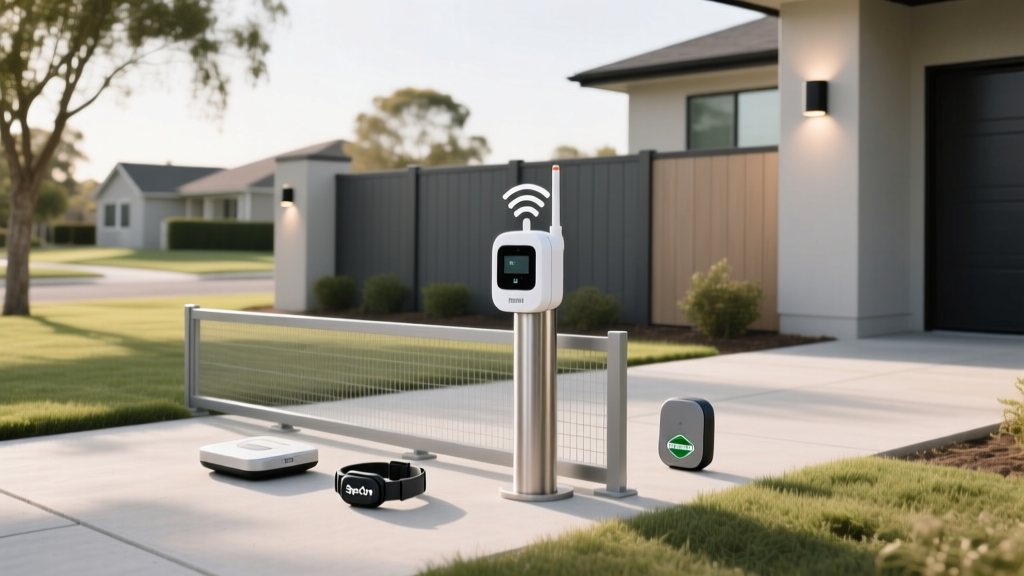
The Physics of Containment: GPS vs. Radio Frequency
The wireless dog fence market has bifurcated into two distinct technological categories: traditional Radio Frequency (RF) systems and modern Global Positioning System (GPS) smart collars. Understanding the underlying physics of each is critical before selecting a brand, as your property's topography will dictate which technology is viable.
Traditional RF wireless fences rely on a central base station that emits a circular AM/FM radio signal. The collar detects the signal strength; as the dog approaches the signal's edge, the collar triggers a warning tone, followed by static correction. Because radio waves are omnidirectional, RF systems can only create perfect circles and are highly susceptible to interference from metal roofs, dense masonry, and topographical shifts.
Conversely, GPS wireless dog fences use satellite triangulation to map custom polygonal boundaries. According to GPS.gov performance standards, standard civilian GPS provides an accuracy of roughly 16 feet (5 meters). However, premium 2026 models utilize advanced corrections—such as Real-Time Kinematic (RTK) positioning or dual-frequency L1/L5 band tracking—to push boundary accuracy down to 1 to 3 feet, allowing for complex property lines that follow driveways, gardens, and natural terrain.
Brand Deep-Dive: Premium GPS Containment Systems
SpotOn GPS Fence: The Dual-Band Heavyweight
SpotOn positions itself as the premium, rugged alternative in the GPS containment space. The current SpotOn collar retails between $995 and $1,295, depending on the strap and housing color options. Its primary technological advantage is its dual-band GPS receiver, which tracks both the legacy L1 frequency and the modern L5 frequency.
SpotOn does not require a subscription to establish or maintain the fence boundary. The $995 hardware cost includes lifetime access to the boundary mapping features. However, if you require cellular escape tracking—meaning the collar will ping your phone via AT&T or Verizon cell towers if the dog breaches the boundary and runs away—an optional cellular subscription costs roughly $8 per month. SpotOn is engineered for properties of 1/2 acre or larger, as the GPS drift margin makes it unsuitable for tight suburban lots.
Halo Collar 4: RTK Precision and the Subscription Model
The Halo Collar 4 (retailing around $699 for the hardware) takes a different approach to solving the GPS accuracy problem. Instead of dual-band receivers, Halo utilizes RTK (Real-Time Kinematic) correction data. By cross-referencing satellite data with a network of ground-based reference stations, Halo achieves sub-meter accuracy in open-sky environments.
Unlike SpotOn, Halo operates on a mandatory subscription model. The hardware is essentially subsidized; to keep the collar active, mapping boundaries, and receiving firmware updates, owners must pay a monthly fee ranging from $15 to $24, depending on the tier (which includes varying levels of training content and cellular tracking).
Halo's edge case vulnerability lies in its reliance on standard L1 GPS bands combined with RTK data streams. If your property features dense, mature hardwood canopies or deep ravines, the collar may lose satellite lock, triggering a 'safe mode' where the fence temporarily deactivates to prevent false corrections. Halo is best suited for open, suburban, or rural acreage with clear sightlines to the sky.
Brand Deep-Dive: Traditional RF Wireless Systems
PetSafe Stay & Play: The Compact Circular Standard
For homeowners with smaller, circular lots, or those who refuse to pay monthly GPS subscriptions, traditional RF systems remain relevant. The PetSafe Stay & Play Wireless Fence (model PIF00-12917) retails for approximately $349 to $399. It covers up to 3/4 of an acre (a 210-foot diameter circle) from a single indoor base station.
Because it relies on radio waves rather than satellites, the PetSafe system works flawlessly under heavy tree cover, indoors, and in dense urban environments where GPS signals bounce erratically off neighboring buildings. However, as noted in extensive field testing by Wirecutter's containment reviews, RF systems suffer from 'boundary drift.' The invisible line can shift by 1 to 4 feet daily based on atmospheric humidity and local electromagnetic interference, meaning you must set the physical boundary flags well inside your actual property line to prevent your dog from accidentally crossing into a neighbor's yard or a busy street.
2026 Specification & Pricing Matrix
| Feature | SpotOn GPS Fence | Halo Collar 4 | PetSafe Stay & Play (RF) |
|---|---|---|---|
| Base Hardware Cost | $995 - $1,295 | $699 | $349 - $399 |
| Mandatory Subscription | No (Cellular tracking optional) | Yes ($15 - $24/mo) | No |
| Boundary Shape | Custom Polygon | Custom Polygon | Perfect Circle Only |
| Min. Property Size | 1/2 Acre | 1/4 Acre (30ft x 30ft min) | Up to 3/4 Acre (Circular) |
| Canopy Performance | Excellent (Dual-Band L5) | Fair (L1 + RTK) | Excellent (Radio Frequency) |
| Correction Types | Tone, Vibration, Static (30 levels) | Tone, Vibration, Static, Sound | Tone, Static (5 levels) |
Property Matching Decision Framework
Selecting the right wireless dog fence requires matching the technology to your specific lot geometry and environmental conditions. Use this framework to finalize your purchase:
- Scenario A (Suburban, < 1/2 Acre, Complex Shape): Avoid GPS. The 16-foot standard drift and 3-foot premium drift will push the boundary into your house or the street. Choose a physical traditional fence or an in-ground wired RF system instead.
- Scenario B (Rural, > 2 Acres, Heavy Woods): Choose SpotOn. The L5 band will maintain satellite lock under the tree canopy, and the lack of a mandatory subscription saves hundreds of dollars over a multi-year period.
- Scenario C (Suburban/Rural, 1-3 Acres, Open Sky, Flat): Choose Halo Collar 4. The RTK correction will provide laser-accurate boundaries around specific garden beds or pools, provided you commit to the monthly software ecosystem.
- Scenario D (Rural Cabin, Circular Clearing, Budget-Conscious): Choose PetSafe Stay & Play. Plug the base station into the cabin, set a 200-foot radius, and avoid cellular/GPS dependencies entirely.
Calibration, Edge Cases, and Failure Modes
The most common reason for wireless dog fence failure is not hardware malfunction, but improper calibration and physical fitting. GPS and RF collars deliver static correction via metal contact points that must penetrate the dog's fur to touch the epidermis.
Battery Degradation: Both SpotOn and Halo utilize internal lithium-ion batteries. In freezing temperatures (below 32°F / 0°C), expect battery life to drop by 40%. Furthermore, leaving the collar on the magnetic charging dock 24/7 will degrade the battery's maximum capacity within 18 months. Train your dog to tolerate the collar being removed and charged nightly.
Multipath Error & False Corrections: If your dog is playing near a large metal structure (like a barn roof, a metal shed, or a chain-link fence), GPS signals can bounce off the metal, tricking the collar into thinking the dog has moved 20 feet instantly. This 'teleportation' effect can trigger a false boundary correction. Always map your GPS boundaries at least 15 feet away from large reflective metal structures.
Welfare, Training, and Regulatory Considerations
Wireless fences are psychological barriers, not physical ones. They will not stop a determined predator from entering your yard, nor will they stop a highly prey-driven dog from bursting through the boundary line if the stimulation level is set too low.
The American Kennel Club (AKC) emphasizes that electronic containment systems require rigorous, positive-reinforcement-based flag training. You cannot simply strap the collar on the dog and let them figure it out. The mandatory protocol requires a minimum of 14 days of leash-guided boundary training using visual flags. The dog must learn to associate the visual flag and the audible warning tone with the boundary line before static correction is ever activated.
'Wireless containment systems demand a higher level of owner involvement than physical fencing. The owner must act as the initial boundary enforcer, using high-value treats to reward the dog for retreating from the warning tone. Without this foundational training, the dog may develop severe barrier frustration or generalized outdoor anxiety.'
Ultimately, a wireless dog fence is a highly effective management tool for rural and large-acreage properties where physical fencing is cost-prohibitive or restricted by HOA regulations. By matching the specific radio or satellite technology to your property's topography, and committing to the 14-day flag training protocol, you can secure your dog safely while maintaining unobstructed views of your landscape.