Woven Wire Fence Maintenance Playbook: Rust and Tensioning Guide
Master woven wire fence maintenance with our expert playbook. Learn tensioning protocols, rust mitigation, coating care, and seasonal repair strategies.
Understanding Galvanization Classes and Coating Failure
The longevity of a woven wire fence is entirely dependent on its protective coating and structural tension. Before executing any maintenance, you must identify your wire's galvanization class. According to manufacturing standards detailed by Red Brand, agricultural woven wire typically falls into two categories:
- Class 1 Galvanization: Features a thin zinc coating (approximately 0.40 oz per square foot). Expected lifespan is 5 to 10 years before red rust appears, especially in high-humidity or coastal environments.
- Class 3 Galvanization: Features a heavy zinc coating (0.80 oz per square foot). This is the industry standard for premium agricultural and commercial fencing, offering a 15 to 20-year lifespan.
- PVC/Vinyl-Coated: A polymer layer extruded over a Class 1 or Class 3 core. The primary failure mode here is UV degradation and mechanical tearing, which traps moisture against the steel core and accelerates hidden corrosion.
Identifying Early Coating Failure
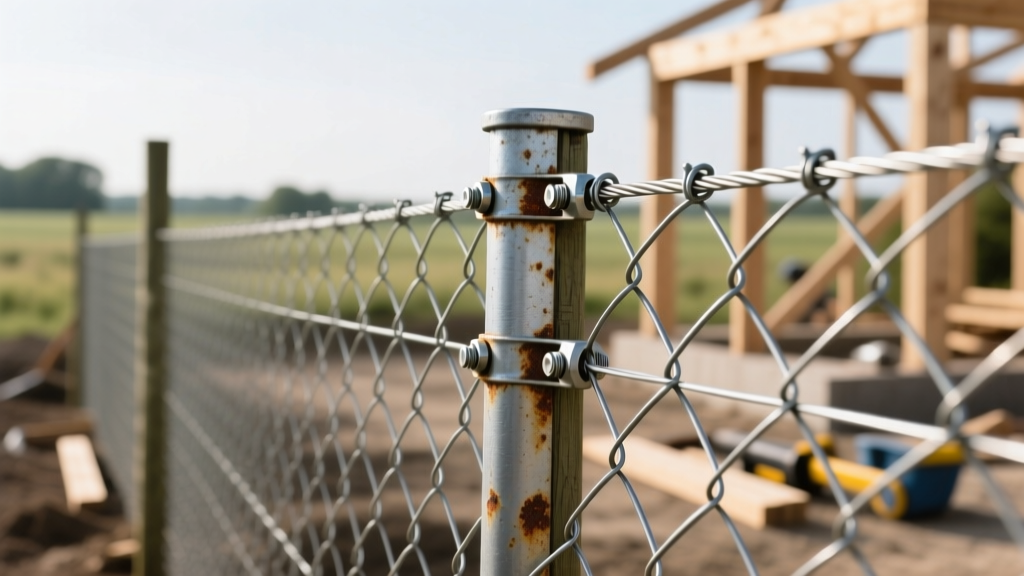
Do not wait for structural failure to address coating issues. "White rust" (zinc oxide) is a normal byproduct of galvanization and does not compromise the steel. However, "red rust" (iron oxide) indicates the zinc layer has been breached. Inspect the horizontal line wires at the base of the fence, as soil splash and moisture accumulation cause 80% of premature coating failures.
The Annual Tensioning and Sag-Check Protocol
Woven wire expands and contracts with seasonal temperature shifts, and wildlife impacts gradually loosen the horizontal stays. A sagging fence not only looks unprofessional but fails to contain livestock and invites predator breaches. Perform this tensioning protocol every spring.
- Clear the Line: Remove all debris, vines, and heavy snow/ice buildup from the fence line. Vegetation pulling on the wire creates uneven tension distribution.
- Inspect Corner and End Posts: Check for leaning. If a wooden corner post has shifted more than 2 degrees, excavate the base and install a concrete collar or a diagonal deadman brace before applying tension.
- Attach the Strainer: Use a 1-ton capacity ratchet fence strainer or a heavy-duty come-along. Attach the pulling jaw to the horizontal line wires, never to the vertical stay wires, to prevent mesh distortion.
- Apply Tension Gradually: Crank the strainer slowly. You should see the mesh squares transition from slight rectangles back to true squares.
- Re-tie and Secure: Once optimal tension is reached, secure the wire to the end post using 12.5-gauge tension bands or heavy-duty U-nails driven at a downward angle to prevent pull-out.
Do not exceed 1,500 lbs of tension on standard 12.5-gauge high-tensile woven wire. Over-tensioning will snap the horizontal stays at the knot joints, permanently ruining the mesh geometry and requiring a full panel replacement. If your strainer's tension gauge reads above 1,200 lbs, stop immediately.
Cleaning, Rust Mitigation, and Vegetation Clearance
Proper cleaning extends the life of both galvanized and PVC-coated woven wire. Avoid pressure washers on PVC coatings, as the high PSI can slice the polymer layer. For galvanized wire, avoid wire brushes that strip the remaining zinc.
| Coating Type | Approved Cleaning Agent | Application Method | Rust Treatment Protocol |
|---|---|---|---|
| Galvanized (Class 1 & 3) | Mild dish soap + water | Soft bristle brush, low-pressure rinse | Sand lightly, apply 93% pure zinc cold-galvanizing spray ($12-$18/can) |
| PVC / Vinyl-Coated | White vinegar + water (1:1) | Microfiber cloth or sponge | Trim peeling PVC, apply exterior-grade UV-resistant liquid vinyl repair |
| Poly-Coated (High-Tensile) | Isopropyl alcohol (for sap) | Spot clean with rag | Use heat-shrink tubing over exposed core wire to prevent moisture ingress |
The 18-Inch Vegetation Rule
According to livestock infrastructure guidelines from Penn State Extension, maintaining an 18-inch clearance on both sides of the fence line is critical. Tall grass and weeds trap morning dew against the lower wire courses, accelerating the corrosion rate by up to 40%. Use a string trimmer with a plastic guard to prevent throwing rocks that could chip PVC coatings.
Spot Repair vs. Full Panel Replacement Matrix
When a section of woven wire is damaged by a falling branch or large animal, you must decide whether to splice the wire or unroll a new 100-foot section. Use this decision matrix to save time and material costs.
When to Spot Repair (Cost: $5 - $15)
- Broken Vertical Stay: If a single vertical wire snaps but the horizontal lines remain intact, weave a new piece of 14-gauge tie wire through the horizontal lines to recreate the vertical stay.
- Loose Knots: If the fixed-knot or hinge-joint slips, use a pair of fencing pliers to crimp a hog ring over the intersection to lock it back in place.
- Small Punctures (Under 12 inches): Cut away the frayed edges and splice in a patch using 12.5-gauge tie wire, wrapping it tightly around the adjacent horizontal wires at least three times per connection point.
When to Replace the Panel (Cost: $80 - $140 per 100ft roll)
- Horizontal Line Failure: If a main horizontal load-bearing wire snaps, the structural integrity of that entire section is compromised. Splicing a horizontal wire creates a weak point that will fail under the next tensioning cycle.
- Widespread Red Rust: If more than 15% of the mesh in a 50-foot run shows active red rust, spot treatments are a waste of labor. Replace the run with Class 3 galvanized wire.
- Severe Mesh Distortion: If an impact has stretched the mesh squares into elongated diamonds that cannot be pulled back into shape with a hand winch, the wire has exceeded its yield strength and must be replaced.
Seasonal Maintenance Calendar
To institutionalize your fence maintenance, follow this seasonal checklist based on recommendations from the USDA Natural Resources Conservation Service for agricultural boundary management.
Spring (March - April)
- Execute the annual tensioning protocol.
- Clear winter debris and inspect for frost-heaved line posts.
- Tamp soil around any posts that have lifted more than 1 inch.
Summer (June - July)
- Perform the first mid-season vegetation mowing (maintain 18-inch clearance).
- Inspect PVC coatings for UV brittleness or peeling.
- Check gate hinges and latches; apply lithium grease to pivot points.
Fall (October - November)
- Remove fallen leaves and organic matter piled against the fence base.
- Apply cold-galvanizing spray to any new rust spots discovered before winter moisture sets in.
- Verify that grounding rods (if using the fence for electric predator deterrence) have tight connections and low resistance (under 25 ohms).
Winter (January - February)
- Knock heavy ice and snow loads off the wire using a soft rubber mallet to prevent permanent stretching.
- Inspect corner post braces for cracking wood or loose hardware caused by freeze-thaw cycles.
Frequently Asked Questions
Can I use a tractor to pull a woven wire fence tight?
No. A tractor's PTO or hydraulic system applies thousands of pounds of uncalibrated force, which will instantly snap the horizontal stays and destroy the mesh geometry. Always use a manual ratchet strainer or a 1-ton come-along equipped with a tension gauge to apply controlled, measurable force.
How deep should line posts be set for a 5-foot woven wire fence?
For standard 4-inch wooden line posts supporting a 5-foot woven wire fence, bury at least 24 to 30 inches of the post in the ground. In areas with high wind loads or sandy soil, increase the burial depth to 36 inches and use crushed gravel for backfill to ensure proper drainage and prevent post rot.
What is the best knot type for high-tension applications?
Fixed-knot woven wire is vastly superior to hinge-joint (field fence) for high-tension applications. The fixed-knot design uses a separate piece of wire to tightly bind the vertical and horizontal wires together, preventing the knot from slipping under heavy tension or animal impact. While fixed-knot wire costs roughly 20% more upfront, it reduces long-term maintenance labor by over half.