3D Forest Floor Epoxy Cost Calculator & Pricing Guide
Calculate exact material quantities and costs for a 3D forest floor epoxy system. Includes pricing matrices, coverage formulas, and prep budgets.
The Economics of 3D Nature-Inspired Resin Floors
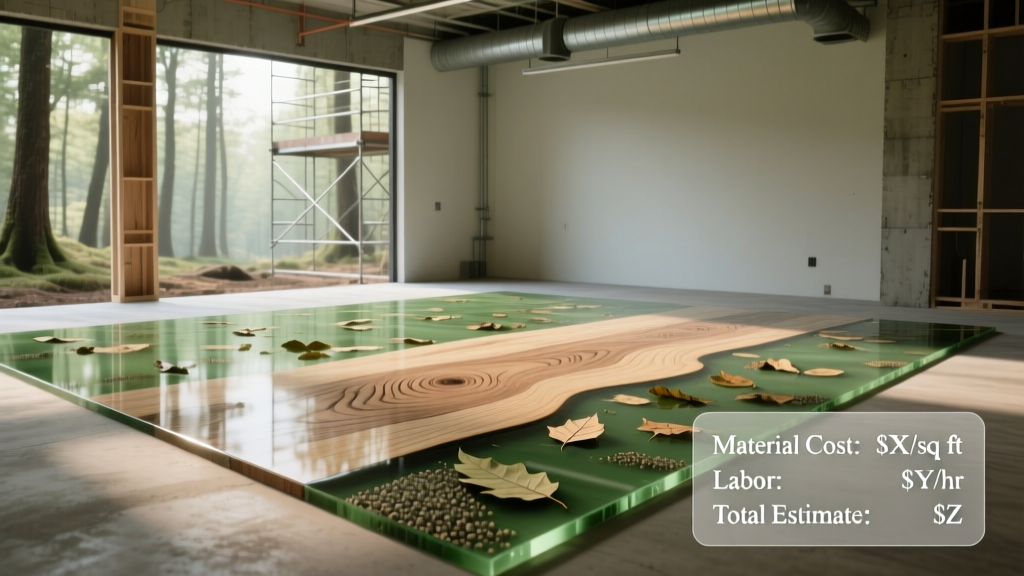
A 'forest floor' epoxy system is not a single product but a complex, multi-layered architectural build. It typically utilizes a high-resolution 3D vinyl decal or physically embedded preserved botanicals (ferns, moss, river stones) encapsulated beneath a thick, crystal-clear flood coat of 100% solids epoxy or polyaspartic resin. Because the aesthetic relies entirely on optical depth and clarity, the material tolerances are vastly stricter than standard metallic or flake garage floors. According to industry pricing data tracked by Forbes Home, decorative 3D epoxy systems command a premium, often ranging from $15 to $35 per square foot for professional installation, driven by the meticulous labor required to eliminate outgassing bubbles and achieve a glass-like finish.
Material Quantity Calculator: The Rule of 1600
To accurately budget a forest floor installation, you must calculate the exact volume of clear flood coat required. The industry standard for 100% solids epoxy coverage is the 'Rule of 1600'. One US gallon of 100% solids epoxy contains 231 cubic inches. One square foot of floor space covered at a thickness of 1 mil (0.001 inches) requires 0.144 cubic inches of material. Dividing 231 by 0.144 yields 1,604. Therefore, one gallon covers approximately 1,600 square feet at 1 mil of thickness.
Flood Coat Calculation Formula
Gallons Needed = (Square Footage × Desired Mil Thickness) / 1600
Example: For a 120 sq ft bedroom requiring a 3/16-inch (approx. 45 mils) flood coat to fully submerge a textured forest decal and river stones:
(120 × 45) / 1600 = 3.37 Gallons.
Always round up and add a 10% waste factor, bringing the total purchase requirement to 4 gallons of clear epoxy.
2026 Cost Estimation Matrix by Room Size
The following matrix breaks down the estimated material and professional labor costs for a complete 5-layer forest floor system (primer, base coat, decorative layer, flood coat, and UV-stable topcoat) in 2026. These figures assume a standard concrete substrate in good condition.
| Room Type | Avg. Sq Ft | Material Cost | Labor Cost | Total Estimated Range |
|---|---|---|---|---|
| Small Bathroom | 40 | $320 - $480 | $800 - $1,200 | $1,120 - $1,680 |
| Medium Bedroom | 150 | $1,050 - $1,500 | $2,500 - $3,800 | $3,550 - $5,300 |
| Large Living Area | 400 | $2,600 - $3,800 | $6,000 - $9,500 | $8,600 - $13,300 |
Substrate Preparation & Hidden Cost Variables
The most common point of failure in 3D resin flooring is inadequate substrate preparation. A forest floor design requires a flawless, perfectly level base; otherwise, the thick clear flood coat will pool in low spots, creating distorted 'lenses' that ruin the 3D optical illusion.
Mechanical Profiling and Leveling
Concrete must be diamond-ground to a CSP-2 or CSP-3 (Concrete Surface Profile) standard. The International Concrete Repair Institute (ICRI) provides visual comparators for these profiles. If the floor has a slope greater than 1/8 inch over 10 feet, a self-leveling underlayment (SLU) must be applied before the epoxy primer. Budget an additional $3.50 to $5.00 per square foot for SLU materials and pumping labor.
Moisture Mitigation (The Budget Killer)
Before applying any primer, conduct a calcium chloride test (ASTM F1869) or an in-situ relative humidity probe test (ASTM F2170). If the Moisture Vapor Emission Rate (MVER) exceeds 3 lbs per 1,000 sq ft per 24 hours, standard epoxies will suffer from osmotic blistering, which looks like cloudy white bubbles trapped under your forest decal. You must install a high-build moisture vapor barrier epoxy primer (such as a 2-part, high-solids moisture mitigation system). This adds roughly $2.50 to $4.00 per square foot to the project cost but is non-negotiable for below-grade or slab-on-grade installations.
Decorative Underlay: Decals vs. Embedded Organics
The method you choose to create the 'forest floor' visual drastically impacts both material quantities and labor hours.
- 3D Printed Vinyl Decals: Cost: $4 to $8 per sq ft. The decal is adhered to the base coat using a thin layer of clear epoxy. Pro-Tip: You must use a squeegee and a spiked roller to push out all micro-bubbles from under the vinyl. A single trapped air bubble will expand during the flood coat curing process and create a permanent blister.
- Embedded Preserved Botanicals: Cost: $12 to $25 per sq ft. Real preserved moss, ferns, and river stones are glued to the base coat. Critical Requirement: Organic materials are highly porous and will outgas heavily when submerged in thick epoxy. You must apply a thin 'seal coat' (approx. 10 mils) of clear epoxy over the organics and let it cure fully before pouring the main 45-mil flood coat. This adds a full day of labor and an extra 1.5 gallons of epoxy per 100 sq ft to the budget.
UV Stability and the Polyaspartic Mandate
Standard 100% solids bisphenol-A epoxy is highly susceptible to UV degradation. When exposed to direct sunlight through windows or skylights, the clear flood coat will undergo photo-oxidation, turning an amber-yellow color within 12 to 18 months. This completely destroys the natural green and brown tones of a forest floor design.
To prevent this, the final wear layer must be an aliphatic polyurethane or a polyaspartic topcoat. Polyaspartic coatings (e.g., 100% solids polyaspartic polyurea) offer zero VOCs, cure in under two hours, and possess absolute UV stability. While polyaspartic topcoats cost roughly $140 to $180 per gallon (compared to $60 for standard urethanes), they are mandatory for any forest floor installation in a room with natural light. Expect to apply this topcoat at a rate of 300 to 400 square feet per gallon.
Frequently Asked Questions
Can I install a forest floor epoxy over existing ceramic tile?
Yes, but it requires extensive prep. The grout lines must be filled with a flexible, epoxy-based patching compound, and the tile surface must be scarified using a heavy-grit diamond cup wheel to break the glaze. If the grout lines are not perfectly leveled, the 3D optical effect will be distorted by the underlying grid pattern.
How thick should the clear flood coat be over a 3D decal?
For a flat vinyl decal, a 1/8-inch (approx. 30 mils) flood coat is sufficient to provide depth and protect the print. If you are embedding physical elements like river stones or thick preserved wood slices, the flood coat must be at least 3/16-inch to 1/4-inch (45 to 60 mils) thick to fully encapsulate the highest point of the objects without exposing them to the surface.
What is the lifespan of a professionally installed 3D forest floor?
When installed over a properly profiled and moisture-tested concrete slab, and protected by a UV-stable polyaspartic topcoat, a 3D forest floor system will last 15 to 20 years in residential settings. The topcoat may require a light scuff-sand and recoat every 7 to 10 years in high-traffic areas to maintain the glass-like gloss.