Clayton Homes Flooring Options: Complete Upgrade Guide
Explore Clayton Homes flooring options, comparing standard LVP, carpet, and sheet vinyl with factory upgrades. Includes costs and marriage line tips.

Navigating Standard vs. Upgraded Flooring Tiers
When configuring a manufactured or modular home, the flooring package you select impacts both the immediate build cost and the long-term durability of the structure. Clayton Homes structures its flooring options into distinct tiers, typically categorized by the base model package and the available customization upgrades. In 2026, the baseline standard for most entry-level Clayton models remains carpet in living areas and sheet vinyl in wet zones, while mid-to-high-tier models increasingly feature Luxury Vinyl Plank (LVP) or Stone Plastic Composite (SPC) as the default.
Understanding the exact specifications of these tiers is critical. A 'standard' vinyl plank might feature a 6-mil to 12-mil wear layer, which is sufficient for light residential traffic but prone to scratching from pets or heavy furniture. Upgraded packages typically bump this to a 20-mil or 22-mil wear layer with an attached cork or IXPE underlayment pad, drastically improving acoustic dampening and impact resistance.
| Tier Level | Primary Material | Typical Specifications | Best Application | Est. Factory Upgrade Cost |
|---|---|---|---|---|
| Base / Standard | Carpet & Sheet Vinyl | 35 oz face weight carpet; felt-backed sheet vinyl | Bedrooms, utility rooms, budget-conscious builds | $0 (Included in base price) |
| Mid-Tier Upgrade | Flexible LVP | 12-mil wear layer, 3mm thickness, glue-down or loose-lay | Living rooms, hallways, single-section homes | $1.25 - $2.00 / sq ft |
| Premium Upgrade | Rigid Core SPC | 20-mil+ wear layer, 5mm+ thickness, click-lock with attached pad | Multi-section homes, high-traffic zones, pet owners | $2.50 - $4.00 / sq ft |
Deep Dive: The Materials Behind the Options
Luxury Vinyl Plank (LVP) and Stone Plastic Composite (SPC)
The most significant shift in Clayton Homes flooring options over the last few years is the dominance of rigid core SPC over traditional flexible LVP. SPC features a limestone-polyvinyl chloride composite core that is entirely waterproof and highly resistant to indentation. When evaluating your factory upgrade sheet, look specifically for the core type. Flexible LVP can telegraph subfloor imperfections—meaning if the OSB subfloor has slight seams or dips, flexible vinyl will eventually mold to those shapes, making them visible. SPC, due to its rigidity, bridges minor subfloor gaps without telegraphing, making it the superior choice for manufactured housing where subfloor seams are abundant.
Carpeting: Face Weight and Pad Density
If you opt for carpet in bedrooms to reduce noise transmission, the specifications matter more than the color. Standard Clayton carpet packages often utilize a 35-ounce polyester face weight with a 4-pound rebond pad. For a noticeable upgrade in comfort and longevity, request a 50-ounce to 60-ounce face weight paired with an 8-pound pad or a memory foam upgrade. The heavier pad reduces the crushing effect on the carpet fibers and improves the thermal R-value of the floor, which is vital for homes placed over vented crawlspaces in colder climates.
Sheet Vinyl: Fiberglass vs. Felt Backing
For laundry rooms, mudrooms, and secondary bathrooms, sheet vinyl remains a cost-effective staple. However, ensure your selection specifies a fiberglass-backed sheet vinyl rather than a traditional felt backing. Fiberglass-backed vinyl lays flatter, resists curling at the edges, and does not require full-spread adhesive, allowing it to float over the subfloor. This is crucial in manufactured homes, as it accommodates the natural expansion and contraction of the wood subfloor without tearing.
The "Marriage Line" Challenge in Multi-Section Homes
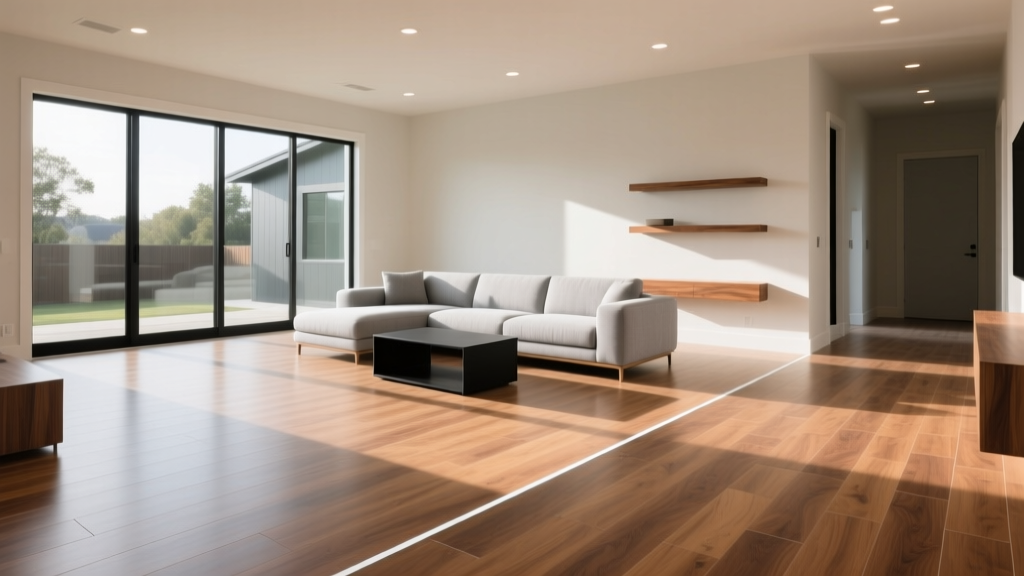
The most critical structural factor unique to multi-section Clayton homes is the 'marriage line'—the junction where two sections of the home are joined together on-site. According to the Manufactured Housing Institute (MHI), the floor joists and subfloor panels meet at this seam, and while they are bolted and lagged together, micro-movements can still occur during the initial settling phase and during extreme seasonal temperature shifts.
Installing large-format ceramic tile or highly rigid, thick SPC continuously across a marriage line without a transition strip is a primary cause of flooring failure in manufactured homes. The micro-deflection at the seam will crack tile grout and can snap the click-lock mechanisms of rigid planks. Actionable Fix: Always install a T-molding transition strip directly over the marriage line, or ensure your flooring contractor leaves a 1/4-inch expansion gap at the seam and covers it with a high-quality, color-matched flexible sealant or overlapping reducer.
Cost Analysis: Factory Upgrades vs. Aftermarket Replacement
A common dilemma for buyers is whether to pay the factory premium for upgraded flooring or accept the standard carpet/vinyl and replace it after the home is set on the foundation. The financial reality heavily favors the factory upgrade, primarily due to financing.
| Factor | Factory Flooring Upgrade | Aftermarket Replacement (Post-Install) |
|---|---|---|
| Material & Labor Cost | $1.50 - $3.50 per sq ft (premium over base) | $5.00 - $9.00 per sq ft (tear-out, prep, new materials) |
| Financing | Rolled into FHA/Conventional mortgage (e.g., $3,000 upgrade costs ~$18/month over 30 years) | Out-of-pocket cash or high-interest personal loan/credit card |
| Subfloor Prep | Done in climate-controlled factory; pristine installation | Requires moving into the home, removing baseboards, and dealing with factory-installed trim |
| Warranty | Covered under the manufacturer's 1-year structural and fit/finish warranty | Separate installer warranty; voids home warranty if installation damages subfloor |
Subfloor Deflection and HUD Code Compliance
All Clayton Homes are built to the federal HUD Code (24 CFR Part 3280), which mandates specific floor deflection limits. The U.S. Department of Housing and Urban Development (HUD) requires that floor systems support a minimum live load of 40 pounds per square foot with a deflection limit of L/360. This means the subfloor is engineered to have a slight, calculated amount of 'give' under heavy loads.
Because of this engineered flexibility, hard-surface flooring must accommodate movement. The National Wood Flooring Association (NWFA) strongly advises against installing solid hardwood or nail-down engineered wood directly over manufactured home subfloors without extensive additional bracing and cross-beaming, as the natural flex will cause the wood to squeak, gap, and eventually pull free from the fasteners. This is precisely why floating floors (LVP, SPC, and laminate) are the industry standard for manufactured housing—they move as a single, unified raft above the subfloor, completely decoupled from the structural flexing beneath them.
Actionable Decision Framework for Buyers
Use this framework when sitting down with your Clayton Homes consultant to finalize your specification sheet:
- If you have large dogs or heavy furniture: Upgrade to a minimum 20-mil wear layer SPC. The rigid core will prevent denting from point-loads (like sofa legs), and the thick wear layer will resist claw scratches.
- If you are financing through an FHA Manufactured Home Loan: Maximize your factory flooring upgrades. The FHA appraisal will account for the permanent improvements, and rolling $4,000 into a 30-year mortgage at current rates is vastly superior to paying cash post-closing.
- If you are buying a multi-section (double-wide or triple-wide): Mandate T-moldings at all marriage lines and major room transitions. Do not allow installers to run continuous rigid plank across the seams.
- If you are prioritizing acoustic privacy in a multi-story modular: Select carpet for all second-floor bedrooms and hallways, or choose an LVP with a minimum 2mm attached cork underlayment to meet impact insulation class (IIC) standards.
Frequently Asked Questions
Can I install heated floors under Clayton Homes' standard LVP?
Generally, no. Most standard factory-installed LVP and SPC products are not rated for radiant heat systems, and the heat can cause the planks to expand, buckle, and void the manufacturer's warranty. If radiant floor heating is a priority, you must specify a compatible engineered wood or tile package during the custom design phase, which requires specialized subfloor prep and thermostat controls integrated into the home's electrical plan.
What happens if the factory flooring is damaged during transit?
Clayton Homes includes a transit damage repair protocol in their delivery contract. If the flooring is scratched, dented, or separated at the seams during transport from the factory to your site, the local setup crew is responsible for replacing the affected planks or sections before the home is turned over to you. Always conduct a thorough walk-through with a flashlight, checking the marriage lines and high-traffic corners, before signing the final delivery acceptance paperwork.
Do upgraded flooring options increase the appraisal value of the home?
Yes, but with diminishing returns. Upgrading from base carpet to mid-tier LVP typically yields a near 1:1 return on investment in the home's appraisal value, as it aligns the home with current market expectations. However, selecting ultra-premium, exotic-look SPC or custom tile packages may not appraise dollar-for-dollar, as manufactured home appraisals are heavily capped by local comparable sales (comps) of similar factory-built homes in your area.
Written by
Elena RodriguezElena Rodriguez is a civil engineer and technical writer specializing in concrete technology, masonry systems, and ASTM/ACI compliance. She earned her B.S. in Civil Engineering from Texas A&M University and spent a decade at a materials testing laboratory, performing over 2,000 concrete compressive strength tests and masonry prism evaluations. Elena is an ACI-certified Field Testing Technician (Grade I) and a member of ASTM Committee C12 on Natural Building Stone. She currently consults on forensic engineering cases involving concrete failures and moisture intrusion. Based in San Antonio, TX, Elena is a proud member of the Society of Women Engineers (SWE) and coaches her daughter's FIRST Robotics team.
More from Elena Rodriguez
View all
Walls & Panels
Cost Analysis: Light Gauge Steel Framing Advantages and Disadvantages
Evaluate light gauge steel framing advantages and disadvantages through a strict cost analysis lens, comparing material, labor, and lifecycle expenses.
Aug 4, 2026

Walls & Panels
Gypsum Board Types: Exact Specifications, Thickness & Dimensions
Compare standard, Type X, and moisture-resistant gypsum board types. Get exact specifications, thicknesses, dimensions, and ASTM standards for your project.
Aug 4, 2026

Fire Resistance
Best Fire-Resistant Outdoor Decking Materials: 2026 Buyer Guide
Discover the best fire-resistant outdoor decking materials for 2026. Compare Class A PVC, aluminum, and hardwood options for WUI compliance and safety.
Aug 4, 2026