Epoxy Floor Installation: Deep-Dive into Top 2026 Brand Systems
Compare top epoxy floor installation brands for 2026. Deep-dive into Rust-Oleum, ArmorPoxy, and Epoxy-Coat systems, costs, and prep requirements.
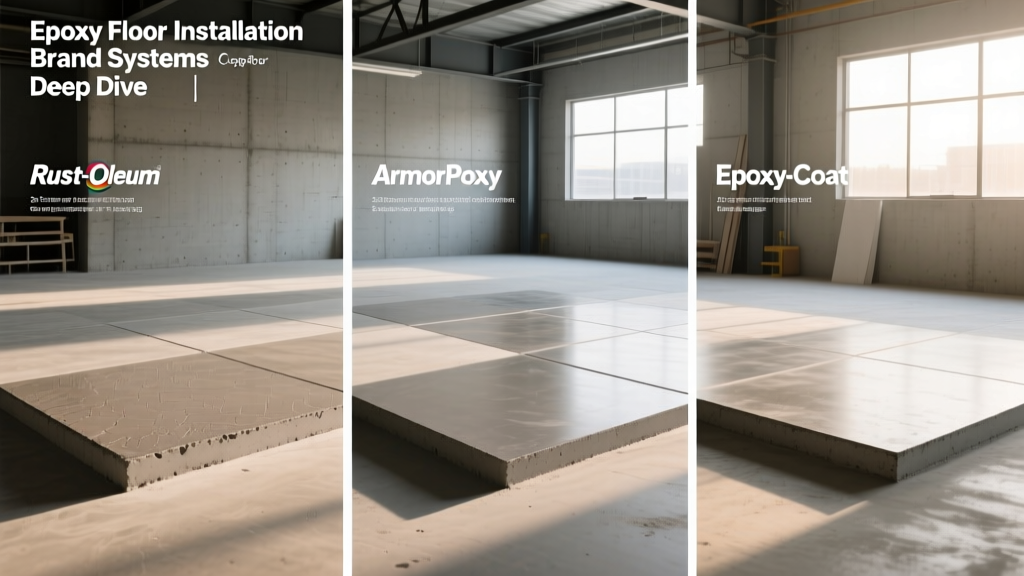
The Chemistry of Failure: Why Brand Selection Dictates Longevity
The majority of epoxy floor installation failures—manifesting as peeling, hot-tire lift, or delamination—do not occur because of poor application technique, but due to fundamental misunderstandings of coating chemistry and concrete surface profiles. When specifying a system for residential garages, commercial warehouses, or light industrial spaces in 2026, the critical metric is Volume Solids (VS). Water-based epoxies typically contain 40% to 50% solids, meaning half the product evaporates as water during curing, leaving a thin film highly susceptible to abrasion. Solvent-based systems hover around 50% to 70% VS. True commercial-grade 100% solids epoxies contain 98% to 100% active ingredients, yielding a Dry Film Thickness (DFT) that matches the Wet Film Thickness (WFT) applied.
Choosing the right brand requires looking past marketing claims of 'lifetime warranties' and examining the Technical Data Sheets (TDS) for mil thickness, chemical resistance, and required Concrete Surface Profile (CSP). Below is a deep-dive into three dominant product lines currently defining the market, ranging from big-box prosumer kits to commercial-grade multi-coat systems.
Brand Deep-Dive: Comparing the Top 3 Epoxy Systems
1. Rust-Oleum EpoxyShield Professional Floor Coating
Widely available at big-box retailers, the EpoxyShield Professional line is a solvent-based, two-part epoxy designed for light commercial and residential use. It is not a 100% solids system; it typically features a Volume Solids content of roughly 50%. When applied at the recommended coverage rate, it yields a DFT of approximately 3 to 4 mils.
- Best For: Budget-conscious DIYers, low-traffic residential garages, and basement floors.
- Weakness: Prone to hot-tire lift if applied over poorly profiled concrete; limited UV resistance (will amber in direct sunlight).
2. ArmorPoxy II Commercial Grade System (by SPX NACE)
ArmorPoxy bridges the gap between prosumer and industrial coatings. The ArmorPoxy II system utilizes a 100% solids epoxy base coat paired with a military-grade aliphatic polyurethane topcoat. This dual-chemistry approach is critical: the 100% solids epoxy provides a 10 to 14 mil DFT base for impact resistance and adhesion, while the polyurethane topcoat offers UV stability and exceptional chemical resistance against automotive fluids and de-icing salts.
- Best For: High-end residential garages, commercial showrooms, and light manufacturing where UV stability and chemical resistance are paramount.
- Weakness: Requires strict environmental controls (humidity below 85%) during the topcoat phase; higher material cost per square foot.
3. Epoxy-Coat Full Kit (100% Solids High Build)
Epoxy-Coat is a premium, cycloaliphatic 100% solids epoxy system engineered for high-build applications. Unlike standard bisphenol-A epoxies, cycloaliphatic epoxies offer superior UV resistance and lower viscosity, allowing the material to penetrate deeply into the concrete pores before cross-linking. The Full Kit is designed to be applied at a massive 10 to 12 mils DFT in a single pass, effectively encapsulating the substrate in a dense, impermeable armor.
- Best For: Heavy-duty commercial garages, aircraft hangars, and environments requiring extreme resistance to battery acid, hydraulic fluid, and heavy impact.
- Weakness: Extremely short pot life (approximately 20-30 minutes at 77°F). Installers must mix small batches continuously; attempting to mix a full gallon at once will result in the product curing in the bucket.
Technical Comparison Matrix: Solids, Thickness, and Cure Times
| Product Line | Base Chemistry | Volume Solids | DFT (Mils) | Pot Life (77°F) | Topcoat Required? |
|---|---|---|---|---|---|
| Rust-Oleum EpoxyShield Pro | Solvent-Based Epoxy | ~50% | 3 - 4 | 2 Hours | Optional (Clear) |
| ArmorPoxy II System | 100% Solids + Poly | 98% (Base) | 10 - 14 | 40 Minutes | Mandatory (Polyurethane) |
| Epoxy-Coat Full Kit | Cycloaliphatic Epoxy | 100% | 10 - 12 | 25 Minutes | Optional (Urethane) |
The Non-Negotiables of Epoxy Floor Installation Prep
The most expensive epoxy system on the market will delaminate within months if applied over an improperly prepared substrate. According to industry guidelines detailed in concrete surface preparation standards, the goal of prep is not merely to clean the floor, but to open the pores and create a mechanical anchor pattern known as the Concrete Surface Profile (CSP).
Diamond Grinding vs. Acid Etching
Historically, DIY kits recommended muriatic acid etching. In 2026, acid etching is universally condemned by professional installers for epoxy floor installation. Acid etching is highly inconsistent, heavily dependent on the concrete's porosity, and leaves behind residual salts that can interfere with the epoxy's cross-linking process. Furthermore, acid etching cannot remove existing sealers, curing compounds, or laitance.
The Professional Standard: Mechanical diamond grinding using a planetary grinder equipped with 30/40-grit metal-bonded diamonds. This achieves a CSP 2 to CSP 3 profile (resembling 80-grit sandpaper), which provides the optimal surface area for 100% solids epoxies to mechanically lock into the substrate. For heavily contaminated floors, shot blasting may be required to achieve a CSP 3 or CSP 4.
Moisture Vapor Transmission Rate (MVTR) Testing
Before specifying any high-build epoxy, installers must conduct moisture testing per industry moisture testing protocols. The standard ASTM F1869 calcium chloride test measures the Moisture Vapor Emission Rate (MVER). If the slab emits more than 3 to 5 lbs of moisture per 1,000 square feet over 24 hours, a standard epoxy will fail. In these scenarios, you must specify a moisture-mitigating epoxy primer (such as a high-moisture-tolerant polyurethane cement or a specialized penetrating epoxy sealer) before applying the decorative high-build coats.
2026 Cost Breakdown: Material vs. Professional Labor
Pricing for epoxy floor installation varies wildly based on the chosen chemistry and the condition of the existing slab. The table below outlines realistic 2026 market rates for a standard 500-square-foot residential garage, assuming the concrete is in fair condition (minor cracking, no major spalling).
| Cost Component | DIY Big-Box Kit (Water/Solvent) | Prosumer 100% Solids (e.g., ArmorPoxy) | Professional Commercial Install |
|---|---|---|---|
| Surface Prep (Grinding/Repair) | $50 - $100 (Acid/Rental) | $150 - $250 (Grinder Rental) | $500 - $800 (Diamond Grind & Patch) |
| Base Coat Material | $150 - $250 | $350 - $500 | $400 - $600 (Wholesale) |
| Topcoat / Flake Broadcast | $0 - $100 | $200 - $300 (Polyurethane) | $300 - $500 (Urethane + Flakes) |
| Total Estimated Cost | $200 - $450 ($0.40-$0.90/sqft) | $700 - $1,050 ($1.40-$2.10/sqft) | $2,500 - $4,000 ($5.00-$8.00/sqft) |
Note: Professional labor rates encompass liability insurance, commercial dust-collection grinding equipment (HEPA vacuums), and multi-day cure-time management. Professional installs typically carry a 5-to-10-year warranty against delamination, whereas DIY kits offer limited material replacement only.
Expert Verdict: Which System Should You Specify?
For property managers and commercial contractors, the Epoxy-Coat Full Kit or equivalent cycloaliphatic 100% solids system is the only viable choice for high-traffic environments. The material cost premium is easily offset by the elimination of downtime associated with premature floor failure and re-coating.
For high-end residential projects where UV stability and aesthetic clarity are the primary drivers, the ArmorPoxy II system, utilizing a 100% solids base and an aliphatic polyurethane topcoat, provides the best balance of thickness, chemical resistance, and non-yellowing performance. Reserve big-box solvent-based kits strictly for low-budget, low-traffic residential utility spaces, ensuring the installer understands that rigorous diamond grinding—not acid etching—remains the mandatory first step regardless of the product chosen.