Loose Lay Flooring: Best Applications and Scenario Matching
Discover where loose lay flooring excels and fails. Match loose lay vinyl to basements, rentals, and commercial spaces with our scenario guide.
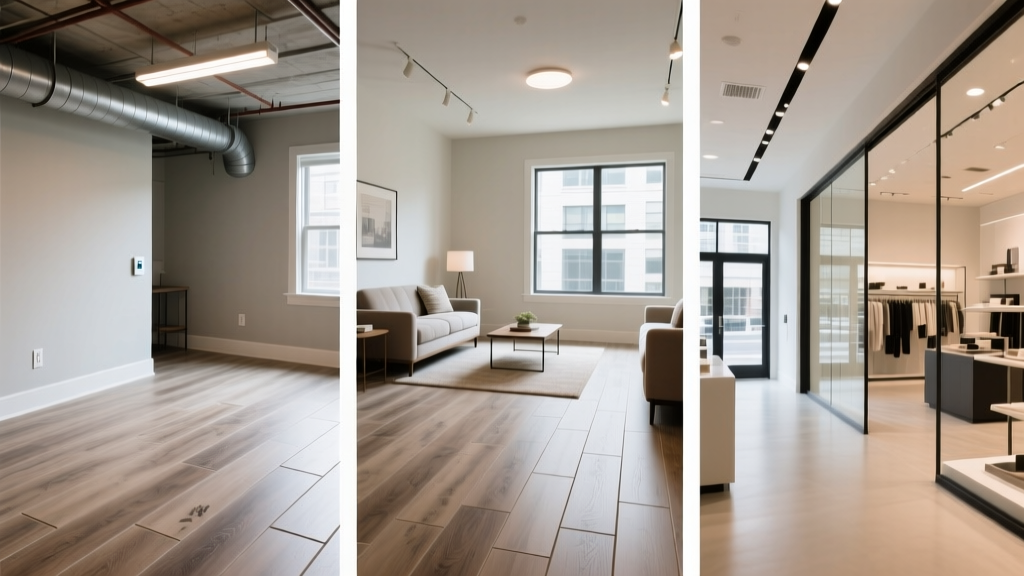
The Mechanics of Friction-Backed Loose Lay Flooring
Loose lay flooring represents a highly specialized category within the luxury vinyl tile (LVT) and plank (LVP) market. Unlike click-lock systems that rely on mechanical interlocking joints, or glue-down LVT that requires full-spread adhesive, loose lay flooring relies on high-friction backing compounds and sheer material weight to grip the subfloor. The planks typically feature a rigid fiberglass core encapsulated in vinyl, topped with a polyurethane or rubberized grip backing. This construction prevents the edges from curling and keeps the planks anchored in place through surface tension and gravity.
However, treating loose lay flooring as a universal substitute for click-lock or glue-down vinyl is a critical installation error. Its performance is entirely dependent on environmental stability, subfloor perfection, and traffic type. Matching this material to the correct architectural scenario is the difference between a 15-year floor and a 15-month failure.
Loose Lay vs. Click-Lock vs. Glue-Down: A Structural Comparison
Before mapping specific room scenarios, it is necessary to understand how loose lay flooring structurally compares to its primary LVT alternatives. The following matrix highlights the operational trade-offs of each installation method.
| Feature | Loose Lay LVT | Click-Lock (Floating) LVT | Glue-Down LVT |
|---|---|---|---|
| Typical Thickness | 5.0mm - 6.5mm | 4.0mm - 8.0mm (with pad) | 2.0mm - 3.0mm |
| Subfloor Tolerance | Strict (3/16' over 10') | Moderate (1/4' over 10') | Extreme (Must be perfectly smooth) |
| Moisture Mitigation | High (No adhesive to degrade) | Moderate (Trapped vapor risk) | Low (Adhesive breaks down) |
| Reusability | Excellent (100% salvageable) | Poor (Locking tabs break) | None (Destroyed on removal) |
| Rolling Load Tolerance | Poor (Seams can catch casters) | Moderate | Excellent (Fully bonded) |
Green Light Scenarios: Where Loose Lay Excels
When deployed in the right environment, loose lay flooring offers unparalleled advantages in speed, indoor air quality, and future-proofing. The following scenarios represent ideal applications.
1. Below-Grade Basements and Slab-on-Grade Condos
Basements are notoriously prone to hydrostatic pressure and vapor transmission. Glue-down LVT in these environments often fails because alkaline moisture degrades the adhesive, causing planks to tent and buckle. Loose lay flooring bypasses this issue entirely because there is no adhesive to break down. If moisture vapor emission rates (MVER) fluctuate, the planks can be easily lifted, the subfloor dried or treated, and the exact same planks reinstalled. For concrete slabs, always verify moisture levels using the ASTM F2170 standard for concrete moisture testing via in-situ relative humidity probes before installation, ensuring RH levels remain within the manufacturer's specified threshold (typically below 85-90%).
2. Raised Access Floors and IT Server Rooms
Commercial spaces with raised access panels (used to route HVAC, electrical, and data cables beneath the floor) require frequent subfloor access. Glue-down vinyl makes accessing these panels destructive and costly. Loose lay planks can be individually lifted with a suction cup or a specialized lifting tool, granting immediate access to the infrastructure below, and then dropped perfectly back into place without visible seams or adhesive residue.
3. Temporary Retail Pop-Ups and Staged Real Estate
For commercial tenants on short-term leases (1-3 years) or real estate stagers needing to cover damaged hardwood temporarily, loose lay flooring is a capital asset rather than a sunk cost. Because it requires zero adhesive, it leaves the underlying subfloor completely unmarred upon removal. The planks can be palletized and relocated to the next commercial space, offering a massive return on investment for serial retail operators.
Because loose lay installation requires zero trowel-applied adhesives, it eliminates off-gassing entirely. This makes it an optimal choice for healthcare facilities, schools, and residential spaces where adherence to strict EPA guidelines on indoor air quality and VOCs is a primary design constraint.
Red Light Scenarios: Where Loose Lay Fails
Equally important is knowing where to strictly prohibit the use of loose lay flooring. Ignoring these environmental and mechanical limits will result in gapping, peaking, and trip hazards.
1. Sunrooms, Solariums, and High-UV Spaces
Vinyl is inherently sensitive to thermal expansion and contraction. While click-lock floors distribute this movement across a unified floating mass, and glue-down floors restrict it entirely, loose lay planks move individually. In a sunroom with direct UV exposure and extreme temperature swings (e.g., 60°F at night to 110°F during the day), loose lay planks will expand and push against one another, then contract and leave visible gaps at the seams. Never install loose lay flooring in spaces with unmitigated direct sunlight or radiant heating systems that exceed 85°F at the surface level.
2. High-Traffic Corridors with Heavy Rolling Loads
Hospitals, hotels, and warehouses that utilize heavy carts, pallet jacks, or narrow-wheelchair casters are poor candidates for loose lay flooring. The point-load pressure of a hard caster rolling across a seam can catch the edge of the plank, breaking the surface tension grip and peeling the corner upward. Once a corner lifts, it creates a trip hazard and allows debris to infiltrate the subfloor, permanently compromising the friction backing.
3. Subfloors with Deflection or Unevenness
Because loose lay planks are not mechanically locked together, they do not bridge subfloor imperfections the way a floating click-lock floor might. If the subfloor has dips, humps, or deflection (sponginess), the individual planks will telegraph every flaw. A plank resting over a slight dip will depress when stepped on, breaking the friction seal and causing the plank to shift out of alignment.
The Perimeter Fixing Rule: A Critical Installation Nuance
A common misconception is that loose lay flooring requires absolutely zero adhesive anywhere in the room. While the field of the floor is indeed loose-laid, most premium manufacturers (such as Tarkett, Karndean, and Shaw) mandate a 'perimeter fix' for rooms exceeding a specific square footage—typically 400 to 500 square feet.
This involves applying a 2-inch band of double-sided acrylic tape or a specialized tackifier adhesive around the entire perimeter of the room, as well as around all fixed vertical obstructions (cabinets, islands, door jambs). This perimeter anchor prevents the outer planks from migrating away from the walls during seasonal temperature drops, which would otherwise expose the subfloor at the baseboards. Always consult the specific technical data sheet (TDS) for the exact product model being installed to determine the square footage threshold for perimeter fixing.
Subfloor Preparation and Tolerances
The success of loose lay flooring hinges entirely on subfloor preparation. The industry-standard tolerance is a maximum deviation of 3/16 of an inch over a 10-foot radius. To achieve this on concrete:
- Shot Blasting or Grinding: Remove existing adhesive residue, paint overspray, and gypsum compounds. The friction backing will grip onto dried drywall mud, causing the plank to shift if the mud later cracks.
- Self-Leveling Underlayment (SLU): Use a Portland cement-based SLU to fill dips. Avoid gypsum-based levelers in below-grade applications due to their susceptibility to moisture re-emulsification.
- Priming: If the concrete is highly porous or dusty, apply the manufacturer-specified primer. A dusty subfloor acts as a dry lubricant, completely neutralizing the grip backing of the LVT.
Cost Analysis and ROI Breakdown
When budgeting for a loose lay flooring project, the material cost is generally higher than click-lock alternatives, but the labor and lifecycle costs often balance the equation.
- Material Costs: Premium 5mm loose lay LVT ranges from $4.50 to $7.50 per square foot. The higher cost reflects the dense fiberglass core and proprietary friction backing compounds.
- Installation Labor: Labor rates are significantly lower, typically ranging from $1.25 to $2.50 per square foot. Installers can lay up to 1,000 square feet per day because there is no clicking, gluing, or waiting for adhesive to flash off.
- Subfloor Prep: Budget an additional $1.50 to $3.00 per square foot for aggressive leveling and priming, which is non-negotiable for this installation method.
Ultimately, loose lay flooring is not a shortcut for poor craftsmanship; it is a precision tool for specific architectural challenges. By matching the material to moisture-prone, temporary, or access-heavy scenarios—and strictly avoiding high-UV and rolling-load environments—facilities managers and homeowners can leverage one of the most versatile flooring systems on the market.