Average Cost Carpet Replacement: Installation Steps & 2026 Pricing
Analyze the average cost carpet replacement by installation phase. Learn how tear-out, subfloor prep, and stretching impact your 2026 budget.
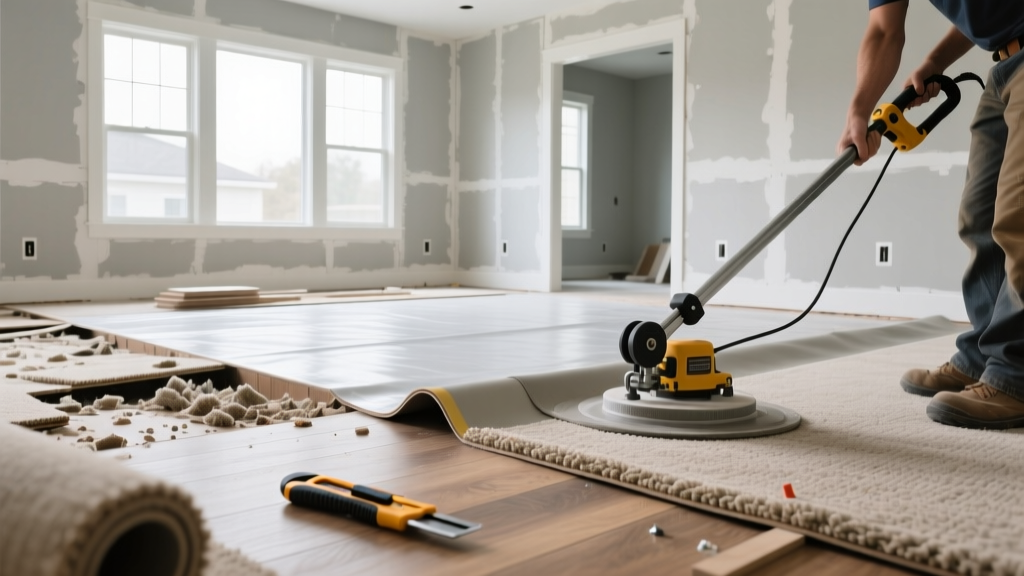
Phase 1: Demolition, Tear-Out, and Disposal Procedures
The initial phase of any carpet replacement dictates the baseline labor cost. Professional tear-out involves detaching the carpet from the tack strips, rolling it, and removing the underlying padding and fasteners. In 2026, standard demolition labor ranges from $0.50 to $1.25 per square foot. However, the true cost variable lies in disposal.
According to the Carpet America Recovery Effort (CARE), over 3 billion pounds of carpet are discarded annually. Landfill tipping fees have surged, pushing haul-away costs to $75–$150 per truckload. If your home was built before 1980, installers may require an asbestos test on the underlying mastic or subfloor before tear-out, adding $300–$500 to the project baseline.
Phase 2: Subfloor Preparation and Remediation
Skipping subfloor prep is the leading cause of premature carpet wear and visible seam peaking. The Carpet and Rug Institute (CRI) Standard 105 mandates that subfloors must be clean, dry, and flat within 3/16 of an inch over a 10-foot radius.
- Wood Subfloors: Securing loose plywood and replacing water-damaged OSB costs $2.50–$4.00 per square foot. Driving 2-inch ring-shank nails into floor joists eliminates squeaks that would otherwise transfer through the new pad.
- Concrete Subfloors: Moisture testing (calcium chloride or relative humidity probes) is mandatory. If moisture vapor emission exceeds 5 lbs/1000 sq ft/24 hours, a penetrating epoxy moisture barrier ($3.00–$5.50 per square foot) must be applied before installing tack strips.
- Leveling: Applying self-leveling underlayment (SLU) to correct concrete dips costs $3.50–$6.00 per square foot, heavily impacting the total cost carpet replacement budget.
Installation Phase Cost Matrix (2026 Estimates)
| Installation Procedure | Material/Tool Cost | Labor Cost (per sq. ft.) | Time Impact |
|---|---|---|---|
| Old Carpet & Pad Tear-Out | N/A | $0.50 - $1.25 | 1-2 hours / 500 sq ft |
| Subfloor Leveling (Wood) | $1.50 (plywood/nails) | $1.50 - $2.50 | 2-4 hours / room |
| Tack Strip & Transition Layout | $0.15 (strips/nails) | $0.20 - $0.40 | 1 hour / room |
| Pad Installation (Staple/Glue) | $0.40 - $1.20 (pad) | $0.25 - $0.50 | 1 hour / 500 sq ft |
| Broadloom Stretch-In | $0.10 (seam tape) | $0.75 - $1.50 | 2-3 hours / room |
Phase 3: Padding Selection and Material Acclimation
Padding dictates the acoustic profile and longevity of the carpet. While basic 6lb rebond polyurethane foam is often included in builder-grade packages, upgrading to an 8lb rebond pad or a high-density memory foam (like Mohawk SmartCushion) adds $0.50 to $1.25 per square foot to the material cost.
From an installation perspective, padding must be stapled every 6 inches along the seams and perimeter. Installers must leave a 1/2-inch gap between the pad and the wall to allow the carpet to be tucked into the tack strip groove. Failing to maintain this gap causes the carpet to ride up on the pad, resulting in visible bulges near baseboards.
Most base installation quotes assume empty rooms. Moving furniture adds $50–$120 per room. Furthermore, if your baseboards lack a sufficient gap for tucking the carpet edge, installers must remove and reinstall quarter-round or shoe molding. Budget an additional $1.50–$3.00 per linear foot for carpentry labor to detach, caulk, and repaint shoe molding without damaging the drywall.
Phase 4: Stretch-In vs. Glue-Down Application Methods
The application method fundamentally alters the labor timeline and cost structure.
Stretch-In Installation (Residential Standard)
Residential broadloom requires a stretch-in method. CRI 105 strictly prohibits using only a knee kicker for rooms larger than 12 feet. Installers must use a power stretcher to achieve the necessary tension (typically 100–300 lbs of lateral force) to prevent premature buckling and wrinkling. Power stretching adds roughly 15% to labor time compared to outdated kicker-only methods but is non-negotiable for warranty compliance. Labor for stretch-in averages $0.75 to $1.50 per square foot.
Direct Glue-Down (Commercial Standard)
For commercial spaces or high-traffic areas utilizing carpet tiles or low-profile commercial broadloom, direct glue-down is preferred. This requires troweling a pressure-sensitive adhesive (like Roberts 2001) onto the primed concrete. While it eliminates the cost of padding and tack strips, the labor is highly intensive. Glue-down installation labor ranges from $1.50 to $2.75 per square foot due to the meticulous adhesive spreading and rolling procedures required to prevent air bubbles.
Phase 5: Seaming, Transitions, and Finishing
Seams are the most vulnerable point in any carpet installation. Professional seaming requires a heat-activated thermoplastic tape and a specialized seaming iron calibrated to exactly 350°F–400°F. If the iron is too cool, the adhesive fails; if too hot, it melts the synthetic carpet fibers (nylon or polyester), causing permanent seam peaking. Expect seams to add 10–15% to the overall labor time, translating to an extra $15–$25 per linear foot of seam.
Transitioning to adjacent hard surfaces requires specific moldings. Installing a Z-bar (carpet gripper) for a seamless transition to hardwood costs $3.00–$8.00 per linear foot. For transitions to tile, a Schluter-RENO-T or similar aluminum profile ($5.00–$12.00 per linear foot) provides a durable, trip-free edge that protects the carpet from fraying at the doorway.
Frequently Asked Questions: Niche Cost Variables
- How do stairs affect the cost carpet replacement? Stairs require intense manual labor. Each step involves cutting, gluing, and stretching small sections of carpet and pad. Expect stair installation to cost $15–$25 per step (or $100–$150 per linear stair foot), significantly higher than flat floor rates.
- Does room geometry increase labor costs? Yes. Installers charge a "cut-up" fee for rooms with numerous closets, alcoves, or angled walls. Every additional corner requires precise cutting and stretching, adding $50–$100 per complex room to the labor invoice.
- What is the cost to repair a buckled carpet? If an existing carpet buckles due to improper initial stretching or high humidity, a professional re-stretching procedure using a power stretcher costs $125–$250 per room, assuming the pad and tack strips remain intact.