Black Carpet Cost Calculator: 2026 Pricing & Yardage
Calculate exact black carpet costs and yardage for 2026. Includes material matrices, waste factors, padding prices, and dye-lot installation tips.
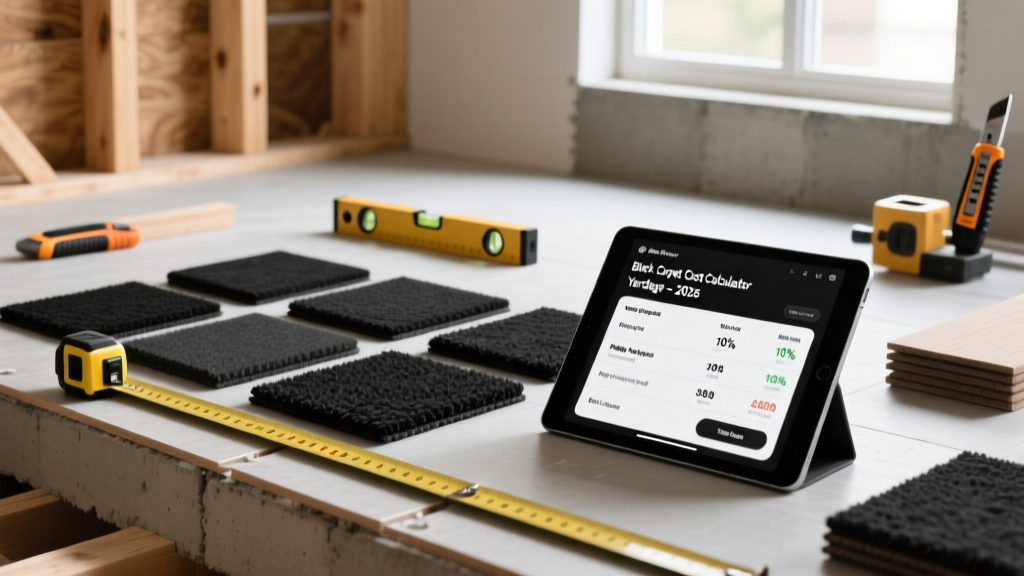
The True Cost of Black Carpet in 2026
Estimating the cost of black carpet requires more than multiplying square footage by a base material rate. True black dye lots command a premium, and the high-contrast nature of dark fibers demands stricter installation tolerances to hide seams and prevent visual shading. In 2026, the national average for black carpet materials ranges from $3.50 to $11.50 per square foot, while professional installation adds $4.50 to $7.50 per square foot. This guide provides the exact formulas, waste factors, and material matrices needed to build an accurate budget for your project.
• Economy (Polyester Plush): $8,200 – $9,500 installed
• Mid-Grade (Nylon 6,6 Frieze): $10,500 – $13,000 installed
• Premium (Wool Loop/Berber): $15,000 – $19,500 installed
Black Carpet Material & Pile Cost Matrix
The fiber composition and pile style dictate both the price and the maintenance reality of black carpet. Dark colors highlight lint, dust, and footprints, making the choice of fiber and texture critical for long-term satisfaction.
| Fiber / Brand Line | Pile Style | 2026 Cost / Sq. Ft. | Durability | Lint & Seam Visibility |
|---|---|---|---|---|
| Polyester (e.g., Mohawk EverStrand) | Cut Plush | $2.80 – $4.50 | Moderate | High (Shows footprints heavily) |
| Nylon 6,6 (e.g., Shaw Anso) | Textured Frieze | $5.50 – $8.20 | Excellent | Low (Twisted fibers hide dust) |
| Triexta (e.g., Mohawk SmartStrand) | Patterned Loop | $6.00 – $9.00 | Excellent | Very Low (Ideal for dark colors) |
| 100% Wool (e.g., Masland Contract) | Level Loop / Berber | $11.00 – $16.50 | Premium | Low (Natural soil resistance) |
The Quantity Calculator: Calculating Yardage and Waste
Carpet is manufactured in 12-foot and 15-foot widths. Calculating yardage for black carpet requires a modified waste factor due to directional pile alignment and dye-lot continuity constraints.
Step-by-Step Yardage Formula
- Calculate Gross Area: Measure the length and width of all contiguous spaces. (e.g., 15 ft x 20 ft living room = 300 sq. ft.).
- Apply the Black Carpet Waste Factor: Standard carpet waste is 10%. However, if you select a directional pattern, a high-pile plush, or a frieze black carpet, you must use a 15% waste factor. This extra material allows the installer to align the pile direction uniformly and place seams away from high-traffic pivot points where they would be visibly stressed.
- Convert to Square Yards: Divide the total square footage (including waste) by 9. (e.g., 345 sq. ft. / 9 = 38.33 sq. yards).
- Calculate Linear Footage: Divide total square footage by the roll width (12 or 15). Always round up to the nearest half-foot to ensure adequate seam overlap.
Hidden Costs: Padding, Tack Strips, and Subfloor Prep
Material and labor are only part of the equation. The substrate and underlayment directly impact the lifespan of black carpet, particularly regarding moisture and seam integrity.
- Padding (Underlay): For black carpet, avoid cheap 6lb rebond foam. The dark fibers absorb heat from sunlight, which can cause low-density foam to break down and off-gas VOCs over time. Specify an 8lb rebond pad ($0.45/sq. ft.) or a 12lb memory foam pad ($0.85/sq. ft.). According to the EPA's guidelines on indoor air quality, selecting CRI Green Label Plus certified padding is essential to minimize VOC emissions, which can become trapped in dense, dark pile structures.
- Tack Strips & Seam Tape: Standard installation includes tack strips. However, black carpet requires premium 3-inch hot-melt seam tape ($0.15 per linear foot). If a seam separates on a dark floor, the white backing material creates a glaring visual defect.
- Concrete Subfloor Moisture Testing: If installing over a concrete slab, a calcium chloride moisture test ($75 - $125 per test) is mandatory. Trapped moisture beneath black carpet backing can cause black mold, which remains entirely invisible against the dark carpet backing until the adhesive completely fails.
Labor Rates and Installation Variables
National average installation rates for 2026 sit between $4.50 and $7.50 per square foot. Black carpet frequently pushes estimates to the higher end of this spectrum due to the exacting standards required for dark fibers.
Why Black Carpet Costs More to Install
Installers must adhere strictly to the Carpet and Rug Institute (CRI) 104 Installation Standard. The CRI mandates the use of a power stretcher for wall-to-wall installations. On light carpets, minor wrinkling is easily hidden. On black carpets, even a 2% lack of tension causes "light pooling"—where the fibers bend and reflect light differently, creating permanent-looking dark and light patches. Installers will charge a premium (typically an additional $0.50 to $1.00 per sq. ft.) for the extra time required to power-stretch dark carpets and carefully groom the seams with a heat bond iron to prevent peaking.
Troubleshooting Black Carpet Shading and Seams
Before finalizing your purchase order, understand the physical characteristics of black fibers to avoid post-installation disputes with your contractor.
The "Pooling" or "Watermarking" Phenomenon
If you choose a cut-pile black nylon carpet, be aware of pooling. This is a natural phenomenon where carpet fibers lay in different directions, creating shaded areas that look like water stains. This is not a manufacturing defect and is not covered under warranty. To mitigate this risk in a black carpet application:
- Choose Frieze or Loop Pile: The tightly twisted fibers of a frieze or the continuous loops of a Berber carpet do not bend easily, effectively eliminating shading issues.
- Control Natural Light: Direct, raking sunlight from low windows will highlight every minor seam and footprint on a black plush carpet. Use UV-blocking window films or heavy drapery in rooms with southern exposure.
- Specify a Monochromatic Backing: When ordering, request a black primary and secondary backing. Standard beige or grey backings will show through the pile at the seams, creating a visible light line across the room.
Commercial vs. Residential Applications
For commercial spaces or high-traffic residential basements, consider black carpet tiles (e.g., Interface or Milliken) instead of broadloom. Carpet tiles cost between $4.00 and $8.00 per square foot and eliminate the need for hot-melt seaming entirely. If a tile becomes irreparably stained or damaged, it can be swapped out without replacing the entire floor, making the long-term cost of ownership significantly lower than broadloom black carpet.