Carpet Runner for Stairs: Material Taxonomy & Selection Guide
Discover the best carpet runner for stairs with our material taxonomy guide. Compare wool, nylon, and olefin fibers for safety, durability, and style.
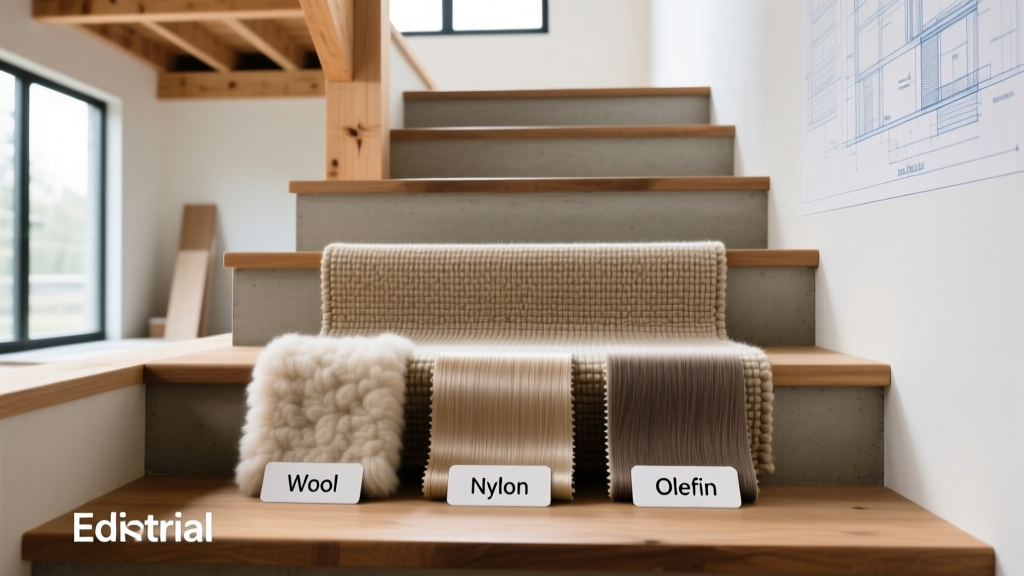
The Physics of Stair Carpeting: Why Standard Broadloom Fails
Selecting a carpet runner for stairs requires understanding the unique mechanical stresses of a stairwell. Unlike flat floors, stairs subject carpet to intense directional shear forces at the tread nose, concentrated foot traffic on the center axis, and strict safety requirements for slip resistance and fire retardancy. Standard broadloom carpet, when cut down to runner widths, often suffers from edge fraying, pile crushing, and dangerous tripping hazards if paired with the wrong underlayment.
A successful stair runner selection hinges on three material pillars: fiber polymer chemistry, weave construction, and dimensional stability. This taxonomy breaks down the exact specifications required for high-performance stair applications.
Material Taxonomy: Fiber Types Ranked for Stairs
The fiber composition dictates the runner's abrasion resistance, soil hiding capability, and long-term resilience. Stair treads require fibers with high twist retention to prevent the 'fuzzing' effect at the nosing edge.
1. Wool: The Premium Benchmark
Wool remains the undisputed standard for high-end stair runners. The natural crimp of wool fibers provides exceptional elasticity, allowing the pile to recover from heavy compression at the tread edge. Furthermore, wool is naturally flame-retardant and has a high moisture absorption rate, which reduces static electricity buildup—a common issue on synthetic stair runners in dry winter climates.
- Best for: Luxury residences, historic restorations, and low-to-medium traffic commercial spaces.
- Specification to demand: 100% New Zealand wool or a 80/20 wool-nylon blend (the nylon adds structural reinforcement to the yarn twist).
- Drawback: Susceptible to protein-based stains and requires specialized dry extraction cleaning.
2. Nylon 6,6: The High-Traffic Workhorse
Nylon 6,6 (specifically type 6,6, not type 6) offers the highest abrasion resistance of any synthetic fiber. For a carpet runner for stairs in a busy household, solution-dyed nylon is optimal. Because the color pigment is extruded directly into the liquid polymer rather than applied topically, it resists bleach-based cleaning agents and UV fading near stairwell windows.
- Best for: High-traffic family homes, commercial offices, and rental properties.
- Specification to demand: Heat-set yarns with a minimum twist level of 5.0 twists per inch (TPI) to prevent edge blooming.
3. Triexta (PTT Polymer): The Stain-Resistant Alternative
Triexta (polytrimethylene terephthalate) is a newer polymer class that combines the softness of polyester with the durability of nylon. Its inherent molecular structure resists hydrophilic stains without requiring topical chemical treatments that wear off over time. However, Triexta has a slightly lower melting point than nylon, making it less ideal for areas where heavy friction might generate localized heat.
4. Olefin (Polypropylene): The Budget Compromise
Olefin is highly stain-resistant and inexpensive, but it has poor resilience. Under the concentrated pressure of a stair nose, olefin fibers will permanently crush and mat within 12 to 18 months. It should only be selected for temporary installations or strictly decorative, low-traffic secondary staircases.
| Fiber Type | Resilience (Crush Recovery) | Stain Resistance | Average Cost (per linear ft) |
|---|---|---|---|
| Wool | Excellent | Moderate | $15.00 - $35.00 |
| Nylon 6,6 | Very Good | High (Solution-Dyed) | $8.00 - $18.00 |
| Triexta | Good | Very High | $7.00 - $15.00 |
| Olefin | Poor | Very High | $4.00 - $9.00 |
Weave and Construction: Why Woven Beats Tufted
The manufacturing method of the carpet runner for stairs is just as critical as the fiber. Most residential carpet is tufted—yarns are punched through a primary backing and glued in place with latex. When tufted carpet is slit into narrow runner widths, the edges are prone to delamination and fraying, requiring secondary binding tape that can look unsightly and catch on footwear.
For stairs, woven construction (specifically Wilton or Axminster weaves) is vastly superior. In woven carpets, the face yarn and the backing are created simultaneously on a loom. This creates an integral selvedge edge that will never unravel, even when cut to custom widths. According to the Carpet and Rug Institute, woven carpets also exhibit superior dimensional stability, preventing the runner from stretching or buckling under the tension of stair installation.
Pile Height and Density Rules
Never install high-pile or plush carpet on stairs. The maximum pile height for a stair runner should be 1/2 inch (12mm). Taller piles create a tripping hazard at the nosing and obscure the visual definition of the step edge. Furthermore, prioritize density over face weight. A low-profile, high-density loop pile (like a tight Berber) or a dense cut-loop pattern will hide vacuum marks and foot traffic directional changes far better than a uniform cut pile.
Underlayment: The Hidden Failure Point
The most frequent cause of premature stair carpet failure is the use of standard, thick residential padding. Stairs require a specialized, thin, high-density underlayment.
Using standard 7/16-inch rebond padding on stairs creates a severe tripping hazard. The thick foam compresses entirely underfoot, causing the carpet to stretch and detach from the tack strips at the tread nose. Always specify a maximum thickness of 1/4 inch with a minimum density of 8 lbs per cubic foot. Synthetic felt or specialized rubber stair pads are the industry standard for runner installations.
Installation Methods: Hollywood vs. Waterfall
The visual and functional outcome of your carpet runner for stairs depends heavily on the installation technique selected by your flooring contractor.
- The Hollywood Method (Tailored Tuck): The carpet is tightly wrapped around the nosing of each individual tread and tucked into the riser corner. This method requires precise cutting and stapling, but it provides the best safety profile by clearly defining the edge of each step and keeping the fabric taut against the wood. This is mandatory for stairs with open sides or decorative balusters.
- The Waterfall Method: The carpet flows over the tread nosing and drops straight down to the next tread without being tucked into the riser. While faster and cheaper to install, it creates a void behind the riser where debris accumulates, and it offers less slip resistance because the fabric is not pulled tightly over the nosing edge.
Sourcing, Dimensions, and 2026 Cost Expectations
Standard stair runners are manufactured in widths of 27 inches, 31 inches, and 33 inches. For a standard staircase with 42-inch wide treads, a 27-inch runner leaves 7.5 inches of exposed hardwood on each side, which is the classic aesthetic proportion. If your treads are wider or feature curved winders, you will need to source a 33-inch runner or commission a custom-width woven runner, which typically incurs a 20% to 30% manufacturing surcharge.
Project Cost Breakdown (Per Linear Foot / Per Step)
Budgeting for a stair runner requires separating the material costs from the highly specialized labor costs. Stair installation is priced per step, not per square foot, due to the intricate cutting and stretching required.
| Cost Category | Budget Tier (Nylon/Olefin) | Premium Tier (Wool/Wilton) |
|---|---|---|
| Runner Material | $6 - $12 / linear ft | $18 - $35 / linear ft |
| Stair Padding (Felt/Rubber) | $1.50 / linear ft | $2.50 / linear ft |
| Installation Labor (Per Step) | $12 - $18 / step | $20 - $35 / step |
| Custom Binding / Edging | $3 - $5 / linear ft | N/A (Woven Selvedge) |
Common Selection Mistakes to Avoid
When specifying a carpet runner for stairs, avoid these frequent specification errors that lead to premature replacement or safety violations:
- Ignoring the Bend Test: Before purchasing, fold a sample of the carpet back on itself. If you can easily see the primary backing through the pile, the density is too low for stair nosings and will crush within months.
- Choosing Directional Patterns on Winders: If your staircase includes curved winders or landings, avoid strict linear stripes or geometric patterns. The carpet must be stretched and distorted to navigate the curves, which will warp the pattern and create a visually chaotic, disorienting effect. Opt for tone-on-tone textures or small-scale organic motifs instead.
- Skipping the Tack Strip Upgrade: Standard 1-inch tack strips are insufficient for the high tension of a stair runner. Specify 2-inch architectural tack strips with double rows of nails to ensure the carpet remains locked into the tread corners under heavy directional foot traffic.
For further technical guidelines on stair carpet flammability and slip-resistance standards, consult the safety bulletins published by the National Fire Protection Association and local building codes regarding tread nosing visibility requirements. Selecting the correct fiber, weave, and padding combination ensures your stair runner remains both a safe transit surface and a durable architectural feature.