True Cost Per Sq Ft for Carpet: Installation Procedures & Pricing
Discover the true cost per sq ft for carpet in 2026. We break down installation procedures, padding, labor rates, and subfloor prep pricing.
The Hidden Variables in Carpet Installation Pricing
Calculating the exact cost per sq ft for carpet requires looking far beyond the showroom material tag. While the carpet fiber itself might range from $2.00 to $8.00 per square foot, the installation procedures, subfloor preparation, and padding selection frequently double the final project cost. In 2026, with specialized labor rates and updated building codes regarding moisture mitigation, understanding the procedural breakdown is essential for accurate budgeting.
- Material Only: $2.00 - $8.00 / sq ft
- Padding: $0.50 - $1.50 / sq ft
- Standard Labor (Stretch-In): $1.25 - $2.50 / sq ft
- Subfloor Prep & Mitigation: $0.75 - $3.50 / sq ft
- Total Installed Cost: $4.50 - $15.50 / sq ft
Subfloor Preparation: The First Cost Hurdle
Carpet is unforgiving of subfloor imperfections. Any deviation greater than 1/8 inch over a 6-foot span will telegraph through the backing, causing premature wear and visible ridges. The cost to prepare the subfloor depends entirely on the existing substrate.
Concrete Slabs and Moisture Mitigation
Installing carpet over a concrete slab requires rigorous moisture testing. Installers must perform in-situ relative humidity (RH) testing per Carpet and Rug Institute (CRI) guidelines and ASTM F2170 standards. If RH levels exceed the adhesive or carpet backing manufacturer's limits (typically 75% to 85%), a moisture mitigation system is mandatory.
- Reactive Penetrating Sealers: $1.50 - $2.50 per sq ft. Used for moderate moisture issues.
- Epoxy Moisture Barriers: $3.00 - $4.50 per sq ft. Required for high-alkalinity, high-moisture slabs before applying self-leveling underlayment.
Wood Subfloors and Leveling
Plywood or OSB subfloors often require sanding of seams, replacement of water-damaged panels, or the application of a feather-finish patching compound. Expect to pay $0.75 to $1.25 per sq ft for wood subfloor prep. If the floor requires structural sistering of joists to eliminate deflection, costs are billed at standard carpentry hourly rates ($85-$125/hour), not per square foot.
Padding Selection and Its Impact on Labor
The cushion layer dictates the carpet's lifespan, acoustic performance, and comfort. The CRI mandates that padding must not exceed 7/16 of an inch in thickness for most residential applications to prevent bottoming-out and seam failure. Higher density pads cost more but significantly reduce labor callbacks for restretching.
| Padding Type | Density / Thickness | Cost Per Sq Ft | Best Application |
|---|---|---|---|
| Rebond (Urethane) | 6-8 lb / 7/16" | $0.50 - $0.75 | Standard residential bedrooms |
| Prime Urethane | 8-10 lb / 3/8" | $0.90 - $1.25 | High-traffic hallways, stairs |
| Memory Foam | 8-12 lb / 1/2" | $1.25 - $1.75 | Luxury master suites |
| Rubber (Waffle/Flat) | 12-16 lb / 1/4" - 3/8" | $1.50 - $2.25 | Commercial, radiant heat floors |
Stretch-In vs. Glue-Down: Procedural Cost Differences
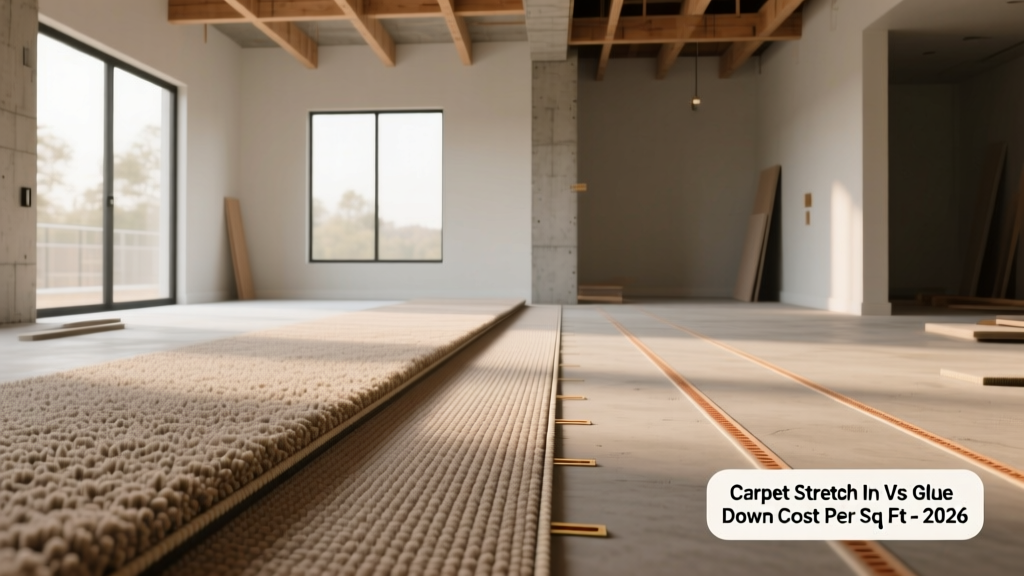
The installation methodology fundamentally alters the labor cost per sq ft for carpet. The choice between stretch-in and glue-down depends on the subfloor, the carpet backing, and the expected traffic load.
The Standard Stretch-In Method (CRI 104)
Stretch-in installation utilizes tack strips nailed or glued around the room's perimeter. The carpet is laid over the pad and stretched using a power stretcher to anchor onto the tack strip pins.
Labor Cost Impact: Standard stretch-in labor ranges from $1.25 to $2.50 per sq ft. Stairs require specialized hand-stretching and bolstering, bumping the stair cost to $12.00 - $18.00 per step (tread and riser).
Glue-Down Installation (Direct or Double Glue)
Glue-down is standard for commercial spaces, loop-pile (Berber) carpets, and installations over radiant heating systems where thick padding would block heat transfer.
- Direct Glue: Adhesive is troweled directly onto the subfloor. Requires a perfectly smooth, moisture-free slab. Labor is highly dependent on adhesive open-time and trowel-notch precision. Cost: $1.50 - $2.75 per sq ft.
- Double Glue: Adhesive is applied to both the subfloor and the carpet backing (or pad). This creates a monolithic, highly stable floor but increases material and labor time significantly. Cost: $2.50 - $4.00 per sq ft.
When selecting adhesives for glue-down applications, ensure they meet low-VOC emissions standards to maintain indoor air quality, as outlined by the EPA's guidelines on volatile organic compounds.
Seaming, Pattern Matching, and Waste Factors
The layout of the room and the pattern of the carpet drastically affect the final cost per sq ft. Carpet typically comes in 12-foot or 15-foot widths. When a room exceeds these dimensions, seams are unavoidable.
The Cost of Pattern Matching
If you select a carpet with a distinct geometric or floral pattern, the installer must align the pattern across seams. This requires significant overage.
- Solid/Texture Carpets: Require 5% to 7% waste factor for cuts and trimming.
- Small Repeat Patterns (under 6 inches): Require 10% to 12% waste factor.
- Large Repeat Patterns (12+ inches): Require 15% to 20% waste factor to ensure the pattern matches perfectly at every seam and doorway.
Furthermore, patterned carpets require hot-melt seam tape and specialized seam sealer to prevent the adhesive from bleeding through and staining the face fiber. Expect seaming labor to add $0.25 to $0.50 per sq ft to the overall installation price for complex pattern matches.
Regional Labor Rates and Certified Installer Premiums
Labor rates for carpet installation are heavily influenced by regional union prevailing wages and the local cost of living. In high-cost metropolitan areas (e.g., San Francisco, New York, Seattle), baseline labor rates start at $2.50 per sq ft and can exceed $4.00 for commercial glue-downs. In the Midwest and Southeast, labor often hovers between $1.25 and $1.75 per sq ft.
Hiring a CRI-certified installer or a contractor affiliated with the FloorCoverings International network typically commands a 15% to 20% premium over independent, non-certified handymen. This premium pays for specialized moisture-testing equipment, commercial-grade power stretchers, and liability insurance that covers ruined subfloors or damaged baseboards.
Finalizing Your Carpet Installation Budget
To accurately forecast your project costs, use this procedural checklist before signing a contract:
- Demand a Moisture Test: If installing over concrete, ensure the contract specifies ASTM F2170 RH testing. Do not accept a visual inspection as sufficient.
- Verify the Pad Specs: Ensure the contract lists the exact pad brand, density (in pounds), and thickness (in fractions of an inch), not just 'premium pad'.
- Confirm Power Stretching: Get written confirmation that a power stretcher will be used for all wall-to-wall areas, per CRI 104 standards.
- Calculate True Waste: Multiply your room's square footage by the appropriate waste factor (7% for solid, 15% for large patterns) before multiplying by the material cost per sq ft.
- Clarify Furniture and Demo: Moving heavy furniture and removing/disposing of old carpet and tack strips are rarely included in the base 'cost per sq ft for carpet' labor quote. Expect flat fees of $1.00 to $2.00 per sq ft for demolition and haul-away.
By dissecting the installation procedures rather than relying on a single bundled metric, you can identify where costs are justified and where contractors may be cutting procedural corners.