Radiant Floor Heat Options: Top Flooring Materials Compared
Compare the best flooring materials for radiant floor heat options. Analyze thermal conductivity, costs, and installation specs for tile, wood, and vinyl.

Thermal Conductivity and R-Value: The Physics of Floor Heat
Selecting the right flooring for radiant floor heat options requires understanding two critical thermal metrics: thermal conductivity (k-value) and thermal resistance (R-value). Radiant systems transfer heat via conduction; therefore, the flooring material must allow heat to pass through efficiently without trapping it at the subfloor level. According to the U.S. Department of Energy, materials with high thermal conductivity and low R-values deliver the fastest response times and highest energy efficiency.
A material's R-value dictates its insulating properties. For radiant heating, the combined R-value of the flooring and any underlayment should not exceed 2.5. Exceeding this threshold forces the heating system to work harder, increasing energy consumption and risking premature failure of the heating elements or the flooring itself.
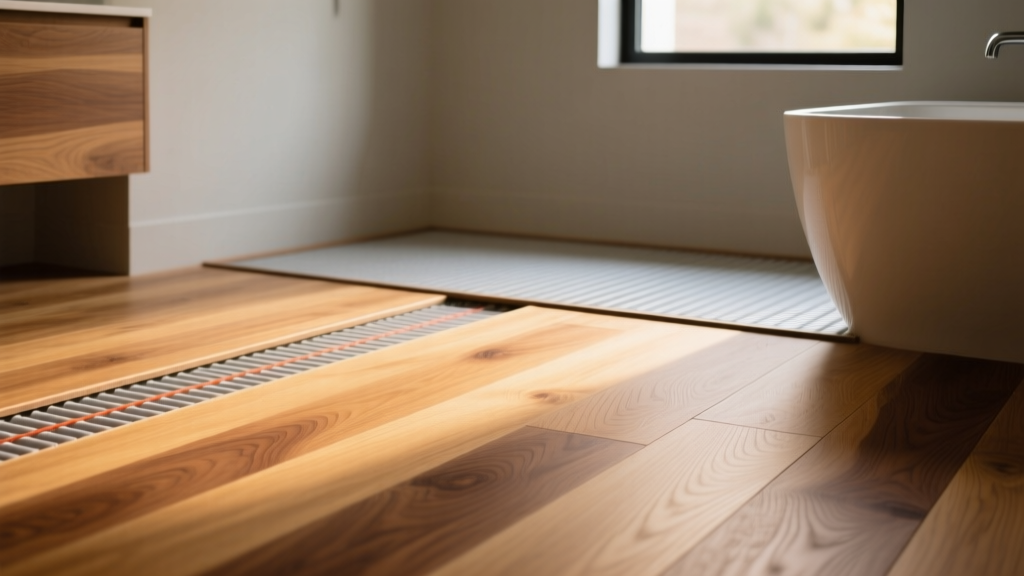
Material Comparison Matrix: Thermal Performance & 2026 Costs
The following matrix compares the most common flooring materials paired with electric and hydronic radiant floor heat options, factoring in thermal properties and current installed costs.
| Material | Thermal Conductivity (W/m·K) | Max Surface Temp | Combined R-Value Limit | Avg Installed Cost (2026) |
|---|---|---|---|---|
| Porcelain/Ceramic Tile | 1.30 - 1.50 | 85°F - 95°F | < 0.5 | $12 - $26 / sq ft |
| Natural Stone | 1.70 - 3.00 | 85°F - 95°F | < 0.5 | $18 - $40 / sq ft |
| Engineered Hardwood | 0.14 - 0.18 | 80°F - 85°F | < 1.5 | $14 - $28 / sq ft |
| SPC Luxury Vinyl | 0.20 - 0.25 | 80°F - 85°F | < 1.0 | $8 - $16 / sq ft |
| Laminate (with pad) | 0.10 - 0.15 | 80°F - 85°F | < 2.5 | $7 - $14 / sq ft |
Ceramic and Porcelain Tile: The Gold Standard
Porcelain and ceramic tiles possess the highest thermal conductivity among residential flooring options. Because tile is fired at extreme temperatures, it is entirely immune to the thermal expansion and contraction that plagues organic materials. It will not off-gas when heated, nor will it warp.
Installation Specifications for Tile
The primary failure mode for tile over radiant heat is cracked grout or debonding due to substrate movement. To mitigate this, an uncoupling membrane is mandatory. Systems like Schlüter DITRA-HEAT integrate the heating cables directly into a polyethylene membrane that neutralizes lateral shear stresses between the subfloor and the tile.
Engineered Hardwood vs. Solid Hardwood
Solid hardwood is fundamentally incompatible with radiant floor heat options. The continuous thermal cycling causes severe moisture content (MC) fluctuations, leading to irreversible cupping, gapping, and checking. Engineered hardwood, with its cross-plywood core, provides the dimensional stability required for heated environments.
Critical Wood Selection Criteria
Not all engineered wood is rated for radiant heat. When specifying engineered wood, adhere to the guidelines established by the National Wood Flooring Association (NWFA):
- Cut Type: Specify rift-sawn or quarter-sawn veneers. These cuts expand and contract up to 50% less than plain-sawn veneers because they follow the radial plane of the tree's growth rings.
- Width Restrictions: Limit plank widths to a maximum of 5 inches. Wider planks experience greater absolute dimensional movement, increasing the risk of edge-gapping.
- Core Construction: Multi-ply birch or eucalyptus cores outperform HDF (High-Density Fiberboard) cores in high-humidity, heated environments.
- Temperature Limits: The surface temperature must never exceed 80°F to 85°F. Exceeding this degrades the urethane finishes and dries out the wood cellular structure.
SPC Luxury Vinyl Plank (LVP)
Stone Polymer Composite (SPC) luxury vinyl has become a dominant choice for radiant floor heat options in moisture-prone areas. Unlike older WPC (Wood Polymer Composite) cores, which can expand and trap air under high heat, SPC cores utilize a limestone-polyvinyl chloride matrix that remains dimensionally stable up to 85°F.
Off-Gassing and Plasticizer Migration
While SPC is stable, the vinyl wear layer contains plasticizers to maintain flexibility. If the surface temperature exceeds the manufacturer's limit (typically 85°F), these plasticizers can migrate to the surface, creating a permanent sticky residue and causing the wear layer to turn opaque or yellow. Always use an external floor temperature sensor wired to the thermostat to hard-cap the maximum output, rather than relying solely on the thermostat's ambient air sensor.
Materials to Avoid or Heavily Modify
Certain materials act as thermal insulators, effectively suffocating the radiant system and driving up operational costs.
- Solid Hardwood: Guaranteed to crack and gap under thermal cycling.
- Thick Carpeting: Carpet and pad combined must have an R-value under 2.5. High-pile wool carpets often exceed R-3.0, trapping heat below the floor.
- Cork Flooring: Cork is a natural thermal insulator (R-value of ~1.25 per 1/4 inch). It severely delays heat transfer and requires the system to run at maximum capacity, risking subfloor damage.
- Solid Rubber Flooring: Similar to cork, rubber insulates and can emit a strong, unpleasant odor when continuously heated.
Decision Framework: Matching Heat Options to Room Types
Selecting the optimal material requires balancing thermal efficiency with the functional demands of the specific room.
1. Bathrooms and Mudrooms
Optimal Choice: Porcelain Tile or Natural Stone.
Rationale: These areas demand high water resistance. Tile's superior thermal conductivity provides rapid warm-up times, which is ideal for spaces used intermittently. Pair with an electric heating mat for localized, on-demand comfort.
2. Living Rooms and Bedrooms
Optimal Choice: Engineered Hardwood (Rift/Quarter-Sawn).
Rationale: These spaces prioritize acoustic dampening and aesthetic warmth. Engineered wood provides a softer underfoot feel and superior sound absorption compared to tile. Hydronic systems are preferred here for whole-home, continuous, low-temperature operation.
3. Kitchens and Basements
Optimal Choice: SPC Luxury Vinyl Plank.
Rationale: Kitchens and basements are high-spill, high-moisture zones where hardwood is risky. SPC provides 100% waterproof protection, handles heavy appliance loads without denting, and transfers heat efficiently enough for comfortable barefoot walking.
Installation Tolerances and Subfloor Preparation
The longevity of any flooring over radiant heat relies entirely on subfloor flatness and moisture management. For electric mats embedded in self-leveling compound, the subfloor must be flat to within 1/8 inch over 10 feet. Any deviation causes the heating cables to sit closer to the surface in some areas, creating localized hot spots that can scorch vinyl or damage wood finishes.
For engineered wood installations, a moisture barrier is non-negotiable. Even in climate-controlled environments, the heating elements can draw residual moisture from concrete slabs upward. Use a vapor-retarding underlayment with a perm rating of less than 0.15, and ensure the wood is acclimated to the home's year-round relative humidity target (typically 35% to 45%) for a minimum of 14 days before installation.
Written by
Sarah WhitfieldSarah Whitfield is a chartered quantity surveyor (MRICS) and construction cost analyst with 15 years of experience in material pricing, procurement strategy, and project budgeting. She earned her degree in Construction Management from the University of Reading (UK) and has worked on projects ranging from $2M custom homes to $180M mixed-use developments across North America and Europe. Sarah currently leads cost estimating for BuildMat Insight, maintaining a proprietary database of 4,000+ material price points updated quarterly. She is a frequent contributor to RSMeans cost data panels and has presented at the International Cost Engineering Council (ICEC) congress. Based in Denver, CO, Sarah is an avid trail runner and volunteer mentor for Women in Construction.
More from Sarah Whitfield
View all
Wood & Lumber
What Are the Different Types of Wood? A Builder's Guide
Compare structural softwoods, finish hardwoods, and engineered lumber. Analyze Janka ratings, MOE values, and 2026 pricing for construction.
Aug 4, 2026

Walls & Panels
Steel Framing vs Wood Framing: Corrosion and Moisture Defense
Compare steel framing vs wood framing for moisture resistance. Learn about galvanized coatings, condensation risks, and corrosion protection strategies.
Jul 21, 2026

Stone & Masonry
How to Cut Stone Veneer: Wet Saw vs Grinder Comparison
Compare the best tools for cutting stone veneer. We review wet saws, angle grinders, and chop saws to help you achieve clean, chip-free cuts.
Jul 21, 2026