Ceramic Floor Tile Applications: A Room-by-Room Scenario Guide
Discover the best applications for ceramic floor tile. Match PEI ratings, slip resistance, and thickness to specific rooms for lasting durability.
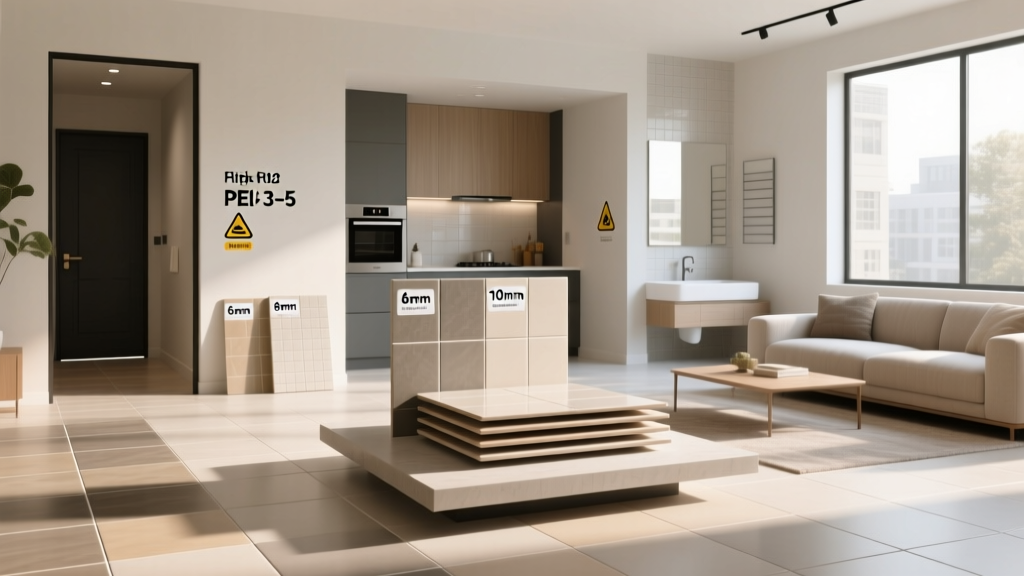
The Science of Scenario Matching: Beyond Aesthetics
Selecting the right flooring requires moving past color and pattern to evaluate structural and environmental compatibility. Ceramic floor tile is not a monolithic material; its performance varies drastically based on manufacturing processes, clay density, and glaze composition. A tile that performs flawlessly in a low-traffic powder room will fracture under the dynamic loads of a busy kitchen or spall in a freeze-thaw climate.
To accurately match ceramic floor tile to specific architectural scenarios, specifiers and homeowners must evaluate three primary metrics: water absorption rates (ASTM C373), surface abrasion resistance (PEI ratings), and slip resistance (DCOF). According to guidelines published by the Tile Council of North America (TCNA), misalignment between these metrics and the installation environment accounts for over 60% of premature tile failures in residential and light-commercial projects.
Critical Metrics: ASTM C373 and PEI Ratings
True ceramic tile (non-porcelain) typically exhibits a water absorption rate between 3% and 7%. This porosity dictates its environmental limits. Furthermore, the Porcelain Enamel Institute (PEI) wear rating classifies tiles from I (no foot traffic, walls only) to V (heavy commercial). For residential flooring applications, you must exclusively source tiles rated PEI III (moderate traffic) or PEI IV (heavy traffic). Installing a PEI II tile on a floor will result in visible glaze scratching and wear patterns within 12 to 18 months in active households.
High-Moisture Zones: Bathrooms and Wet Rooms
Bathrooms present a dual challenge: constant moisture exposure and a high risk of slip-and-fall incidents. When specifying ceramic floor tile for wet areas, the Dynamic Coefficient of Friction (DCOF) is the governing safety metric. The ANSI A137.1 standard mandates a DCOF of 0.42 or greater for level interior spaces expected to be wet.
Never install ceramic wall tile on a bathroom floor. Wall tiles are typically 1/4-inch thick, lack a PEI rating, and feature a high-gloss glaze with a DCOF well below 0.30. Under foot traffic, they will crack, and when wet, they become dangerously slick.
For master showers and wet rooms, opt for unglazed ceramic mosaics or smaller format tiles (2x2 inches or hex profiles). The increased grout joint density inherently boosts slip resistance. Ensure the substrate is fully waterproofed using a liquid-applied membrane (like Mapei Mapelastic AquaDefense) or a sheet membrane (like Schluter Kerdi) before setting the tile with a polymer-modified thinset mortar.
High-Traffic Hubs: Kitchens, Entryways, and Mudrooms
Kitchens and entryways demand high abrasion resistance and impact tolerance. Dropped utensils, grit tracked in from outdoors, and heavy appliance loads require a robust assembly. For these zones, specify a PEI IV ceramic floor tile with a minimum thickness of 3/8-inch (10mm). Rectified edges are highly recommended here, as they allow for narrow 1/16-inch grout joints, minimizing the accumulation of dirt and grease in the kitchen environment.
Entryways and mudrooms introduce abrasive silica sand and moisture. A matte or structured-texture glaze is mandatory to hide micro-scratches and maintain traction. According to design standards referenced by the National Kitchen and Bath Association (NKBA), transition zones between outdoors and indoors should utilize tiles with a slightly higher surface profile to scrape debris from footwear.
Scenario Matching Matrix
| Scenario / Room | Required PEI | Min DCOF | Ideal Format & Edge |
|---|---|---|---|
| Powder Room / Half Bath | PEI III | > 0.42 | Large format, rectified |
| Master Bathroom Floor | PEI III | > 0.45 | Mosaic or small format |
| Kitchen | PEI IV | > 0.42 | Large format, rectified |
| Mudroom / Entryway | PEI IV | > 0.50 | Textured, non-rectified |
| Living Room (Radiant Heat) | PEI III | > 0.42 | Large format, 3/8" thick |
Climate-Specific Applications: Radiant Heat and Outdoor Patios
Ceramic floor tile possesses excellent thermal conductivity, making it an ideal surface covering for hydronic or electric radiant heating systems. However, the thermal expansion and contraction cycles require specific installation protocols. You must utilize an uncoupling membrane (such as Schluter Ditra) to absorb the lateral movement and prevent the tile from tenting or cracking. Furthermore, the thinset mortar must be specifically rated for radiant heat applications, retaining flexibility after curing.
When installing over radiant heat, never use a grout joint smaller than 1/8-inch. The slight increase in joint width provides the necessary thermal expansion buffer to prevent compressive stress fractures in the ceramic body during rapid heating cycles.
For outdoor patios and balconies, standard ceramic floor tile is generally a poor choice unless you reside in a strictly warm, arid climate with zero freeze-thaw cycles. Because non-porcelain ceramic absorbs up to 7% of its weight in water, freezing temperatures will cause the absorbed moisture to expand, leading to catastrophic spalling and glaze popping. For exterior applications in temperate or cold climates, you must pivot to impervious porcelain tile (water absorption ≤ 0.5%).
Where Ceramic Floor Tile Fails: Scenarios to Avoid
Understanding where a material fails is just as critical as knowing where it succeeds. Ceramic floor tile should be strictly avoided in the following scenarios:
- Residential Garages: The point-load impact of dropping heavy tools, combined with the chemical exposure from automotive fluids and de-icing salts, will degrade the glaze and stain the porous ceramic body.
- Commercial Kitchens: Grease, heavy rolling carts, and extreme thermal shock from spilled boiling liquids require heavy-duty quarry tile or commercial-grade porcelain, not standard ceramic.
- Unconditioned Sunrooms: Extreme UV exposure can fade certain organic glaze pigments over time, and the lack of climate control exacerbates substrate movement.
"The most common mistake in residential tile specification is treating all ceramic as porcelain. They share a lineage, but their physical properties dictate entirely different lifespans when subjected to moisture and mechanical stress." — Senior Materials Inspector, International Association of Certified Home Inspectors
Cost and ROI by Application Scenario
Budgeting for ceramic floor tile requires calculating both material and specialized labor costs. As of current market rates, standard ceramic floor tile materials range from $2.00 to $6.00 per square foot. However, the installation labor varies wildly based on the scenario complexity:
- Standard Bathroom Floor (Simple layout): $5.00 - $7.00 per sq. ft. for labor.
- Kitchen with Diagonal Layout & Radiant Heat: $9.00 - $14.00 per sq. ft. for labor, plus membrane and heating mat costs.
- Large Format (24x24 or larger): Requires a premium for lippage control systems and two-person handling, adding roughly $1.50 to $2.50 per sq. ft. to base labor rates.
By rigorously matching the tile’s ASTM and PEI specifications to the exact demands of the room, you eliminate the need for premature replacement, securing a long-term ROI that outperforms almost any other hard-surface flooring category.