Flooring Durability Guide for UGA Student Apartment Floor Plan Options
Analyze the best flooring materials for UGA student apartment floor plan options. Discover durable, cost-effective specs for Athens, GA property managers.

The Athens Market: Why Student Housing Demands Extreme Durability
Managing off-campus student housing near the University of Georgia (UGA) presents a unique set of structural challenges. With an enrollment exceeding 41,000 students, the Athens rental market is characterized by extreme, synchronized turnover. Property managers typically have a 48- to 72-hour window in late July to turn over units before the August move-in rush. During this compressed timeline, flooring must not only survive a year of heavy abuse but also be easy to clean, repair, and replace without delaying occupancy.
When evaluating uga student apartment floor plan options, durability cannot be treated as a one-size-fits-all metric. A 4-bedroom, 4-bathroom layout experiences vastly different traffic patterns and wear-and-tear compared to a premium studio or a 2-bedroom shared unit. Selecting the correct flooring material requires mapping specific resilient flooring specifications to the exact spatial dynamics of the floor plan. According to maintenance benchmarks tracked by the National Apartment Association (NAA), flooring replacement and deep-cleaning account for nearly 28% of total unit turnover costs in student housing. By aligning material specs with floor plan usage, Athens property owners can drastically reduce capital expenditure over a 10-year hold period.
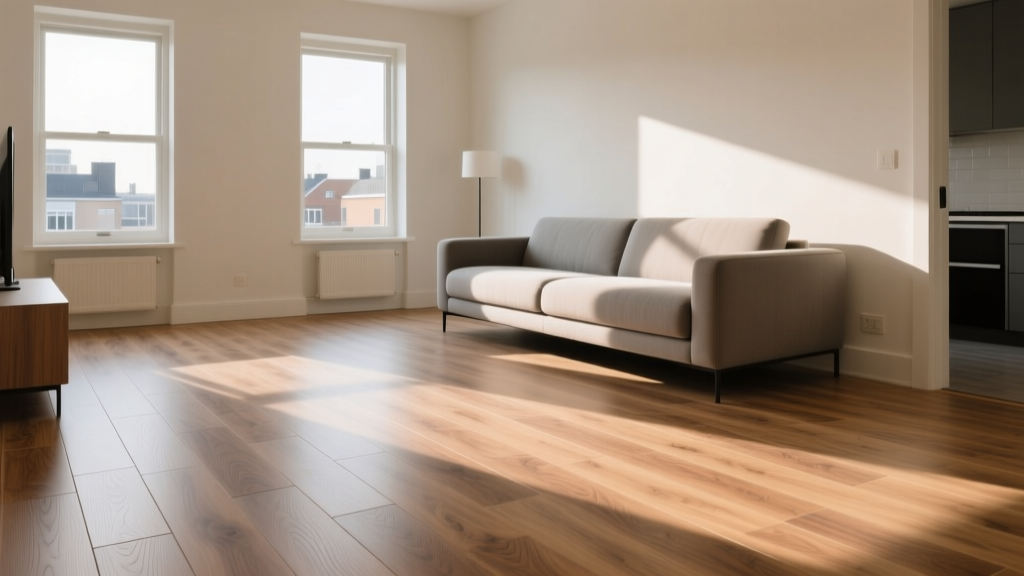
Mapping Flooring to UGA Student Apartment Floor Plan Options
The physical layout of a student apartment dictates where the highest impact zones are located. Here is a durability-driven breakdown of how to specify flooring based on the dominant floor plans in the Athens market.
The 4-Bedroom 'By-the-Bed' Layout (High-Traffic Commons)
In a 4-bedroom configuration, the living room and kitchen serve as a high-density social hub. Four to eight students (including guests) routinely traverse this space, dragging chairs, dropping heavy backpacks, and spilling food and beverages.
- Common Areas: Specify Stone Plastic Composite (SPC) Luxury Vinyl Plank (LVP) with a minimum 22-mil urethane wear layer. SPC features a rigid limestone core that resists indentation from heavy furniture and does not expand when exposed to the inevitable liquid spills that occur in student kitchens. Avoid Wood Plastic Composite (WPC), which is prone to heat expansion and denting under point-loads.
- Private Bedrooms: To balance the budget, downgrade the bedrooms to a 12-mil LVP or utilize commercial-grade carpet tiles (such as Interface Entropy). Carpet tiles allow property managers to replace a single stained 24x24 square during the July turnover window without replacing the entire bedroom floor, saving roughly $3.00 per square foot in material and labor.
The Studio & 1-Bedroom Premium Layouts
Studios and 1-bedroom units near UGA are typically leased by graduate students or upperclassmen willing to pay a premium per square foot. These units experience lower foot traffic but require a higher aesthetic finish to justify the rent.
For these layouts, large-format porcelain tile (minimum PEI Rating IV) in the entryway and kitchen provides an indestructible, waterproof surface that elevates the perceived value of the unit. In the main living and sleeping areas, engineered hardwood with an aluminum oxide finish offers the premium look of solid wood while providing superior scratch resistance against pet claws, a critical factor since many premium Athens apartments allow pets with a non-refundable deposit.
The 2-Bedroom Shared Layout
The 2-bedroom floor plan is the middle ground. The living area requires the same 20-mil+ SPC LVP used in 4-bedroom commons, but the transition between the two bedrooms requires a unified flooring strategy. Running a continuous 20-mil LVP throughout the entire unit eliminates the need for transition strips (T-moldings), which are notorious tripping hazards and frequently crack when students drag mini-fridges or bookshelves over them.
Material Durability Matrix: What Survives the 'UGA Cycle'
The following matrix outlines the optimal material specifications for student housing, factoring in the 2026 Athens, GA installation market rates and industry durability standards recognized by the Resilient Floor Covering Institute (RFCI).
| Material Type | Critical Durability Spec | Best Floor Plan Application | Expected Lifespan (Student Use) | Athens Installed Cost (2026) |
|---|---|---|---|---|
| Rigid Core SPC LVP | 20-22 mil wear layer, IXPE pad | 4-Bed Commons, 2-Bed Entire Unit | 7-10 Years | $4.85 - $6.50 / sq ft |
| Porcelain Tile | PEI IV or V rating, rectified edge | Studio/1-Bed Entries & Kitchens | 15+ Years | $9.00 - $13.50 / sq ft |
| Commercial Carpet Tile | Solution-dyed nylon, PVC backing | 4-Bed Private Bedrooms | 5-7 Years (with spot replacement) | $3.25 - $4.75 / sq ft |
| Polished Concrete | Densifier treated, matte guard | Ground-floor lobby-style layouts | 20+ Years | $6.00 - $9.00 / sq ft |
Critical Failure Modes in Student Apartments
Understanding how flooring actually fails in a student environment allows property managers to spec materials that preemptively mitigate these issues.
Modern students spend hours at desks using hard-caster rolling chairs. Standard 12-mil residential LVP will develop white stress marks and micro-fissures within six months under these point-loads. Always specify a commercial-grade ceramic bead or diamond-fused urethane topcoat on the wear layer to resist localized friction burns.
Hydrostatic Pressure and Subfloor Telegraphing
Many student apartment complexes in Athens are built using wood-frame construction with concrete slab-on-grade for the first floor. If a student leaves a balcony door open during a Georgia thunderstorm, water will pool. If the flooring relies on a click-lock system with a flexible core, the planks will separate. SPC's rigid core maintains structural integrity even when submerged, provided the seams are tightly engaged. Furthermore, wood subfloors in multi-story buildings naturally deflect. Using a flooring product with a high psi (pounds per square inch) crush rating prevents the flooring from telegraphing the imperfections of the OSB subfloor below.
Acoustic Failures and Noise Complaints
Noise transmission is the leading cause of lease non-renewals in multi-story student housing. Hard surface flooring exacerbates impact noise (footsteps, dropped items). When specifying LVP for second- and third-floor units, the attached underlayment pad is non-negotiable. Require an attached 1.5mm IXPE or cork backing that achieves a minimum Sound Transmission Class (STC) of 52 and an Impact Insulation Class (IIC) of 50. Floating floors without adequate acoustic backing will result in immediate complaints from the units directly below.
Actionable Specifications for Athens Property Managers
When drafting your procurement orders for the next renovation cycle, use this checklist to ensure your flooring specifications meet the rigorous demands of the UGA student demographic:
- Demand the Wear Layer Data Sheet: Do not accept a vendor's claim of 'commercial grade.' Require the ASTM F499 test report proving the wear layer is a minimum of 0.5mm (20 mil) of pure virgin PVC, not a printed film layer.
- Standardize the Color Palette: Select a mid-tone, wire-brushed oak or grey-washed LVP. High-gloss finishes show every scuff mark from rubber-soled shoes, while extremely dark or light floors highlight dust and pet hair, leading to excessive maintenance calls from students claiming the floor is 'defective' or 'dirty' upon move-in.
- Eliminate Transition Strips: Design your floor plan flooring layouts to run continuously under interior doors. Use an undercut jamb saw to slide the planks beneath the door casings. This creates a seamless visual flow and removes the primary trip-and-snap hazard found in student units.
- Maintain a 5% Attic Stock: Student housing turns over annually. Always order and store an additional 5% of the exact LVP dye-lot in a climate-controlled on-site maintenance closet. When a plank is gouged by a moving dolly in July, your maintenance team can snap-and-replace the damaged board in 10 minutes without sourcing new material.
By treating flooring as a structural asset rather than a mere cosmetic finish, and by tailoring the material to the specific uga student apartment floor plan options in your portfolio, property owners in Athens can drastically reduce turnover friction, minimize mid-lease maintenance tickets, and protect their net operating income.
Written by
Marcus ChenMarcus Chen is a licensed structural engineer (PE) and building materials analyst with over 12 years of experience across residential, commercial, and industrial construction. He holds a Master of Science in Civil Engineering from UC Berkeley and spent six years at Thornton Tomasetti before transitioning to independent consulting and technical writing. Marcus specializes in material selection for seismic-prone regions, concrete reinforcement strategies, and lifecycle cost analysis. His work has been cited by the American Concrete Institute (ACI) and the Structural Engineers Association of California (SEAOC). When he is not on a job site or at his desk, you will find him hiking the Sierra Nevada or restoring a 1920s craftsman bungalow in Oakland, CA.
More from Marcus Chen
View all
Construction Cost
How Much Did the Eiffel Tower Cost to Build?
How much did the Eiffel Tower cost to build in 1889? We adjust for inflation and compare its budget to modern skyscraper construction.
Aug 4, 2026

Fire Resistance
What Is a Fire Resistant Material? Testing & Certification Guide
Discover what is a fire resistant material through ASTM and UL testing. Learn how fire ratings, certifications, and assemblies work in construction.
Aug 4, 2026

Construction Cost
How Much Did the Burj Khalifa Cost to Build?
How much did the Burj Khalifa cost to build? We break down the $1.5B project and extract 5 money-saving strategies for your next build.
Jul 30, 2026