Best Cheap Flooring Options for Basement Concrete Slabs
Discover the best cheap flooring options for basement concrete slabs. Compare costs, moisture resistance, and DIY prep for budget-friendly below-grade floors.

The Below-Grade Reality: Hydrostatic Pressure and Capillary Action
Basements present a unique microclimate that destroys standard flooring. Because they sit below grade, concrete slabs are in constant contact with surrounding soil. Even if a slab feels completely dry to the touch, it is likely emitting moisture vapor. Concrete is essentially a rigid sponge; microscopic capillaries draw groundwater upward through hydrostatic pressure. When you trap this vapor beneath an impermeable or organic flooring layer, the result is alkaline efflorescence, adhesive failure, and mold proliferation.
According to the Environmental Protection Agency (EPA), mold can begin growing on damp, organic materials within 24 to 48 hours. Therefore, when evaluating cheap flooring options for basement environments, the primary metric is not just the upfront cost per square foot, but the material's dimensional stability and inorganic composition. A $2.00/sq. ft. floor that survives 15 years is infinitely cheaper than a $1.50/sq. ft. floor that requires demolition and mold remediation in year two.
Before purchasing any flooring, tape a 2-foot by 2-foot square of clear 6-mil polyethylene sheeting to your concrete slab using duct tape on all four sides. Leave it for 48 hours. If you observe condensation on the underside of the plastic or darkening of the concrete, you have active moisture vapor emission and must use a floating floor or apply a penetrating silicate sealer before installation. Reference the ASTM D4263 standard test method for exact protocols.
Cost & Performance Matrix: Budget Below-Grade Materials
The following matrix breaks down the most viable cheap flooring options for basement concrete slabs, comparing 2026 market pricing, moisture tolerance, and installation requirements.
| Material Type | Avg. Cost (per sq. ft.) | Moisture Tolerance | Subfloor Required? | Best Basement Use Case |
|---|---|---|---|---|
| Rigid Core SPC Vinyl | $1.80 - $2.80 | 100% Waterproof | No (Floating) | Finished living areas, home theaters |
| Fiberglass Sheet Vinyl | $1.50 - $2.50 | Highly Resistant | No (Loose-lay/Adhesive) | Laundry rooms, utility spaces |
| Interlocking PVC Tiles | $2.00 - $3.50 | 100% Waterproof | No (Floating/Air gap) | Workshops, home gyms, storage |
| Engineered Vinyl (EVP) | $2.50 - $3.80 | 100% Waterproof | No (Floating) | Bedrooms, playrooms (warmer feel) |
Top Budget Materials Engineered for Below-Grade Survival
1. Rigid Core Luxury Vinyl Plank (SPC vs. WPC)
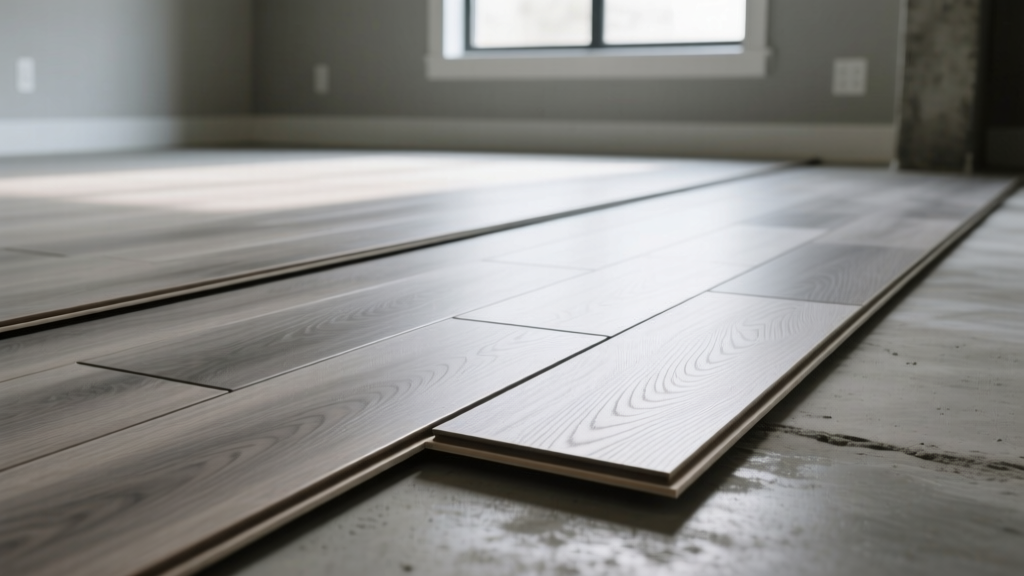
Stone Polymer Composite (SPC) and Wood Polymer Composite (WPC) luxury vinyl planks are the undisputed champions of budget basement flooring. Both feature a 100% waterproof core, but their physical properties differ significantly.
- SPC (Stone Polymer Composite): Made from limestone dust and PVC stabilizers. It is incredibly dense, dent-resistant, and generally the cheapest option ($1.80–$2.80/sq. ft.). However, its density makes it cold underfoot and prone to transmitting sound, which can make a basement feel cavernous.
- WPC (Wood Polymer Composite): Contains a foaming agent that expands the core, creating microscopic air pockets. This makes WPC warmer, quieter, and more forgiving over minor concrete imperfections. It costs slightly more ($2.50–$3.80/sq. ft.) but saves money on acoustic underlayments.
Critical Spec: Ensure the planks have a minimum 20-mil wear layer for residential durability. If the planks do not have an attached cork or IXPE underlayment pad, you must lay down a 6-mil polyethylene vapor barrier beneath the floating floor to prevent mold growth between the plank and the slab.
2. Fiberglass-Backed Sheet Vinyl
Sheet vinyl has evolved past the cheap, easily torn rolls of the 1990s. Modern fiberglass-backed sheet vinyl (such as Tarkett's ProGen lines) is dimensionally stable, resists mold, and can often be loose-laid or installed with a pressure-sensitive adhesive rather than permanent mastic. At $1.50 to $2.50 per square foot, it is one of the most cost-effective ways to waterproof a large basement area seamlessly.
3. Interlocking PVC Garage/Basement Tiles
For utility spaces, workshops, or home gyms, interlocking PVC tiles (often marketed as garage flooring) are an exceptional cheap flooring option for basement concrete. These tiles snap together without adhesive and sit slightly elevated off the slab due to their grid-like understructure. This air gap allows ambient moisture to evaporate laterally rather than trapping it against the concrete. Pricing ranges from $2.00 to $3.50 per square foot, and installation requires only a utility knife and a rubber mallet.
The "Cheap" Traps: Materials That Will Destroy Your Budget
When searching for cheap flooring options for basement slabs, homeowners frequently fall for materials that have low upfront costs but catastrophic failure rates below grade. Avoid these entirely:
- Laminate Flooring: Laminate features an MDF (Medium-Density Fiberboard) core. MDF acts like a sponge. Even "water-resistant" laminates will swell, buckle, and turn to mush when exposed to the alkaline moisture vapor emitted by concrete.
- Carpet and Traditional Padding: The University of Minnesota Extension explicitly advises against installing wall-to-wall carpet directly on basement slabs. Carpet traps organic dust and moisture, creating an ideal incubator for toxic mold spores.
- Peel-and-Stick Vinyl Tiles: Concrete is highly alkaline (pH 9-11). As moisture pushes through the slab, it carries alkali salts to the surface (efflorescence). This chemical reaction breaks down the pressure-sensitive adhesive on peel-and-stick tiles, causing them to unstick and curl within months.
Mandatory Subfloor Prep: The $1.20/Sq Ft Insurance Policy
Even when installing a floating, 100% waterproof floor like SPC vinyl, treating the concrete slab is non-negotiable if you want to prevent musty basement odors and protect your baseboards.
- Diamond Grinding or Acid Etching: Remove existing sealers, paint, or efflorescence to open the concrete pores. A rental walk-behind diamond grinder costs roughly $80/day.
- Apply a Penetrating Silicate Sealer: Products like RadonSeal or Lithi-Tek 4500 (approx. $1.20/sq. ft.) penetrate up to 4 inches into the slab. The silicate reacts with the free lime in the concrete to form calcium silicate hydrate, permanently plugging the capillaries and blocking both moisture vapor and radon gas.
- Perimeter Gap Management: When installing floating floors, always leave a 1/4-inch expansion gap around the perimeter. Do not fill this gap with caulk; use a compressible backer rod and cover it with baseboards to allow the floor to expand and contract with basement temperature fluctuations.
Sourcing Hacks for Maximum Savings
To keep your basement flooring project strictly within budget, bypass big-box retail showrooms. Instead, seek out "contractor packs" or "builder grade" SPC vinyl from dedicated flooring liquidators or warehouse stores like Floor & Decor. Look specifically for discontinued colorways of premium rigid core lines; manufacturers frequently discontinue gray or white oak patterns to introduce new trends, liquidating the remaining pallets at 40% to 60% below MSRP. Because SPC is completely synthetic, buying a discontinued line carries no risk of UV fading or off-gassing associated with aged organic materials.
Frequently Asked Questions
Can I install cheap flooring over existing basement paint or sealers?
No. Paint and topical acrylic sealers will peel under the friction and weight of a floating floor, or prevent adhesives from bonding to sheet vinyl. You must mechanically grind the slab down to bare, porous concrete before applying a penetrating silicate sealer or laying down any flooring material.
Do I need a vapor barrier under rigid core vinyl?
If your chosen SPC or WPC vinyl plank does not have a pre-attached underlayment pad, a 6-mil polyethylene vapor barrier is mandatory. Overlap the seams by 8 inches and tape them with moisture-resistant sheathing tape to create a continuous, monolithic barrier against vapor emission.
Written by
Marcus ChenMarcus Chen is a licensed structural engineer (PE) and building materials analyst with over 12 years of experience across residential, commercial, and industrial construction. He holds a Master of Science in Civil Engineering from UC Berkeley and spent six years at Thornton Tomasetti before transitioning to independent consulting and technical writing. Marcus specializes in material selection for seismic-prone regions, concrete reinforcement strategies, and lifecycle cost analysis. His work has been cited by the American Concrete Institute (ACI) and the Structural Engineers Association of California (SEAOC). When he is not on a job site or at his desk, you will find him hiking the Sierra Nevada or restoring a 1920s craftsman bungalow in Oakland, CA.
More from Marcus Chen
View all
Construction Cost
How Much Did the Eiffel Tower Cost to Build?
How much did the Eiffel Tower cost to build in 1889? We adjust for inflation and compare its budget to modern skyscraper construction.
Aug 4, 2026

Fire Resistance
What Is a Fire Resistant Material? Testing & Certification Guide
Discover what is a fire resistant material through ASTM and UL testing. Learn how fire ratings, certifications, and assemblies work in construction.
Aug 4, 2026

Construction Cost
How Much Did the Burj Khalifa Cost to Build?
How much did the Burj Khalifa cost to build? We break down the $1.5B project and extract 5 money-saving strategies for your next build.
Jul 30, 2026