Best Floor Leveler Brands and Product Lines for 2026
Compare top floor leveler brands like Ardex, Mapei, and Custom. Explore product specs, pricing, pot life, and pro installation tips for flawless floors.
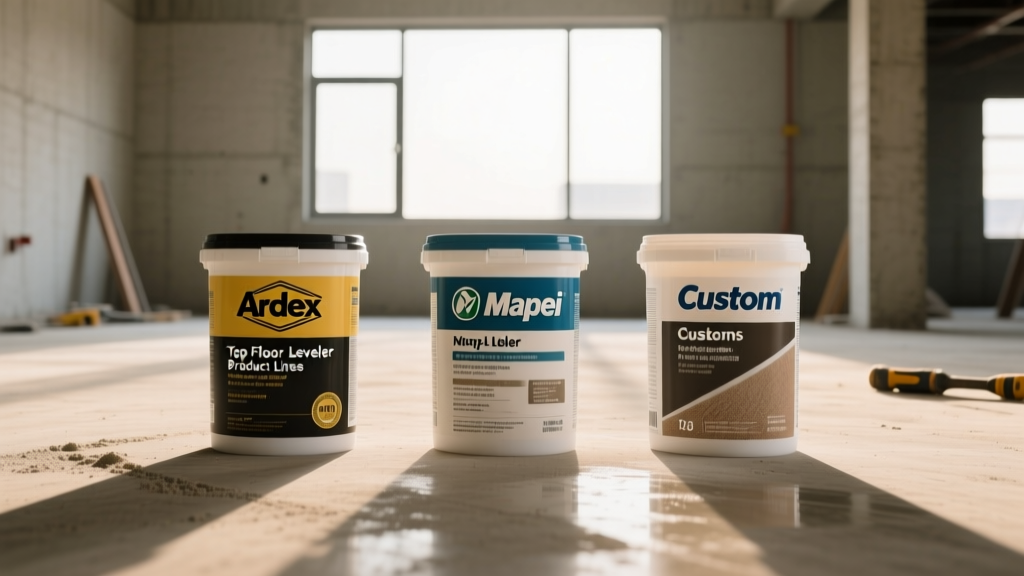
The Chemistry and Mechanics of Modern Self-Leveling Underlayments
Choosing the right floor leveler is not merely about picking a brand; it is about understanding the chemical composition of the bag. Self-leveling underlayments (SLUs) are broadly categorized by their cementitious binder: Portland cement or Calcium Aluminate cement. While Portland-based levelers are cheaper, they are prone to higher shrinkage and slower cure times. Calcium Aluminate-based SLUs, which dominate the premium professional market, offer rapid hydration, minimal shrinkage, and high early compressive strength, allowing for floor covering installation in as little as 24 hours.
According to guidelines from the National Tile Contractors Association (NTCA), substrate preparation and moisture mitigation are just as critical as the SLU selection itself. A flawless pour requires a deep understanding of product-specific water ratios, primer dilution, and ambient temperature controls.
Brand Deep-Dive: Ardex (The Premium Professional Standard)
Ardex Americas remains the undisputed heavyweight in the commercial and high-end residential flooring sector. Their formulations are heavily engineered for predictability, which is why large-scale flooring contractors default to them despite the higher price point.
Spotlight: Ardex K 15 Self-Leveling Underlayment
Ardex K 15 is a calcium aluminate-based SLU designed to be poured from a featheredge up to 1 inch thick in a single lift. It boasts an impressive compressive strength of 6,100 psi at 28 days, making it suitable for heavy rolling loads and commercial traffic.
- Water Ratio: Exactly 5.5 quarts per 50 lb bag. Over-watering will cause aggregate separation and destroy the structural integrity.
- Flow Life (Pot Life): 10 minutes at 70°F. This requires a highly coordinated mixing and pouring crew.
- Walkable Time: 2 to 3 hours.
- Primer Requirement: Ardex P 51. Must be diluted 1:1 with water for standard concrete, or 1:3 for highly porous substrates. Skipping the primer will result in catastrophic outgassing and pinholing.
- Estimated Cost: $48 - $55 per 50 lb bag (2026 pricing).
Brand Deep-Dive: Mapei (The High-Flow Commercial Workhorse)
Mapei bridges the gap between high-performance commercial specifications and accessible distribution. Their product lines are frequently specified by architects for healthcare and educational facilities due to their strict VOC compliance and exceptional flow characteristics.
Spotlight: Mapei Novoplan 71
Novoplan 71 is a premium, calcium aluminate-fortified Portland cement blend. It is engineered for interior use and can be poured from 1/8 inch up to 1 inch thick. It flows exceptionally well, often requiring less physical rake work than competing brands.
- Water Ratio: 4.75 to 5.25 quarts per 50 lb bag.
- Flow Life: 15 minutes, offering a slightly more forgiving window for smaller crews.
- Compressive Strength: 6,000 psi at 28 days.
- Primer Requirement: Mapei Primer T. Applied undiluted or diluted depending on substrate porosity.
- Estimated Cost: $42 - $48 per 50 lb bag.
Brand Deep-Dive: Custom Building Products (The Big-Box Accessible Choice)
Custom Building Products (CBP) dominates the big-box retail space. While their products are accessible to DIYers and small remodeling contractors, they require strict adherence to instructions to achieve professional results.
Spotlight: Custom LevelQuik RS (Rapid Setting)
LevelQuik RS is a Portland-cement based SLU. It is more forgiving regarding water ratios but sacrifices some ultimate compressive strength and long-term dimensional stability compared to calcium aluminate alternatives.
- Water Ratio: 5.5 to 6 quarts per 50 lb bag. The wider tolerance makes it easier for DIYers using standard measuring jugs.
- Flow Life: 10 to 15 minutes.
- Compressive Strength: 4,300 psi at 28 days (adequate for residential tile and LVP, but not heavy commercial).
- Primer Requirement: CustomBond Acrylic Multipurpose Primer.
- Estimated Cost: $35 - $40 per 50 lb bag.
Head-to-Head Product Comparison Matrix
| Brand / Model | Cement Base | 28-Day PSI | Flow Life | Max Thickness | Est. Cost/Bag |
|---|---|---|---|---|---|
| Ardex K 15 | Calcium Aluminate | 6,100 | 10 mins | 1 inch | $48 - $55 |
| Mapei Novoplan 71 | CA-Fortified Portland | 6,000 | 15 mins | 1 inch | $42 - $48 |
| Custom LevelQuik RS | Portland | 4,300 | 10-15 mins | 1.5 inches | $35 - $40 |
Mixing Protocols and Essential Tooling
The most common point of failure in SLU installation occurs in the mixing bucket. Hand mixing or using an underpowered drill will leave dry clumps that harden into ridges under your final floor covering.
- The Drill: Use a heavy-duty, low-speed/high-torque drill (minimum 650 RPM, ideally 1200 RPM for larger batches). Standard high-speed hammer drills will whip air into the mixture, weakening the cure and causing surface blistering.
- The Paddle: Use a helix-style mixing paddle designed specifically for mortars and SLUs. Avoid paint mixers, which do not generate the necessary shear force to fully hydrate the polymers.
- Water Temperature: Use cold water (approx. 65°F). Warm water accelerates the chemical reaction, cutting your flow life in half and causing 'flash setting' where the leveler seizes before it can be smoothed.
- Spreading Tools: A gauge rake set to the exact depth of your pour, followed immediately by a smoothing blade (such as a QEP or Roboz flat blade) to pop surface tension and merge the pours seamlessly.
Before pouring any SLU, test the concrete slab for moisture vapor emission using in-situ relative humidity probes per ASTM F2170 standards. If RH levels exceed 85%, standard primers will fail. You must apply a dedicated moisture mitigation system (like Mapei Primer TMB or Ardex MC) before the leveling primer, or the SLU will eventually delaminate from hydrostatic pressure.
Critical Failure Modes and Troubleshooting
1. Pinholing and Outgassing
The Symptom: Hundreds of tiny craters appear on the surface of the cured leveler.
The Cause: Air escaping from a porous concrete slab pushes through the liquid SLU. This happens when the primer is skipped, under-applied, or improperly diluted.
The Fix: Always apply the manufacturer-specified primer. For highly porous or broom-finished concrete, two coats of primer are mandatory. The first coat seals the deep pores; the second coat creates the film necessary for the SLU to flow.
2. Delamination and Hollow Spots
The Symptom: The leveler sounds hollow when tapped and cracks under foot traffic.
The Cause: The substrate was contaminated with dust, drywall mud, paint overspray, or old adhesive residue. SLU will bond to the dust, not the concrete.
The Fix: Mechanical preparation is non-negotiable. Diamond grinding or shotblasting the slab to expose clean, open pores is required before vacuuming and priming.
3. Ridge Lines and Poor Flow
The Symptom: Visible overlap lines where buckets were poured, resulting in an uneven surface.
The Cause: The crew exceeded the 'wet edge' time limit. If bucket B is not poured into bucket A's wet edge within 5 to 10 minutes, a cold joint forms.
The Fix: For large rooms, use a continuous mixing pump (like a Turbosol) that meters water and SLU automatically, ensuring an unbroken wet edge. If hand-mixing, use a barrel pump and have at least three people dedicated solely to mixing and hauling buckets.
Sourcing and Final Pro Tips
For residential remodelers and DIYers, Custom Building Products' LevelQuik RS is readily available at major home improvement centers and provides adequate strength for luxury vinyl plank (LVP) and residential tile. However, for commercial projects, radiant heat encapsulation, or heavy natural stone installations, sourcing Ardex K 15 or Mapei Novoplan 71 through specialized flooring distributors is mandatory. Always buy 10% more material than your square footage dictates; running out of SLU mid-pour is a catastrophic error that usually requires grinding the entire floor down and starting over.