Best Floor Options for House: A Room-by-Room Guide
Discover the best floor options for house interiors. Compare hardwood, tile, LVP, and carpet costs, durability, and ideal rooms in our expert guide.

The Core Framework: Moisture, Traffic, and Subfloor
Selecting the right flooring requires moving beyond aesthetics to evaluate three structural variables: moisture exposure, dynamic traffic loads, and subfloor compatibility. A material that performs flawlessly in a climate-controlled living room will catastrophically fail in a below-grade basement. This guide breaks down the best floor options for house interiors by specific room environments, providing exact material specifications, installation thresholds, and cost parameters.
Kitchen & Dining: High Traffic and Spill Zones
Kitchens demand surfaces that withstand heavy static loads (appliances, islands), high dynamic traffic, and frequent liquid exposure. The two premier choices here are Rigid Core Luxury Vinyl Plank (LVP) and Porcelain Tile.
Stone Plastic Composite (SPC) LVP
For kitchens, specify SPC LVP over WPC (Wood Plastic Composite). SPC features a dense limestone-polyvinyl chloride core that resists denting from heavy refrigerator legs and kitchen islands. WPC contains a foaming agent that makes it softer underfoot but highly susceptible to permanent indentation under static point loads.
Porcelain Tile
Porcelain offers near-zero water absorption (less than 0.5% per ASTM C373). For kitchens, select rectified porcelain tiles. Rectified edges are mechanically ground to exact dimensions, allowing for narrow 1/16-inch grout lines that minimize dirt accumulation and maintenance.
- Material Cost: $4.00 – $8.00 per sq. ft. (Porcelain); $3.50 – $7.00 per sq. ft. (SPC LVP)
- Installation Cost: $8.00 – $15.00 per sq. ft. (Tile); $2.00 – $4.00 per sq. ft. (LVP)
- PEI Rating: Minimum Class 4 for heavy residential kitchen traffic.
Living Areas & Hallways: Continuity and Comfort
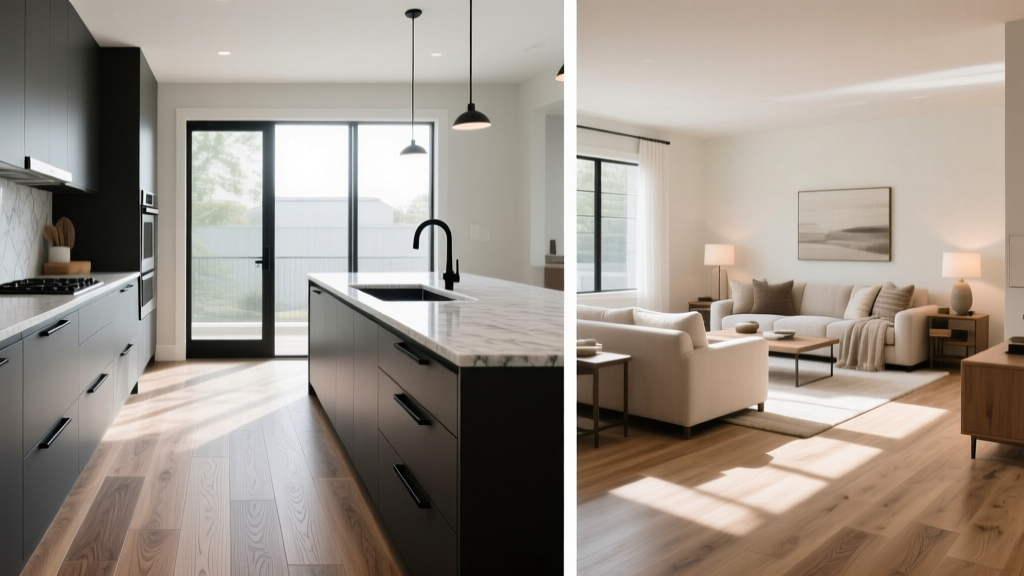
Main living spaces prioritize underfoot warmth, acoustic dampening, and visual continuity. Engineered hardwood remains the gold standard, offering the authenticity of solid wood with superior dimensional stability.
Engineered Hardwood Specifications
Unlike solid hardwood, which expands and contracts significantly across the grain with seasonal humidity shifts, engineered hardwood utilizes a cross-plywood core that restricts lateral movement. When evaluating engineered floor options for house living areas, the critical metric is the veneer wear layer thickness.
According to the National Wood Flooring Association (NWFA), engineered wood must be acclimated to the home's interior environment (typically 60-80°F and 30-50% relative humidity) for at least 48 to 72 hours prior to installation to prevent post-installation gapping or cupping.
Bathrooms & Laundry: Extreme Moisture Defense
Full bathrooms and laundry rooms are wet environments where standing water and high ambient humidity are daily occurrences. Solid hardwood and laminate are strictly prohibited here. The only viable options are ceramic/porcelain tile and specialized sheet vinyl.
Slip Resistance and Waterproofing
When selecting tile for wet rooms, aesthetics must be secondary to safety. The Tile Council of North America (TCNA) enforces the ANSI A137.1 standard, which requires a minimum Dynamic Coefficient of Friction (DCOF) of 0.42 for level interior spaces expected to be walked on when wet. Always request the manufacturer's DCOF AcuTest data sheet before purchasing bathroom tile.
Furthermore, tile and grout are water-resistant, not waterproof. To protect the subfloor from moisture migration, install an uncoupling and waterproofing membrane, such as Schluter-Ditra or LATICRETE Hydro Ban, over the subfloor before applying thin-set mortar. This membrane absorbs lateral subfloor movement, preventing cracked grout lines and loose tiles.
Bedrooms: Acoustics and Underfoot Warmth
Bedrooms require materials that mitigate impact noise and provide thermal comfort. While hardwood and LVP are popular for their cleanliness, they reflect sound, creating echo chambers in large bedrooms.
Cork Flooring and Broadloom Carpet
Cork is a highly underrated bedroom flooring option. Its cellular structure contains millions of air-filled pockets, providing natural thermal insulation and exceptional acoustic dampening. Look for floating cork planks with a minimum density of 28 lbs/ft³ to resist furniture indentation.
If choosing broadloom carpet, evaluate the face weight (the ounces of fiber per square yard). For a master bedroom, specify a minimum face weight of 40 to 50 ounces. Pair it with a high-density rebond or memory foam pad (minimum 8-pound density, 7/16-inch thick) to maximize lifespan and underfoot comfort.
Basements: Below-Grade Moisture Management
Basements present the most hostile environment for flooring due to hydrostatic pressure and concrete slab moisture vapor emission. Even if a basement appears dry, concrete is highly porous and continuously wicks moisture from the surrounding soil.
Moisture Testing and Subfloor Systems
Before installing any adhesive-bound flooring over a basement slab, conduct an in-situ Relative Humidity (RH) probe test per ASTM F2170. Most flooring adhesives and warranties void if the slab RH exceeds 75% to 80%. If moisture levels are high, you must utilize a dimpled polyethylene subfloor system (like Delta-FL or Platon). These systems create an air gap that allows moisture to equalize without damaging the finished floor, while also raising the floor temperature by breaking the thermal bridge to the cold concrete.
The safest floor options for house basements are floating SPC LVP or polished/sealed concrete. Avoid glue-down carpet tiles or solid hardwood entirely.
Master Comparison Matrix: Floor Options for House
Use this decision matrix to align your material choice with the specific demands of each room.
| Material | Ideal Rooms | Moisture Tolerance | Expected Lifespan | Avg. Installed Cost |
|---|---|---|---|---|
| SPC Luxury Vinyl | Kitchen, Bath, Basement | 100% Waterproof | 15 - 25 Years | $6 - $11 / sq.ft. |
| Engineered Hardwood | Living, Bedroom, Dining | Low (Spills only) | 40 - 80+ Years | $12 - $22 / sq.ft. |
| Porcelain Tile | Kitchen, Bath, Laundry | Impervious | 50+ Years | $14 - $25 / sq.ft. |
| Broadloom Carpet | Bedrooms, Stairs | Very Poor | 8 - 15 Years | $5 - $12 / sq.ft. |
| Cork (Floating) | Bedrooms, Home Office | Moderate | 20 - 30 Years | $8 - $14 / sq.ft. |
Final Installation Note
The longevity of any flooring material is dictated by subfloor preparation. Whether installing LVP or tile, ensure wood subfloors meet a flatness tolerance of 3/16-inch over a 10-foot radius. Self-leveling compounds and floor patching are non-negotiable prerequisites to prevent joint failure, hollow spots, and premature wear layer degradation.
Written by
Elena RodriguezElena Rodriguez is a civil engineer and technical writer specializing in concrete technology, masonry systems, and ASTM/ACI compliance. She earned her B.S. in Civil Engineering from Texas A&M University and spent a decade at a materials testing laboratory, performing over 2,000 concrete compressive strength tests and masonry prism evaluations. Elena is an ACI-certified Field Testing Technician (Grade I) and a member of ASTM Committee C12 on Natural Building Stone. She currently consults on forensic engineering cases involving concrete failures and moisture intrusion. Based in San Antonio, TX, Elena is a proud member of the Society of Women Engineers (SWE) and coaches her daughter's FIRST Robotics team.
More from Elena Rodriguez
View all
Walls & Panels
Cost Analysis: Light Gauge Steel Framing Advantages and Disadvantages
Evaluate light gauge steel framing advantages and disadvantages through a strict cost analysis lens, comparing material, labor, and lifecycle expenses.
Aug 4, 2026

Walls & Panels
Gypsum Board Types: Exact Specifications, Thickness & Dimensions
Compare standard, Type X, and moisture-resistant gypsum board types. Get exact specifications, thicknesses, dimensions, and ASTM standards for your project.
Aug 4, 2026

Fire Resistance
Best Fire-Resistant Outdoor Decking Materials: 2026 Buyer Guide
Discover the best fire-resistant outdoor decking materials for 2026. Compare Class A PVC, aluminum, and hardwood options for WUI compliance and safety.
Aug 4, 2026