Floor Cord Covers: Load Ratings & Trip-Hazard Specs
Technical specifications for floor cord covers, including ADA compliance, load-bearing axle limits, slip resistance, and material fire ratings.
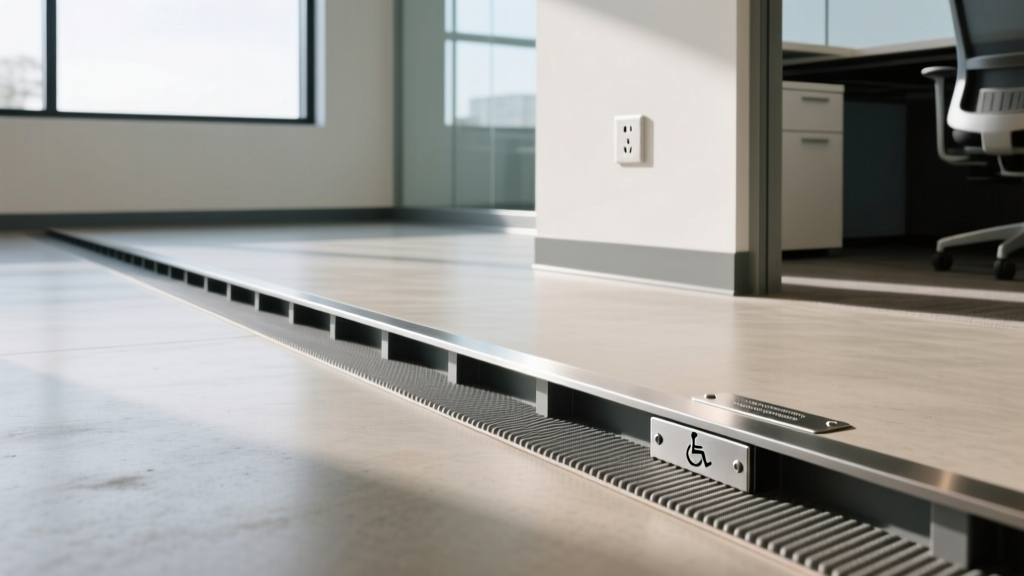
Load-Bearing Classifications and Axle Limits
Selecting the correct floor cord cover requires matching the product's structural yield point to the specific dynamic loads of the environment. A cover rated for pedestrian traffic will catastrophically fail under the point-load of a forklift, exposing the cables inside and creating a severe safety hazard. Manufacturers classify cable protectors based on per-axle weight limits rather than total vehicle weight, as the concentrated force of a single axle dictates the material's compressive stress.
| Load Class | Max Axle Load | Typical Material | Use Case | Avg Cost / Linear Ft |
|---|---|---|---|---|
| Light Duty | 2,000 lbs | Flexible PVC | Office walkways, home theaters | $2.50 - $4.00 |
| Medium Duty | 5,000 lbs | Rigid PVC / TPU | Retail spaces, light carts | $5.00 - $8.00 |
| Heavy Duty | 18,000 lbs | Polyurethane (PU) | Warehouses, standard forklifts | $10.00 - $15.00 |
| Extra-Heavy | 24,000+ lbs | Cast Aluminum / Steel | Construction sites, heavy machinery | $25.00 - $45.00 |
When calculating load requirements for industrial settings, always factor in the dynamic impact multiplier. A 10,000 lb forklift traveling at 5 mph generates an impact force up to 1.5 times its static weight upon hitting a ramp transition. For these environments, specify polyurethane covers with a Shore D hardness of 65 or higher to prevent permanent deformation.
ADA Compliance and Trip-Hazard Geometry
In public-facing commercial spaces, floor cord covers must comply with the Americans with Disabilities Act (ADA) regarding changes in level. Non-compliant covers expose facility managers to severe liability and create impassable barriers for wheelchairs and mobility devices. According to the 2010 ADA Standards for Accessible Design, specific geometric thresholds must be met for any floor transition.
- Maximum Vertical Rise: Changes in level up to 1/4 inch (6.4 mm) can be vertical.
- Beveled Transitions: Changes in level between 1/4 inch and 1/2 inch (13 mm) must be beveled with a slope no greater than 1:2 (rise:run).
- Maximum Height: Any change in level exceeding 1/2 inch requires a ramp with a maximum slope of 1:12. Most standard 5-channel cord covers exceed this height and technically require ADA-compliant ramp transitions at their ends, not just beveled edges.
Furthermore, OSHA Standard 1910.22 mandates that walking-working surfaces be kept free of hazards, specifically targeting trip hazards created by temporary cabling. For office environments, specify low-profile, 1-channel or 2-channel covers with a maximum peak height of 0.4 inches and integrated 1:2 beveled edges to satisfy both OSHA and ADA requirements simultaneously.
Material Polymers and Fire Ratings
The polymer composition of a floor cord cover dictates its UV stability, chemical resistance, and flammability. While inexpensive covers utilize plasticized PVC, high-performance environments require specialized compounds.
PVC vs. Polyurethane vs. Aluminum
- Plasticized PVC: Offers a Shore A hardness of 80-90. Highly susceptible to plasticizer migration, which causes the cover to become brittle and crack after 12-18 months of UV exposure. Not recommended for outdoor or semi-outdoor use.
- Thermoplastic Polyurethane (TPU): Features superior abrasion resistance (DIN 53516 volume loss < 30mm³) and retains flexibility down to -40°F. Ideal for cold-storage facilities and outdoor events.
- Cast Aluminum: Used for extreme point-loads. Often features a drop-in hinge mechanism rather than an integrated polymer hinge, allowing for infinite cycle-life without hinge tearing.
Flammability Standards
For indoor commercial and data center applications, cord covers must meet specific flame-spread ratings. Specify covers that carry a UL 94 V-0 flammability rating. This certification ensures that if the material is exposed to an open flame, it will self-extinguish within 10 seconds and will not produce flaming drips that could ignite the cables housed inside or the flooring substrate below.
Slip Resistance and Traction Coefficients
The surface texture of a cord cover is critical for preventing slip-and-fall incidents, particularly in areas prone to moisture. Slip resistance is measured using the Static Coefficient of Friction (SCOF) or Dynamic Coefficient of Friction (DCOF). For commercial flooring transitions, the cover's top surface must achieve a DCOF of 0.42 or higher when tested via the ANSI A326.3 standard.
To achieve this, heavy-duty covers utilize molded-in diamond-plate or chevron tread patterns. However, in wet environments, smooth polymer surfaces become hydroplaning hazards. For food processing plants or outdoor event venues, specify covers with embedded aluminum oxide grit strips or deep water-channeling grooves that maintain a DCOF above 0.50 even when submerged in 1/8 inch of water.
Common Failure Modes and Edge Cases
Even highly rated floor cord covers fail when deployed outside their engineered parameters. Understanding these failure modes allows facility managers to implement preventative procurement strategies.
- Hinge Fatigue and Tearing: Integrated polymer hinges on 5-channel covers typically fail after 5,000 to 10,000 open/close cycles. In high-maintenance areas where cables are frequently swapped, specify covers with drop-in modular channels or metal piano hinges rather than flexible polymer webbing.
- Adhesive Delamination: Double-sided tape fails on dusty concrete or low-pile carpet. For permanent installations on VCT (Vinyl Composition Tile) or sealed concrete, use pressure-sensitive acrylic adhesives rated for 40 lbs of shear force per linear inch. For carpet, use hook-and-loop (Velcro) backing with a minimum 1-inch width per channel.
- Thermal Expansion Warping: Long continuous runs of PVC covers in sunlit atriums can expand up to 1/4 inch per 10 feet when temperatures rise from 65°F to 100°F. If runs exceed 15 feet, install expansion gaps of 1/8 inch between sections to prevent the cover from bowing upward and creating a trip hazard.
- Cable Compression Damage: Overstuffing a 1-inch channel with three 0.4-inch cables prevents the lid from latching securely. The lid will pop open under foot traffic. Always calculate the total cross-sectional area of the cables; the combined cable diameter should not exceed 85% of the channel's internal width.
Ingress Protection (IP) for Outdoor and Event Use
When routing power and data to outdoor stages, trade show floors, or temporary construction sites, the cord cover must protect the internal conductors from moisture and dust ingress. Standard indoor covers offer no IP rating. For outdoor deployments, specify covers rated at IP65 (dust-tight and protected against water jets) or IP68 (submersible). IP68-rated covers utilize integrated silicone gasket seals along the lid mating surface and require threaded brass locking bolts rather than snap-fit latches to maintain compression on the gasket.
Procurement Decision Matrix
Use the following matrix to align your specific environmental variables with the correct technical specifications.
| Environment | Required Load Class | Mandatory Material Spec | Fastening Method | Required ADA Feature |
|---|---|---|---|---|
| Corporate Office (Carpet) | Light (2k lbs) | Flexible PVC (UL 94 V-0) | Hook-and-Loop backing | Max 0.4" height, 1:2 bevel |
| Retail Store (VCT Tile) | Medium (5k lbs) | Rigid TPU | Acrylic pressure-sensitive tape | Low-profile 2-channel design |
| Warehouse Aisle (Concrete) | Heavy (18k lbs) | Polyurethane (Shore D 65) | Mechanical anchor bolts | Ramp transitions at ends |
| Outdoor Festival (Asphalt) | Medium (5k lbs) | UV-Stable TPU (IP65 rated) | Steel masonry nails / sandbags | High-vis yellow/black contrast |
| Heavy Construction (Dirt/Gravel) | Extra-Heavy (24k+ lbs) | Cast Aluminum with steel hinges | Rebar stakes through flange holes | N/A (Hardhat zone only) |
By strictly adhering to these performance ratings, load classifications, and geometric specifications, facility and project managers can eliminate trip hazards, protect critical infrastructure cabling, and ensure full regulatory compliance across any walking-working surface.