Timeless Flooring Options: Hardwood vs. Natural Stone vs. Tile
Compare timeless flooring options including solid white oak, natural stone, and porcelain tile. Analyze 2026 costs, subfloor needs, and lifecycle ROI.

The Anatomy of "Timeless" in Flooring
When evaluating flooring for a permanent residence or a high-end build, the term "timeless" is often misused as a synonym for "neutral." In architectural and construction terms, a truly timeless floor must satisfy two rigorous criteria: aesthetic permanence (resisting micro-trends that date a home within five years) and physical longevity (surviving 50+ years of foot traffic without requiring full replacement). As of 2026, luxury vinyl plank (LVP) and engineered laminates dominate the budget and mid-tier markets, but they fail the 50-year physical longevity test due to irreversible wear-layer degradation and UV fading.
Material Deep-Dive: The Big Three
1. Solid Hardwood (Specifically White Oak)
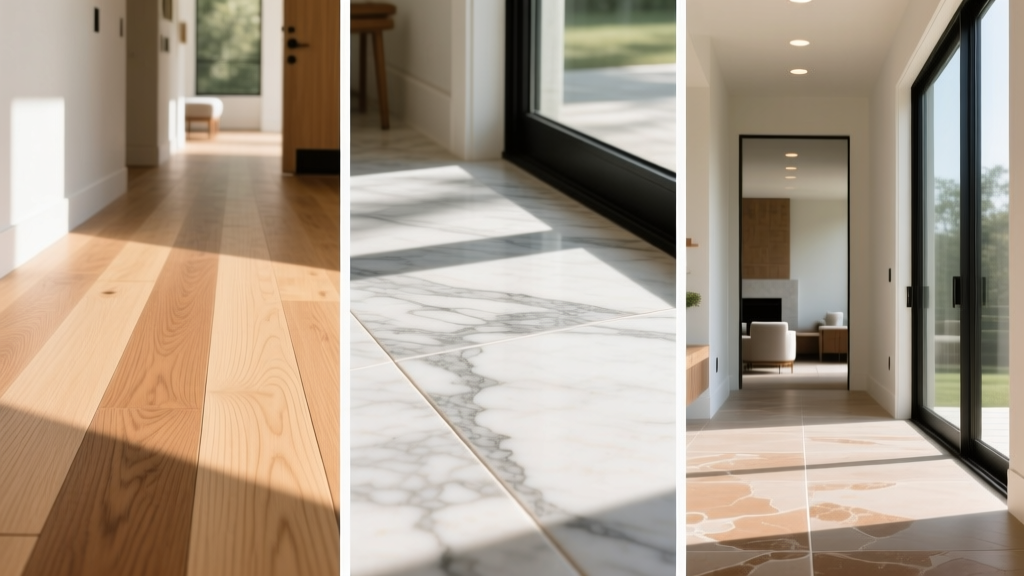
While exotic woods and high-gloss finishes cycle in and out of favor, plainsawn or quartersawn solid white oak remains the undisputed baseline for timeless residential flooring. The critical specification for a legacy hardwood floor is dimension: 3/4-inch thickness with a 5-inch to 7-inch width. Wider planks (over 7 inches) are prone to severe seasonal cupping unless meticulously acclimated and glued alongside being nailed.
Cost & Specs: Expect to pay between $11.00 and $16.00 per square foot installed in 2026 for site-finished 5-inch solid white oak. The Janka hardness rating of 1360 lbf provides an optimal balance between dent resistance and workability.
Failure Modes & Edge Cases: The most common failure in modern hardwood installation is the use of oil-based polyurethanes, which amber heavily over time, shifting the wood's hue toward orange. To maintain a timeless, raw-wood aesthetic, specify a two-component waterborne finish like Bona Traffic HD. This commercial-grade finish costs roughly 30% more than standard polyurethanes but resists yellowing and requires fewer recoats over a 15-year cycle. According to the National Wood Flooring Association (NWFA), maintaining interior humidity between 35% and 55% is mandatory to prevent gapping in solid 3/4-inch planks.
2. Natural Stone (Honed Marble & Slate)
Polished marble is highly susceptible to etching from acidic spills (citrus, wine, vinegar), which permanently dulls the surface. Therefore, the genuinely timeless application of marble in high-traffic zones is a honed finish. Honed Carrara or Calacatta marble masks minor scratches and etches, allowing the stone to develop a desirable, antique patina over decades, much like historic European estates. Alternatively, cleft-finished natural slate offers extreme durability and hides dirt exceptionally well, though it requires a highly specific subfloor.
Cost & Specs: Honed 12x12 or 18x18 marble tile ranges from $18.00 to $32.00 per square foot installed. Slate typically falls between $14.00 and $24.00 per square foot.
Failure Modes & Edge Cases: Stone is unforgiving of structural movement. If installed over a floor joist system that deflects under load, the stone will crack before the grout fails. Furthermore, stone requires an impregnating sealer (such as Tenax Ager or Miracle Sealants 511 Impregnator) applied annually or bi-annually to prevent oil and water staining.
3. Unglazed Through-Body Porcelain
Glazed porcelain tiles feature a printed design layer covered by a glass-like coating. If a heavy cast-iron pot chips the surface, the contrasting clay body underneath is exposed, ruining the illusion. Unglazed, through-body (or double-loaded) porcelain features the same color and pattern throughout the entire thickness of the tile. A chip on a through-body tile is virtually invisible. Classic formats, such as unglazed hex mosaics or large-format stone-look porcelain, transcend era-specific design trends.
Cost & Specs: High-quality through-body porcelain costs $10.00 to $18.00 per square foot installed. Look for a PEI (Porcelain Enamel Institute) rating of IV or V, indicating suitability for heavy commercial traffic.
Failure Modes & Edge Cases: The primary vulnerability of porcelain is not the tile, but the grout. Standard cementitious grout is porous and will stain, darkening over time and altering the floor's overall appearance. To maintain a timeless look, specify an epoxy or advanced urethane grout, such as Laticrete SpectraLOCK PRO, which is entirely stain-proof and color-fast, albeit more expensive and labor-intensive to install.
Head-to-Head Comparison Matrix
| Metric | Solid White Oak | Honed Natural Stone | Through-Body Porcelain |
|---|---|---|---|
| 2026 Installed Cost | $11 - $16 / sq ft | $18 - $32 / sq ft | $10 - $18 / sq ft |
| Durability Standard | 1360 Janka (Dent prone) | 3-5 Mohs (Scratch/Etch prone) | PEI IV/V (Near indestructible) |
| Subfloor Deflection | L/360 minimum | L/720 minimum | L/360 minimum |
| 50-Year Lifecycle | 3-4 Refinishes required | Annual sealing, zero replacement | Zero maintenance/replacement |
| Water Tolerance | Low (Cupping risk) | Moderate (Staining risk) | High (Impervious) |
Subfloor Realities: The Hidden Dealbreaker
A common mistake in luxury builds is selecting natural stone without verifying the floor joist framing. The Natural Stone Institute and the Tile Council of North America (TCNA) mandate strict deflection limits for hard-surface flooring. Deflection measures how much a floor bends under a 300-pound concentrated load.
- L/360 Standard (Hardwood & Ceramic/Porcelain): A floor spanning 15 feet (180 inches) can safely deflect up to 1/2 inch (180 / 360). This is standard for most modern residential framing (e.g., 2x10 joists spaced 16 inches on center).
- L/720 Standard (Natural Stone): Because stone has zero tensile flexibility, it requires a floor twice as stiff. That same 15-foot span can only deflect 1/4 inch (180 / 720). Achieving this often requires upgrading to engineered I-joists, reducing spacing to 12 inches on center, or adding a secondary layer of 3/4-inch plywood glued and screwed to the subfloor before installing an uncoupling membrane like Schluter-Ditra.
Expert Insight: If your architect specifies 2x10 dimensional lumber at 16" O.C. for a 14-foot span, do not install marble on the second floor without reinforcing the joists. The stone will crack along the grout lines or through the tile body within the first three years of live-load settling.
Long-Term Maintenance & Refinishing Cycles
"Timeless does not mean maintenance-free. It means the maintenance restores the material to its original glory rather than simply delaying its replacement."
Understanding the 50-year maintenance timeline is crucial for calculating the true cost of ownership.
- Years 1-10: Hardwood requires only routine cleaning and occasional screening/recoating of the polyurethane top layer. Stone requires annual impregnation. Porcelain requires only standard mopping.
- Years 10-15: Solid hardwood will likely require its first full sand-and-refinish. A 3/4-inch plank has approximately 5/16-inch of wear layer above the tongue-and-groove, allowing for 4 to 5 full sandings over its lifespan. Stone grout may require professional extraction and color-sealing if cementitious grout was used.
- Years 20-30: Hardwood undergoes its second refinish. Stone and porcelain remain structurally intact, though stone may develop a noticeable, desirable patina in high-traffic corridors (the "desire path" effect).
Verdict: Decision Framework
Select your timeless flooring based on the specific environmental and structural constraints of your build, not just visual preference.
Choose Solid White Oak If:
Your home has standard L/360 framing, you prioritize acoustic warmth (wood absorbs sound better than stone/tile), and you are installing in living areas, bedrooms, or dining rooms where moisture is controlled. Avoid in full bathrooms or below-grade basements.
Choose Honed Natural Stone If:
You are building a ground-level entryway, a luxury primary bathroom, or a kitchen where you appreciate a living surface that patinas over time. Ensure your structural engineer signs off on L/720 deflection limits and budget for premium uncoupling membranes.
Choose Through-Body Porcelain If:
You demand zero long-term maintenance, require an impervious surface for wet rooms, mudrooms, or kitchens, or are installing over radiant floor heating systems (porcelain's thermal conductivity outperforms wood). Always pair with epoxy grout to ensure the installation outlasts the mortgage.
By prioritizing material integrity, structural prerequisites, and lifecycle maintenance over fleeting visual trends, you secure a floor that will anchor your home's architecture for generations.
Written by
Priya KapoorPriya Kapoor is a real estate market analyst and construction economics researcher with expertise in housing affordability, development feasibility, and infrastructure investment. She holds a Master of Regional Planning from Cornell University and previously worked as a senior analyst at CBRE's Investment Properties group, where she modeled returns for $4B in mixed-use development pipelines. Priya now runs an independent research practice advising developers, municipalities, and REITs on construction cost forecasting and market timing. She publishes the quarterly "BuildMat Market Pulse" report tracking material price indices across 12 commodity categories. Based in Austin, TX, Priya serves on the board of Habitat for Humanity Austin and is a marathon runner.
More from Priya Kapoor
View all
Construction Cost
Cost to Build a 1600 Sq Ft Home in 2026: Full Breakdown
Accurate 2026 cost to build a 1600 sq ft home—material, labor, and regional pricing breakdowns included. Plan your budget with real-time estimates.
Aug 11, 2026

Wood & Lumber
Name the Types of Wood for Pressure Treatment and Preservation
Learn how to name the types of wood best suited for pressure treatment. Compare species treatability, chemical retention levels, and 2026 preservation costs.
Aug 4, 2026

Stone & Masonry
Stone Veneer Suppliers Lindenhurst: 2026 Cost Analysis
Analyze 2026 stone veneer costs in Lindenhurst, NY. Compare local supplier pricing, delivery fees, and Suffolk County installation labor rates.
Aug 4, 2026