Specifying a Floor Mirror Green Finish: Glass Terrazzo & Epoxy Guide
Explore the material taxonomy for achieving a floor mirror green finish. Compare green glass terrazzo and epoxy systems, costs, and installation specs.
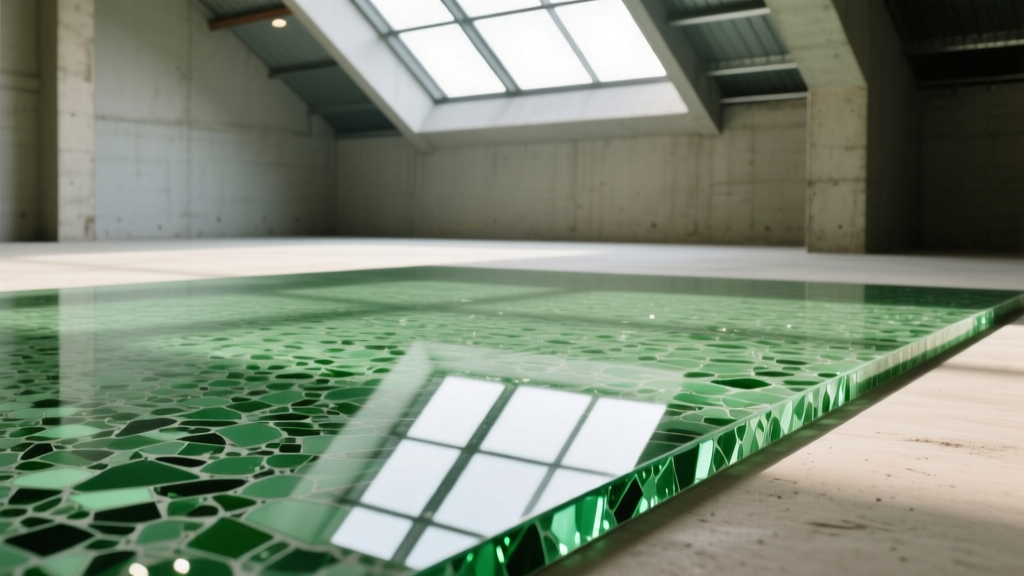
The Material Taxonomy of Reflective Green Glass Flooring
Achieving a true 'floor mirror green' aesthetic in commercial or high-end residential architecture requires moving beyond standard surface coatings. This specific design intent—a deep, translucent green matrix interlaced with highly reflective mirror shards—relies on a precise combination of tinted binders and recycled glass aggregates. In the flooring industry, this effect is classified under decorative seamless flooring and architectural terrazzo.
When specifying a floor mirror green finish, material selection hinges on the chemical compatibility between the binder and the mirror aggregate. The reflective backing on standard mirror glass is highly susceptible to chemical degradation, making the choice of matrix (epoxy vs. cementitious) the most critical decision in the project lifecycle. Below is a comprehensive taxonomy and selection framework for these systems.
Epoxy Matrix Systems: High-Gloss Green Mirror Floors
For interior environments requiring high chemical resistance and rapid installation, a 100% solids, two-part epoxy matrix is the industry standard for green mirror floors. Unlike water-based or solvent-based alternatives, 100% solids epoxies do not shrink during curing, ensuring the mirror chips remain fully suspended and level with the surface.
Pigmentation and Optical Clarity
To achieve the 'floor mirror green' look, the binder must be translucent enough to allow light to penetrate, hit the mirror chips, and reflect back through the green tint. Opaque pigments (like standard iron oxides) will block light and kill the reflectivity. Instead, specify transparent aniline dyes or specialized Phthalocyanine Green G liquid colorants. The typical loading rate is 2 to 4 ounces of transparent green dye per gallon of Part A epoxy resin. This maintains the low-VOC emissions profile required for modern indoor air quality standards while delivering a rich, emerald-toned depth.
Aggregate Specifications
Recycled mirror glass for epoxy systems is typically crushed and sieved to 1/8 inch or 1/4 inch sizes. Because epoxy has a neutral pH (around 7.0 once cured), it does not react with the silver or aluminum backing of the mirror glass. This allows contractors to use standard, unsealed recycled mirror aggregate, significantly reducing material costs compared to cementitious systems.
Cementitious Terrazzo: The Alkaline Challenge
Cementitious terrazzo offers a breathable, sustainable, and highly durable alternative to epoxy, often favored in large-scale civic or institutional projects. However, creating a floor mirror green finish with Portland cement introduces a severe chemical hazard to the mirror aggregate.
Standard Portland cement is highly alkaline, with a pore water pH between 12.5 and 13.5. The reflective backing on mirror glass is typically a thin layer of silver or aluminum protected by a basic paint coat. When embedded in raw cement, the high alkalinity eats through the protective backing and oxidizes the silver, turning the mirror chips black, cloudy, or completely opaque within 30 to 60 days.
The Pre-Sealed Aggregate Solution
To successfully execute a green mirror cementitious terrazzo floor, you must specify pre-sealed mirror glass. The aggregate supplier must coat the mirror chips in an acid- and alkali-resistant epoxy or polyurethane resin before shipping. Furthermore, the green tint in cementitious systems is achieved using synthetic iron oxide green pigments (loaded at 3% to 5% by weight of the cement). While iron oxides are more opaque than epoxy dyes, using a white Portland cement base combined with a lighter green oxide can preserve enough translucency to maintain the mirror effect.
Comparison Matrix: Epoxy vs. Cementitious Green Mirror Floors
| Feature | 100% Solids Epoxy Matrix | Pre-Sealed Cementitious Terrazzo |
|---|---|---|
| Binder pH Level | Neutral (~7.0) | Highly Alkaline (12.5+) |
| Mirror Aggregate | Standard unsealed recycled glass | Must be pre-sealed / resin-coated |
| Optical Clarity | High (transparent dyes available) | Medium (opaque iron oxide pigments) |
| System Thickness | 3/8 inch to 1/2 inch | 1/2 inch to 3/4 inch |
| UV Stability | Poor (requires aliphatic urethane topcoat) | Excellent (inorganic pigments) |
| Average Installed Cost | $14.00 - $22.00 per sq. ft. | $28.00 - $45.00 per sq. ft. |
Selection Framework: Substrate and Environmental Conditions
Selecting between these two taxonomies requires rigorous substrate testing. The most common cause of catastrophic failure in green mirror epoxy floors is moisture vapor emission from the concrete slab.
Moisture Vapor Emission Rate (MVER)
Before specifying a 100% solids epoxy system, conduct in-situ relative humidity testing per ASTM F2170 standards. If the internal relative humidity of the concrete slab exceeds 75%, or if the calcium chloride MVER test exceeds 3 lbs per 1,000 square feet per 24 hours, a standard epoxy binder will emulsify, turning milky white and destroying the green mirror aesthetic. In high-moisture scenarios, you must either apply a specialized moisture mitigation primer (such as a two-part polyurethane or high-solids epoxy sealer rated for 99% RH) or pivot to a breathable cementitious terrazzo system.
The Polishing Sequence: Exposing the Mirror Without Scratching
The final aesthetic of a floor mirror green finish is entirely dependent on the grinding and polishing protocol. Mirror glass is softer than standard quartz or granite aggregates, and the reflective backing is easily destroyed by aggressive tooling.
- Coarse Grinding (30 to 60 Grit): Use metal-bonded diamond pads to cut the epoxy or cement matrix down to within 1/16 inch of the mirror chips. Do not expose the glass fully at this stage, or the metal bonds will gouge the reflective backing.
- Transition Grinding (100 to 200 Grit): Switch to hybrid or transitional resin-bonded pads. This removes the metal scratches from the matrix and begins to expose the top edge of the green-tinted binder and the glass.
- Resin Polishing (400 to 800 Grit): Use strictly resin-bonded diamond pads. The resin matrix of the pad is soft enough to polish the epoxy/cement without tearing the silvering off the back of the exposed mirror chips.
- Burnishing (1500 to 3000 Grit): Final burnishing with high-number resin pads or specialized hog hair pads brings the green epoxy to a glass-like finish, maximizing light refraction into the mirror chips.
Procurement and Quality Assurance
When procuring materials for a floor mirror green project, require physical mock-ups (minimum 2x2 feet) from your contractor before full-scale installation. The mock-up must be fully cured and polished to the specified grit level. Inspect the mock-up under both natural daylight and the specific 3000K to 4000K LED lighting that will be used in the final space. According to the National Terrazzo and Mosaic Association (NTMA), approving a physical mock-up is the only reliable way to verify that the green pigment loading has not over-saturated the binder and obscured the mirror reflectivity. Ensure all pre-sealed mirror aggregates come with a manufacturer's warranty explicitly covering alkali-induced silvering degradation for a minimum of 10 years.