Rug on Carpet Compatibility: Pile Ratings & Performance Specs
Master rug on carpet placement with our guide to pile ratings, backing specifications, and slip resistance standards for safe, durable layering.
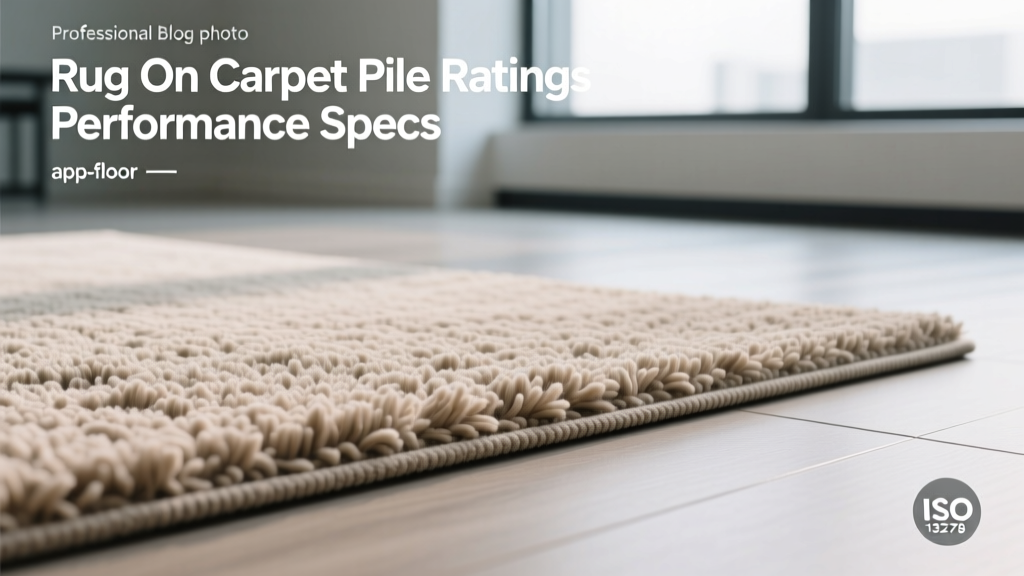
The Engineering of Layered Flooring: Rug on Carpet Specifications
Placing an area rug over wall-to-wall carpet is a common design choice, but from a performance and materials science perspective, it introduces complex mechanical and chemical interactions. Unlike hard surface layering, a rug on carpet creates a dual-suspension system. If the pile heights, backing polymers, and weight distributions are not correctly matched, the installation will suffer from differential deflection (trip hazards), accelerated fiber crushing, and chemical degradation of the underlying carpet binder.
This guide details the exact performance ratings, material specifications, and testing standards required to safely and durably layer a rug over carpeted substrates.
Pile Height Ratio Matrix and Deflection Limits
The most critical specification when placing a rug on carpet is the ratio between the carpet's pile height and the rug's profile. When a person walks across a layered floor, the foot compresses the underlying carpet. If the rug's edge binding is too rigid or thick relative to the carpet's compression depth, it creates a 'ramp effect'—a severe trip hazard that fails basic safety clearances.
| Underlying Carpet Pile | Carpet Thickness Spec | Recommended Rug Profile | Max Edge Binding Thickness | Required Rug Pad Spec |
|---|---|---|---|---|
| Low Pile / Commercial | < 1/4 inch (6mm) | Any (Flatweave to Plush) | 1/4 inch | 1/8 inch needle-punched felt |
| Medium Pile / Saxony | 1/4 to 1/2 inch (6-12mm) | Low to Medium Profile | 3/16 inch | 1/4 inch felt-rubber composite |
| High Pile / Plush | > 1/2 inch (12mm+) | Heavyweight Low Profile | 1/8 inch | 1/4 inch to 3/8 inch thick felt |
| Loop Pile / Berber | Variable | Flatweave only | 1/8 inch | Smooth felt (No aggressive grip) |
Never use a rug pad with an aggressive rubber waffle or gripper pattern over loop-pile (Berber) carpets. The friction and foot traffic will cause the rubber nodes to catch and pull the continuous loops of the Berber carpet, causing irreversible structural damage to the primary backing.
Backing Material Chemistry: What Destroys Carpet
The backing material of the area rug (and its pad) dictates the chemical longevity of the installation. Many consumers assume any non-slip backing is acceptable, but specific synthetic polymers will chemically destroy the polyurethane or latex binders used in wall-to-wall carpet manufacturing.
Polymers to Strictly Avoid
- PVC (Polyvinyl Chloride): PVC backings rely on phthalates and liquid plasticizers to remain flexible. Under the ambient heat and friction of foot traffic, these plasticizers migrate out of the PVC and into the carpet's latex binder. This causes the carpet binder to break down, resulting in permanent yellowing, brittleness, and delamination of the carpet tufts.
- SBR (Styrene-Butadiene Rubber): Often marketed as 'non-slip rubber,' SBR traps moisture and off-gases volatile organic compounds (VOCs). According to the Environmental Protection Agency (EPA), trapped VOCs in poorly ventilated floor layers can significantly degrade indoor air quality.
- Polyurethane Foam: While common in cheap rug pads, polyurethane foam crushes completely under concentrated loads (like furniture legs) when placed over a soft carpet substrate, offering zero indent protection.
Approved Backing Specifications
For a rug on carpet, the backing or pad must be 100% recycled synthetic felt, natural needle-punched wool, or a specialized felt-rubber composite where the rubber is completely encapsulated and only the felt touches the carpet. The felt must have a minimum density of 45 ounces per square yard to resist bottoming out under dynamic loads.
Weight Distribution and Indent Prevention Specs
When layering floors, the point-load pressure from furniture legs is magnified because the underlying carpet acts as a shock absorber, allowing the furniture leg to sink deeper than it would on a hard surface. This creates severe indentation in both the rug and the carpet beneath.
Industry standard testing for floor indentation measures the residual depth of a 150-pound point load applied via a 2-inch diameter dowel over 24 hours. On a dual-layer carpet system, indentation depth can exceed 40% of the total pile height without proper load distribution.
Actionable Specification: Any furniture placed on a rug over carpet must be fitted with load-dispersing casters or pads. For standard residential furniture, use felt-bottomed load spreaders with a minimum surface area of 4 square inches per leg. For heavy items like sofas or solid wood dining tables, upgrade to 6-inch to 8-inch diameter hard plastic or rubber load-dispersing coasters to prevent the legs from punching through the rug's primary backing and crushing the carpet tufts below.
Slip Resistance and ASTM Standards
A rug on a hard floor relies on high-friction rubber to prevent movement. A rug on carpet, however, relies on mechanical interlocking and mass. Rubber grips are largely ineffective on carpet fibers and, as noted, can cause damage.
According to safety guidelines referenced by the Occupational Safety and Health Administration (OSHA) regarding walking-working surfaces, floor transitions and layered surfaces must not present a slip or trip hazard. While OSHA focuses on commercial spaces, the ASTM D2047 standard for slip resistance is the benchmark for flooring safety.
Achieving Stability Without Rubber
To achieve a stable rug on carpet without destructive rubber backings, you must rely on the rug's face weight and the pad's mechanical grip:
- Minimum Face Weight: The area rug must have a minimum face weight of 40 ounces per square yard. Lightweight rugs (under 20 oz/sq yd) will ripple and buckle when placed over carpet because the carpet's pile pushes back against the rug's secondary backing during foot traffic.
- Pad Thickness vs. Density: A thicker pad is not always better. On high-pile carpet, a 1/2-inch pad will cause the rug to 'swim' or shift laterally. Stick to a maximum thickness of 1/4 inch, but prioritize high-density needle-punched felt which allows the carpet fibers to push up into the felt, creating a natural mechanical lock.
- V-Strip Tape (Edge Case): For lightweight rugs that must be placed on carpet, use double-sided acrylic-based V-strip carpet tape only on the extreme outer edges. Acrylic adhesives are less likely to leave permanent residue on carpet fibers compared to hot-melt rubber adhesives.
Maintenance, Airflow, and Vacuuming Specifications
Layering rugs over carpet restricts airflow to the underlying floor, creating a microenvironment that can trap moisture, dust mites, and soil. Proper maintenance protocols must be adjusted to account for the dual-layer system.
When vacuuming a rug placed over carpet, you must adjust the vacuum's beater bar (brush roll) height to the highest possible setting. If the beater bar is set too low, it will aggressively agitate the rug's primary backing against the underlying carpet, generating excessive friction heat that can melt synthetic rug fibers or tear the backing lattice. Refer to the Shaw Floors Care and Maintenance Guidelines for specific beater bar clearance tolerances on high-pile installations.
Moisture and Mold Mitigation
If a liquid spill penetrates the rug, the rug pad, and the carpet, it becomes trapped against the subfloor. Standard carpet extraction tools may not reach the deepest layer.
- Immediate Action: Lift the rug and pad immediately upon a major spill. Do not attempt to extract through three layers of textile.
- Airflow Requirement: Once a year, or immediately following a wet cleaning, the rug must be rolled back to expose the underlying carpet to ambient air and HVAC airflow for a minimum of 12 hours to ensure the carpet's latex binder dries completely, preventing mold sporulation.
- Dry Soil Removal: The rug pad acts as a massive filter, trapping fine particulate matter that falls through the rug. The pad must be removed and shaken outdoors, or vacuumed on both sides with a suction-only canister vacuum (no beater bar) every 6 months.
Summary Checklist for Specification Compliance
Before finalizing a rug on carpet installation, verify the following technical specifications:
- [ ] Underlying carpet pile height measured and matched to rug pad thickness matrix.
- [ ] Rug backing confirmed as 100% felt, wool, or encapsulated composite (Zero PVC, Zero exposed SBR).
- [ ] Rug face weight verified at >40 oz/sq yd to prevent lateral shifting and rippling.
- [ ] Furniture legs fitted with load-dispersing pads (>4 sq inches surface area).
- [ ] Edge binding thickness verified to be less than the compression depth of the underlying carpet to eliminate trip hazards.