Utility Trailer Flooring Options: 2026 Cost Analysis
Compare 2026 costs for utility trailer flooring options. Expert analysis of treated pine, Apitong hardwood, aluminum, and composite pricing per square foot.

The Economics of Trailer Decking: Beyond the Initial Quote
The floor of a utility trailer takes more abuse than any other component, enduring point-loads from skid steers, chemical spills from landscaping fertilizers, and constant moisture exposure. When evaluating utility trailer flooring options, looking strictly at the upfront material cost per square foot is a critical error. The true cost of ownership factors in replacement labor, payload weight penalties, and structural failure modes. As of 2026, material pricing has stabilized following previous supply chain disruptions, but the gap between budget softwoods and commercial-grade hardwoods remains significant.
This analysis breaks down the exact material costs, hidden installation expenses, and lifecycle value of the most common trailer decking materials on the market today.
2026 Material Cost & Performance Matrix
| Material Type | Cost per Sq. Ft. (2026) | Weight per Sq. Ft. | Expected Lifespan | Primary Failure Mode |
|---|---|---|---|---|
| Pressure-Treated Pine (3/4") | $1.50 - $2.50 | 2.8 lbs | 5 - 8 Years | Rot from trapped moisture, splitting |
| Douglas Fir (Untreated/Sealed) | $2.00 - $3.20 | 2.5 lbs | 7 - 10 Years | Delamination, water ingress |
| Apitong / Keruing Hardwood (1-1/8") | $4.50 - $7.00 | 4.5 lbs | 15 - 20+ Years | Edge splintering if left unsealed |
| Steel Diamond Plate (1/8") | $4.00 - $6.00 | 5.1 lbs | 10 - 15 Years | Oxidation/rust at weld points |
| Aluminum Diamond Plate (1/8") | $8.00 - $12.00 | 1.8 lbs | 20+ Years | Galvanic corrosion, fatigue cracking |
| Composite / PVC Extruded | $6.50 - $9.50 | 3.2 lbs | 15 - 20 Years | Sagging under concentrated point-loads |
Deep Dive: Wood & Hardwood Decking
Pressure-Treated Pine: The Budget Standard
Pressure-treated Southern Yellow Pine remains the default flooring for 70% of consumer-grade utility trailers. Modern treatments utilize Copper Azole (CA-C) or Micronized Copper Azole (MCA) rather than the older, highly corrosive Alkaline Copper Quaternary (ACQ). According to data from the USDA Forest Products Laboratory, while MCA treatments offer excellent resistance to fungal decay and termites, the wood remains highly susceptible to dimensional instability. It will warp, cup, and crack as it undergoes seasonal wet-dry cycles.
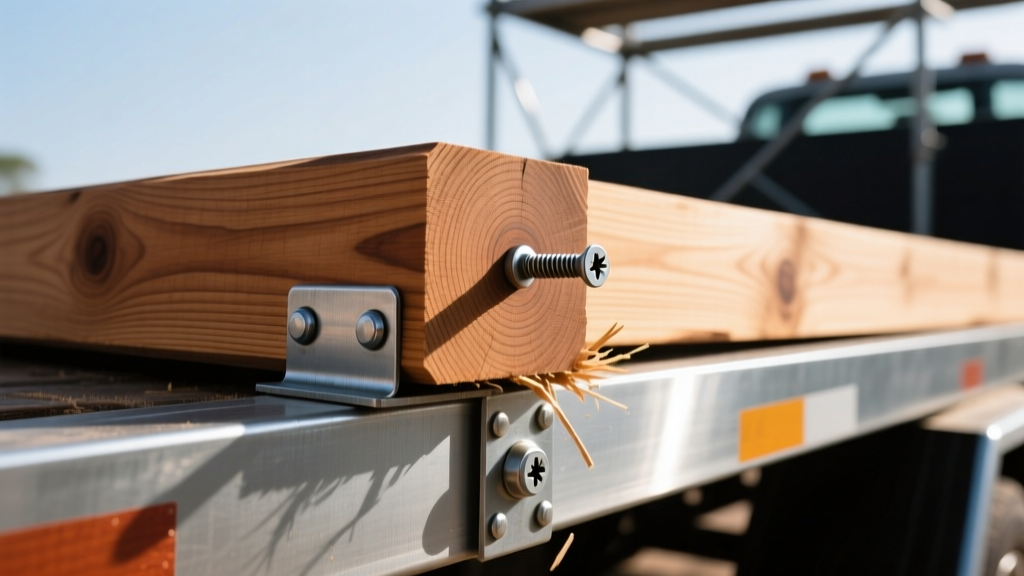
Cost Reality: While the lumber itself costs around $1.75 per square foot, you must factor in the fasteners. Standard zinc-plated screws will corrode within 18 months when in contact with copper-based wood preservatives. You must use hot-dipped galvanized or 410 stainless steel #10 self-drilling screws, which adds roughly $0.25 per square foot to the total build cost.
Apitong (Keruing): The Commercial Flatbed Standard
Apitong is a dense Southeast Asian hardwood with a Janka hardness rating of approximately 3,000 lbf—making it nearly three times harder than oak. It is the undisputed king of heavy-duty flatbed trailers because it can withstand the extreme point-loads of forklift tires and steel-tracked machinery without denting or crushing.
Apitong is typically sold in 1-1/8" thickness with a shiplap or tongue-and-groove profile, creating a watertight interlocking deck. The natural resins in the wood provide inherent rot resistance. However, at $5.50+ per square foot, an 8.5' x 20' trailer (170 sq ft) will cost over $930 just for the raw decking material. According to the National Association of Trailer Manufacturers (NATM), the upfront premium of Apitong is easily justified in commercial fleets, as it eliminates the need for mid-life deck replacements that require taking the trailer out of revenue-generating service.
Deep Dive: Metal Tread Plates
Steel vs. Aluminum Diamond Plate
Metal flooring is favored for low-clearance loading and easy cleanup, but the metallurgy dictates the lifespan.
- 1/8" Steel Tread Plate: Priced around $4.50 per square foot, steel is incredibly rigid and handles heavy sliding loads (like dragging concrete blocks). However, the raised diamond lugs trap water and road salt. Unless you commit to an annual regimen of fluid-film or polyurethane undercoating, rust will compromise the structural integrity of the floor within a decade.
- 1/8" Aluminum Diamond Plate: Priced between $9.00 and $11.00 per square foot, aluminum saves significant weight—a critical factor when trying to maximize payload capacity on a 10,000 GVWR trailer.
Never bolt an aluminum floor directly to a bare steel trailer frame. The dissimilar metals, combined with road spray acting as an electrolyte, will cause rapid galvanic corrosion, literally eating away the aluminum. The Aluminum Association mandates the use of an isolating barrier. You must apply a continuous strip of UHMW (Ultra-High Molecular Weight) polyethylene tape or a heavy neoprene gasket between the steel crossmembers and the aluminum plating before fastening.
The Overlay Trap: Why Rubber Mats Accelerate Decay
A common mistake among trailer owners hauling ATVs, livestock, or landscaping equipment is laying heavy 3/4" rubber mats directly over a pressure-treated wood floor to provide grip and protect the wood from scratches.
This creates a catastrophic micro-environment. Water washes over the sides of the trailer and gets trapped between the impermeable rubber mat and the wood. Deprived of UV light and airflow, the wood remains perpetually damp. This accelerates fungal decay and dry rot at an exponential rate. A treated pine floor that would normally last 8 years will often rot through in 3 to 4 years when suffocated under a rubber mat. If you require a non-slip surface, apply a commercial-grade polyurea bed liner directly to the wood or metal, or use interlocking PVC grid tiles that allow for drainage and airflow.
Hidden Costs: Fasteners, Sealants, and Labor
When budgeting your utility trailer flooring options, the raw material is only part of the equation. A proper installation requires specific ancillary materials:
- Fasteners: For wood, use #10 or #12 x 2" Type 17 auger-point stainless steel screws. They cost roughly $0.15 each. An 8x16 trailer requires about 120 screws ($18 total). For metal-to-steel framing, use #14 x 1" hex-washer self-drilling tek screws.
- Perimeter Sealing: To prevent water from wicking into the end-grain of wood planks or seeping under metal plates, run a continuous bead of marine-grade polyurethane sealant (like Sikaflex-291) along the perimeter where the floor meets the trailer rails. Budget $25 per 10oz tube; a standard trailer requires two tubes.
- Labor Rates: If you are not installing the floor yourself, professional trailer fabrication shops charge between $75 and $110 per hour for decking labor. Ripping out old, rusted screws and replacing a rotted 16-foot deck typically takes 4 to 6 hours of shop time, adding $300 to $660 in labor costs alone.
Decision Framework: Matching Floor to Payload
Select the optimal flooring based on your specific cargo profile to maximize return on investment:
- Landscaping & Skid Steers (High Point-Load, Moisture): Choose 1-1/8" Apitong Hardwood. It resists the crushing weight of steel tracks and ignores the moisture from wet mulch and soil.
- ATVs, Motorcycles, & Light Cargo: Choose 3/4" Pressure-Treated Pine coated with a polyurea spray liner. It offers the best balance of low cost, light weight, and high traction.
- Waste Hauling & Scrap Metal: Choose 3/16" Steel Tread Plate. It can handle the brutal impact of dropping heavy scrap metal and won't splinter or dent under shifting, jagged loads.
- Enclosed Car Haulers & Show Vehicles: Choose interlocking PVC composite tiles over a sealed plywood subfloor. It provides a premium, non-scratch surface that is easy to sweep and chemically resistant to oil drips.
Strategic Sourcing for 2026
To avoid retail markup, do not buy trailer flooring from big-box home improvement stores. For Apitong and commercial hardwoods, source directly from specialized industrial lumber distributors like J. Gibson McIlvain or Advantage Trim & Lumber, who sell pre-grooved trailer decking kits cut to exact trailer widths. For aluminum and steel tread plate, contact local metal service centers or online industrial suppliers like MetalsDepot, which sell 4x8 or 4x10 sheets at wholesale commodity pricing, cutting your material costs by up to 30% compared to buying pre-cut panels from a trailer dealer.
Written by
Priya KapoorPriya Kapoor is a real estate market analyst and construction economics researcher with expertise in housing affordability, development feasibility, and infrastructure investment. She holds a Master of Regional Planning from Cornell University and previously worked as a senior analyst at CBRE's Investment Properties group, where she modeled returns for $4B in mixed-use development pipelines. Priya now runs an independent research practice advising developers, municipalities, and REITs on construction cost forecasting and market timing. She publishes the quarterly "BuildMat Market Pulse" report tracking material price indices across 12 commodity categories. Based in Austin, TX, Priya serves on the board of Habitat for Humanity Austin and is a marathon runner.
More from Priya Kapoor
View all
Construction Cost
Cost to Build a 1600 Sq Ft Home in 2026: Full Breakdown
Accurate 2026 cost to build a 1600 sq ft home—material, labor, and regional pricing breakdowns included. Plan your budget with real-time estimates.
Aug 11, 2026

Wood & Lumber
Name the Types of Wood for Pressure Treatment and Preservation
Learn how to name the types of wood best suited for pressure treatment. Compare species treatability, chemical retention levels, and 2026 preservation costs.
Aug 4, 2026

Stone & Masonry
Stone Veneer Suppliers Lindenhurst: 2026 Cost Analysis
Analyze 2026 stone veneer costs in Lindenhurst, NY. Compare local supplier pricing, delivery fees, and Suffolk County installation labor rates.
Aug 4, 2026