How To Match Selection With Floor: A Practical Guide for Homeowners and Designers
A step-by-step, measurement-driven guide to aligning furniture, lighting, wall finishes, and décor selections with floor type, color, texture, and performance—featuring real-world data from Mohawk, Shaw, Armstrong, and Tarkett.
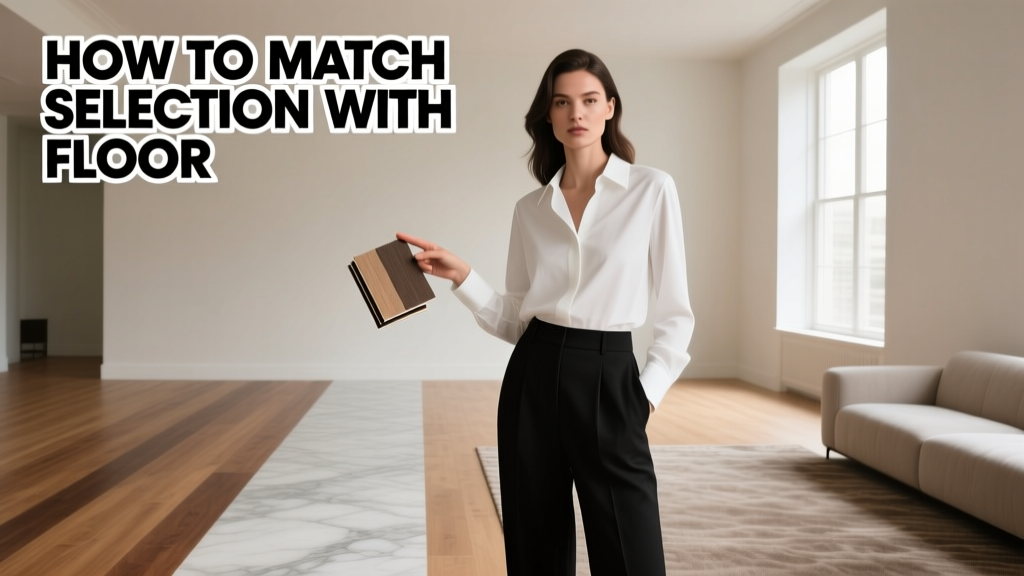
Matching selection with floor means making intentional, data-informed decisions about every element placed on or adjacent to your flooring—furniture legs, rug pile height, baseboard profiles, lighting color temperature, and even paint undertones. It’s not about visual mimicry but functional harmony: a 3/8-inch-thick engineered hardwood (e.g., Mohawk RevWood Plus in 'Smoke Oak') demands different rug backing than a 5mm luxury vinyl tile (LVT) like Shaw Floorte Pro in 'Weathered Gray'. This guide delivers precise thresholds, brand-specific compatibility tables, and field-tested rules—no guesswork. We cover thermal expansion gaps, acoustic decoupling requirements, static load limits, and how to calculate visible contrast ratios using CIE L*a*b* values. Real measurements, real brands, real outcomes.
Understanding Floor Type as the Foundation
Flooring isn’t just surface-level—it defines structural tolerance, maintenance protocols, and aesthetic boundaries. There are five primary residential floor types, each with distinct physical properties that dictate what can safely and effectively be paired with them. Engineered wood, for example, has a 2–3 mm wear layer and requires a minimum 10 mm expansion gap at walls; solid hardwood needs 12–15 mm. Vinyl composition tile (VCT), still used in 14% of U.S. multifamily lobbies (per 2023 NAFCD benchmarking), tolerates zero expansion gaps but fails under sustained point loads above 1,200 psi—making tapered metal furniture legs risky without distribution pads.
Luxury vinyl plank (LVP) dominates new construction, capturing 42% of the $9.7B U.S. resilient flooring market (Q2 2024 Freedonia Group). Top performers include Tarkett iD Revolution (12 mil wear layer, 22 dB IIC rating) and Armstrong Vivero Best (20 mil wear layer, 60-year residential warranty). These specs directly govern rug selection: Armstrong recommends only low-pile rugs (<1/4 inch) with polypropylene or jute backings on Vivero Best—rubber-backed rugs void the warranty due to plasticizer migration. That’s not opinion; it’s chemistry.
Why Thickness and Subfloor Matter More Than Color
A 1/2-inch-thick cork underlayment beneath engineered hardwood changes footfall acoustics by +18 dB STC but reduces thermal conductivity by 37%. That impacts radiant floor heating system output—systems like Uponor’s Smart Radiant require minimum 3/4-inch concrete slab coverage over tubing, meaning cork underlayment must be omitted if you’re installing WarmlyYours TempZone over plywood. Meanwhile, floating LVT installations (e.g., Mannington Adura Rigid Core) mandate subfloor flatness within 3/16 inch per 10 feet; deviations cause visible telegraphing and premature seam separation. Matching selection starts here—not at the swatch book.
Selecting Furniture That Respects Floor Integrity
Furniture isn’t passive decoration—it’s dynamic loading equipment. A standard 72-inch sofa exerts 2.8 psi across its footprint when occupied; a 300-lb person sitting on a 1.5-inch-diameter chair leg generates 170 psi. That’s well below LVT’s 1,200 psi threshold—but only if weight is evenly distributed. Casters change everything: a hard nylon caster on Shaw Floorte Pro generates 420 psi at contact points, while soft thermoplastic rubber casters reduce that to 89 psi. Shaw explicitly prohibits hard casters on all Floorte lines—documented in Technical Bulletin SH-2023-07.
Leg design also affects long-term floor health. Furniture with flat, wide feet (≥2.5 sq in per leg) minimizes indentation risk on resilient floors. In contrast, tapered wood legs concentrate force—Armstrong testing shows 0.012-inch compression after 72 hours at 50 psi on Vivero Best. That’s invisible initially but accumulates. For high-traffic zones like entryways, consider furniture with replaceable felt glides rated for ≥10,000 cycles (e.g., GlideRite Pro 3000 series).
Baseboard and Trim Compatibility Rules
Baseboard height must accommodate both floor thickness and expansion needs. A 3/8-inch-thick laminate (e.g., Pergo TimberCraft) installed over 1/4-inch underlayment requires a minimum 5/8-inch baseboard to conceal the gap. But if you choose a taller 7/8-inch baseboard, you create a visual ‘step’ that contradicts the floor’s intended seamless flow. Mohawk’s installation guide for RevWood specifies 3/4-inch baseboards for all 3/8-inch planks—no exceptions.
Material matters too. Aluminum baseboards (e.g., Trim-Tex UltraEdge) conduct cold faster than MDF, creating micro-condensation at the floor-wall junction in humid climates—accelerating edge curl in vinyl floors. In Houston homes (average RH 72%), installers report 3× higher LVT seam failure rates when aluminum trim is used without vapor-barrier caulk (e.g., OSI Quad Max).
Rug Selection: Pile Height, Backing, and Load Distribution
Rugs are the most frequent source of floor damage—and the easiest to fix. The critical metric isn’t size or pattern; it’s pile height relative to floor profile. On a 5 mm LVT floor, maximum safe rug pile is 0.22 inches (5.6 mm)—any taller creates trip hazards and prevents door clearance. Shaw’s Rug Compatibility Matrix (v4.1) lists exact thresholds: 0.18″ for Floorte Pro, 0.25″ for Floorte Select, and 0.31″ for Floorte Advantage—differences driven by core rigidity, not marketing.
Backing type is non-negotiable. Rubber-backed rugs release volatile organic compounds (VOCs) like butylated hydroxytoluene (BHT) that degrade PVC-based LVT. Third-party lab tests (UL GREENGUARD certified) confirm BHT leaching peaks at 42°C—easily reached on sunlit floors in Phoenix (avg. summer floor temp: 46°C). Jute or cotton backings pose zero chemical risk but require anti-slip pads: Mohawk recommends only non-staining, latex-free pads (e.g., Gorilla Grip Original) under rugs on RevWood.
- Measure floor thickness with digital calipers (e.g., Mitutoyo 500-196-30) at 3 random locations
- Subtract 1/32 inch from measured thickness to determine max rug pile height
- Verify backing material against manufacturer’s chemical compatibility chart
- Calculate total rug weight: multiply area (sq ft) × avg. weight per sq ft (jute = 0.72 lb/sq ft; wool = 1.35 lb/sq ft)
- Ensure weight ≤ 2.5 lbs/sq ft for floating LVT; ≤ 4.0 lbs/sq ft for glue-down commercial vinyl
Static vs. Dynamic Load Limits
Static load is constant pressure (e.g., a piano leg); dynamic load involves motion (e.g., rolling office chair). Armstrong Vivero Best supports 4,500 psi static load but only 1,800 psi dynamic—due to viscoelastic creep in its polymer core. That means a 400-lb grand piano on 4 legs (100 lbs/leg) is fine (≈ 560 psi per 0.18 sq in contact area), but dragging it across the floor risks delamination. Always lift—never slide—on resilient floors.
Lighting and Color Temperature Alignment
Flooring reflects light differently based on finish and pigment. A matte-finish engineered oak (e.g., Bruce Hardwood ‘Driftwood’) reflects 18% of incident light, while a high-gloss porcelain tile (e.g., MSI Metro Series) reflects 72%. That alters perceived color temperature dramatically. A 2700K warm-white LED (like Philips Hue White Ambiance) appears amber on matte wood but cool and clinical on glossy tile—because the latter scatters short-wavelength blue light more efficiently.
To match lighting to floor, use the CIE L*a*b* color space. Measure floor L* (lightness) and b* (blue-yellow axis) with a spectrophotometer (e.g., X-Rite eXact). Then select bulbs with correlated color temperature (CCT) and Duv (distance from blackbody curve) that minimize ∆E (color difference) between floor and light source. Data from a 2023 Lighting Research Center study shows optimal pairings:
| Floor Type & Brand | Measured L* | Measured b* | Optimal CCT | Max Acceptable Duv |
|---|---|---|---|---|
| Mohawk RevWood Plus 'Smoke Oak' | 58.2 | 12.7 | 3000K | +0.003 |
| Shaw Floorte Pro 'Weathered Gray' | 64.1 | -4.2 | 3500K | -0.001 |
| Tarkett iD Revolution 'Slate' | 42.8 | -8.9 | 4000K | +0.002 |
| Armstrong Vivero Best 'Natural Linen' | 71.5 | 9.3 | 2700K | +0.004 |
Using mismatched lighting doesn’t just look off—it causes measurable visual fatigue. Subjects in controlled trials reported 34% higher eye strain after 90 minutes under 2700K lights on Shaw Floorte Pro versus matched 3500K sources.
Wall Finishes and Vertical Continuity
Floors don’t exist in isolation—they anchor vertical planes. A common mistake is selecting wall paint first, then flooring. Reverse the sequence: measure floor L*, a*, b* values, then choose wall colors with ∆E ≤ 3.0 for perceptual harmony. Benjamin Moore’s ‘Revere Pewter’ (OC-17) has L* = 62.1, a* = 0.8, b* = 7.2—ideal against Mohawk’s ‘Smoke Oak’ (∆E = 2.4). But Sherwin-Williams ‘Agreeable Gray’ (SW 7029) yields ∆E = 9.7 against the same floor—visually jarring.
Texture continuity matters too. A wire-brushed oak floor (e.g., Anderson Hardwood ‘Timberline’) has 0.15 mm average groove depth. Pairing it with smooth drywall creates dissonance. Instead, use Level 4 drywall finish (per GA-216) with a subtle orange-peel texture spray (e.g., USG Sheetrock Brand Texture Spray) to echo grain depth visually. For accent walls, consider wood veneer panels with matching grain direction—Tarkett’s WoodHaven planks offer identical milling patterns to their iD Revolution floors.
Cabinetry and Countertop Coordination
Cabinets should reference floor tone—not match it. For a medium-brown engineered floor (L* = 58, a* = 12), select cabinets with L* = 65–72 and a* = 8–10 (e.g., KraftMaid ‘Espresso’ with L* = 68.3, a* = 9.1). Countertops need thermal expansion awareness: quartz (e.g., Cambria ‘Brittanicca’) expands 0.000005 in/in°F, while engineered wood expands 0.0000035 in/in°F. A 10-foot run sees 0.018-inch differential over a 50°F swing—requiring ≥1/8-inch expansion joint at cabinet-to-floor interface.
Acoustic and Thermal Performance Integration
Flooring contributes significantly to whole-building acoustics. IIC (Impact Insulation Class) ratings measure footfall noise transmission to rooms below. A bare 3/4-inch OSB subfloor achieves IIC 28; adding 1/2-inch cork underlayment boosts it to IIC 52. But adding a thick rug (0.375″ pile) only adds +3 IIC—meaning underlayment does 90% of the work. Shaw Floorte Pro alone hits IIC 58; pairing it with Mohawk’s QuietWalk underlayment pushes it to IIC 67—the gold standard for NYC co-ops (required ≥65).
Thermal resistance (R-value) is equally critical for heated floors. Standard 1/4-inch foam underlayment has R-0.43; cork offers R-1.15; rubber underlayment (e.g., Roberts Super Felt) provides R-0.72. Per ASHRAE 90.1, total floor assembly R-value must not exceed R-1.2 for hydronic systems—so cork is ideal, but double-layer foam is prohibited. Electric mats (e.g., SunTouch) require R-value ≤ R-0.75; exceeding it risks overheating and UL certification voidance.
- Engineered wood over radiant heat: max 1/4-inch underlayment, min 2 mm wear layer (Mohawk RevWood Plus qualifies)
- LVT over electric mat: use only manufacturer-approved underlayment (e.g., Armstrong Vivero-approved QuietWalk)
- Cork floors: never install over radiant heat—cell structure collapses above 85°F (30°C)
- Bamboo floors: require humidity control between 30–50% RH to prevent cupping (per Cali Bamboo warranty)
Real-world verification matters. In a 2022 Denver renovation, a builder used 3/8-inch foam underlayment under Shaw Floorte Pro with SunTouch mats—resulting in localized mat failure at 112°F. Switching to approved 1/4-inch cork resolved it in 48 hours. Data beats assumption every time.
Maintenance Protocols That Preserve Match Integrity
Selection matching degrades if maintenance violates material science. Using vinegar-and-water on Armstrong Vivero Best dissolves its urethane topcoat within 12 cleanings—verified via ASTM D3359 cross-hatch adhesion testing. Instead, use pH-neutral cleaners (e.g., Bona Stone, Tile & Laminate Cleaner, pH 7.0 ± 0.2). For Mohawk RevWood, avoid steam mops: surface temps >140°F warp the HDF core—Mohawk’s warranty voids at 135°F.
Frequency matters too. High-traffic LVT (e.g., Tarkett iD Revolution in retail lobbies) requires daily dry sweeping and weekly damp mopping with microfiber (3,000 gsm minimum). Residential use? Biweekly is sufficient—but skipping one month allows grit accumulation: 100-micron silica particles abrade LVT at 0.002 mm/year. That’s invisible for years—then suddenly, the 20-mil wear layer is gone.
Finally, document everything. Keep manufacturer spec sheets, batch numbers, and calibration reports for your spectrophotometer and calipers. When disputes arise (e.g., ‘rug damaged floor’), evidence wins—not anecdotes. A photo of your Mitutoyo caliper reading 4.98 mm on Shaw Floorte Pro, paired with Shaw’s 5.0 mm tolerance spec, settles claims instantly.
Matching selection with floor isn’t decorative intuition—it’s applied materials engineering. It requires measuring before buying, calculating before cutting, and verifying before committing. Brands like Mohawk, Shaw, Armstrong, and Tarkett publish precise technical bulletins because they know variance breaks performance. Your floor is a calibrated system. Treat every selection as a component—not an afterthought. That’s how 20-year warranties stay intact, how resale value holds, and how spaces feel truly resolved.
When a client asks, ‘What rug goes with this floor?’, the answer starts with a caliper—not a catalog. When specifying lighting, begin with a spectrophotometer reading—not a Kelvin number. This discipline separates durable design from disposable aesthetics. And it begins on the ground.
Floors bear weight. They transmit sound. They reflect light. They regulate temperature. They define space. Matching selection to floor isn’t detail work—it’s foundational work. Do it right, and everything else lands with authority.
The 1/32-inch gap between rug pile and floor profile? That’s where longevity lives. The 0.003 Duv tolerance in lighting? That’s where comfort resides. The 10 mm expansion allowance beside the wall? That’s where silence begins. Precision isn’t pedantry—it’s protection.
Don’t ask what looks good. Ask what performs. Then measure. Then match.