How to Clean Vinyl Flooring: Maintenance Costs & Supply Calculator
Calculate the true cost of vinyl floor maintenance. Learn how to clean vinyl flooring with exact supply quantities, unit prices, and wear-layer protocols.
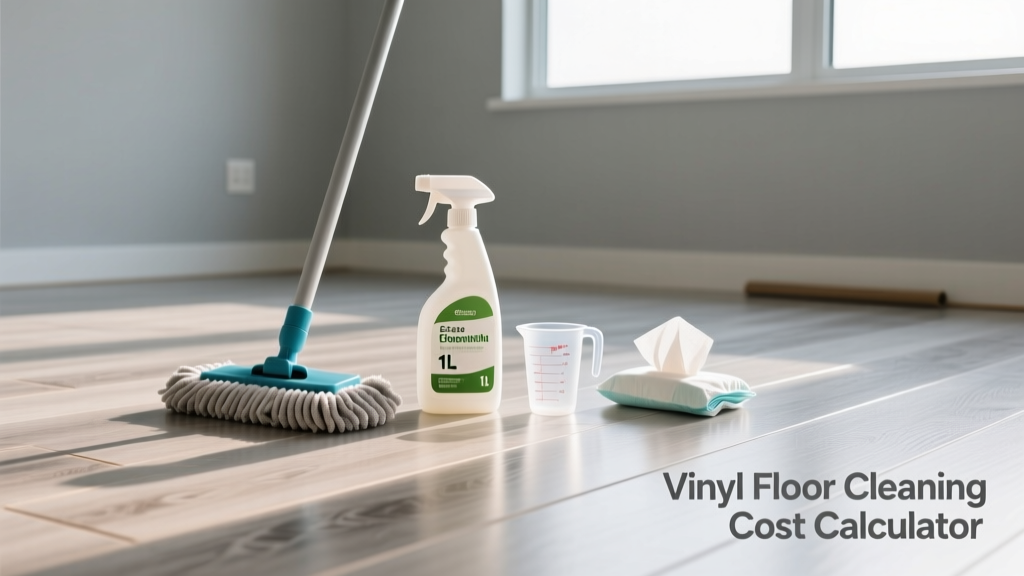
The Hidden Economics of Vinyl Floor Maintenance
Luxury vinyl plank (LVP) and vinyl tile (LVT) are marketed as low-maintenance alternatives to hardwood and stone. While they resist stains and water, the urethane wear layers require specific chemical environments to survive their rated 15-to-25-year lifespans. Improper cleaning protocols—such as using high-pH degreasers or high-heat steam mops—cause micro-abrasions and urethane delamination, accelerating replacement costs by up to a decade. At an average installed cost of $4.50 to $8.00 per square foot, a premature replacement on a 1,000-square-foot main level costs between $4,500 and $8,000.
Understanding how to clean vinyl flooring is fundamentally an exercise in cost preservation. This guide provides a quantitative framework for estimating your annual maintenance budget, calculating exact supply quantities, and executing wear-layer-specific cleaning protocols.
10-Year Maintenance Cost Calculator: DIY vs. Professional
The lifetime cost of maintaining 1,000 square feet of vinyl flooring varies drastically based on whether you rely entirely on DIY methods or integrate professional hard-surface extraction. Below is a projected 10-year cost model based on 2026 supply pricing and national service averages.
| Maintenance Strategy | Frequency | Unit Cost | 10-Year Total (1,000 sq ft) | Cost Per Sq Ft / Year |
|---|---|---|---|---|
| 100% DIY (Routine Mop & Sweep) | Weekly | $45 - $60 / year | $450 - $600 | $0.04 - $0.06 |
| Hybrid (DIY Weekly + Pro Annual) | Weekly + Annual | $45 DIY + $350 Pro | $3,950 | $0.39 |
| 100% Professional Service | Bi-Weekly | $0.25 - $0.40 / sq ft | $13,000 - $20,800 | $1.30 - $2.08 |
Note: Professional hard-surface cleaning rates reflect IICRC-certified technicians utilizing truck-mounted or portable rotary extractors with neutral-pH hard surface solutions.
Supply Quantity Estimator & Unit Pricing
To calculate your exact annual supply budget, you must account for the coverage rates of pH-neutral cleaners and the depreciation of microfiber applicators. Avoid generic multi-surface cleaners; vinyl requires solutions with a pH between 7.0 and 8.0 to prevent stripping the factory-applied aluminum oxide or urethane topcoats.
Approved Cleaners & Coverage Rates
- Bona Hard-Surface Floor Cleaner: Priced at approximately $0.35 per fluid ounce. Ready-to-use formula covers 500 sq ft per 36 oz bottle. Annual requirement for 1,000 sq ft (cleaning bi-weekly): 1.5 bottles ($18.37).
- Rejuvenate Luxury Vinyl Cleaner: Priced at approximately $0.42 per fluid ounce. Covers 400 sq ft per 32 oz bottle. Annual requirement: 2 bottles ($26.88).
- Concentrated Neutral Cleaners (e.g., Basic Squeegee or Prochem Neutral Floor Cleaner): Dilution ratio of 1:128 (1 oz per gallon). A 1-gallon jug ($35-$45) yields 128 gallons of working solution, lasting an average household 3 to 4 years.
Microfiber Pad Depreciation Formula
Microfiber pads trap silica and grit. Once the fibers are saturated with microscopic abrasives, they act like sandpaper on the vinyl wear layer. Replace pads based on the following estimator:
Pad Replacement Formula: (Total Square Footage / 500) x 2 = Pads needed per month.
Example: A 1,500 sq ft home requires 6 pads per month. At $4.00 per commercial-grade pad, budget $24.00 monthly or $288 annually for pad rotation.
⚠️ Warning: The High-pH and Steam Mop Failure Modes
Using alkaline cleaners (pH 9.0+, such as Fabuloso, Pine-Sol, or ammonia-based solutions) chemically degrades the urethane topcoat, resulting in a permanent hazy finish that requires a $2.00/sq ft professional buff-and-coat restoration. Furthermore, steam mops emit vapor at 212°F to 250°F. Vinyl planks utilize a PVC core and urethane wear layer bonded by heat-sensitive adhesives. Sustained heat above 180°F softens the core and compromises the click-lock joints, leading to edge curling, peaking, and subfloor moisture intrusion.
How to Clean Vinyl Flooring: Protocol by Wear Layer Thickness
The mechanical action required to clean vinyl depends entirely on the thickness of the clear wear layer, measured in mils (1 mil = 0.001 inches). Adjust your cleaning aggression based on your product specifications.
12-Mil to 20-Mil Wear Layers (Residential Standard)
Standard residential LVP features a 12-mil to 20-mil wear layer. This thickness is highly susceptible to micro-scratching from trapped grit.
- Dry Extraction (Crucial Step): Vacuum using a hard-floor setting (beater bar disabled) or sweep with a flagged-bristle broom. This removes 85% of abrasive silica dust.
- Chemical Application: Mist an EPA Safer Choice certified neutral cleaner directly onto the floor or onto the microfiber mop head. Never pour liquid directly onto the seams, as capillary action can draw moisture into the click-lock mechanisms.
- Mechanical Agitation: Use a flat-head microfiber mop. Apply light downward pressure and move in the direction of the plank grain to push debris out of the embossed texture grooves.
- Drying: Allow to air dry. Ensure HVAC airflow is active to evaporate residual moisture within 10 minutes.
22-Mil+ Wear Layers (Commercial & Heavy-Duty Residential)
Commercial-grade vinyl (22-mil to 40-mil) often features a ceramic bead or aluminum oxide infusion for extreme scratch resistance. These floors can withstand heavier mechanical agitation.
- Equipment Upgrade: You can safely use a low-speed rotary floor machine (175 RPM) with a white or red scrubbing pad for quarterly deep cleans.
- Autoscrubbers: For large commercial spaces, walk-behind autoscrubbers with soft bristle brushes and neutral-pH detergent are the most cost-effective method, reducing labor costs by 60% compared to manual mopping.
The Break-Even Point: When to Call an IICRC Pro
While DIY maintenance handles surface soil, it fails to extract embedded grit from the deep embossed grooves of textured LVP. Over 3 to 5 years, this embedded soil creates a dull, grayish cast. The break-even point for hiring a professional occurs when the cost of replacing damaged planks exceeds the cost of professional extraction.
Professional hard-surface cleaning utilizes cylindrical brush machines or rotary extractors that agitate the deep textures and vacuum the suspended soil simultaneously. Schedule an IICRC-certified hard-surface technician every 18 to 24 months. The average cost is $0.35 per square foot. For a 1,000 sq ft area, a $350 bi-annual investment preserves the factory sheen and extends the floor's functional lifespan by an estimated 5 to 8 years, yielding a massive return on investment compared to the $6,500 average cost of a full tear-out and reinstall.
Summary Matrix: Approved vs. Prohibited Cleaning Agents
Use this quick-reference matrix to audit your current cleaning supplies and prevent accidental chemical damage to your vinyl investment.
| Cleaner Type | pH Level | Safe for Vinyl? | Financial Risk / Consequence |
|---|---|---|---|
| Neutral Floor Cleaners (Bona, Rejuvenate) | 7.0 - 8.0 | Yes | None. Preserves urethane topcoat. |
| Dish Soap (Dawn, Palmolive) diluted in water | 8.5 - 9.5 | Caution | Leaves dulling soap scum residue requiring $150+ professional stripping. |
| Multi-Surface Degreasers (Fabuloso, Simple Green) | 9.0 - 11.0 | No | Strips factory finish. Requires $2.00/sq ft professional buff-and-coat. |
| Ammonia or Bleach Solutions | 11.0 - 13.0 | No | Causes irreversible discoloration and embrittlement of PVC core. |
| Vinegar & Water Mixtures | 2.0 - 3.0 | No | Acidic degradation of the wear layer over time, leading to hazing. |
For further verification on chemical compatibility, always consult the EPA Safer Choice database or refer directly to the warranty care guidelines provided by major manufacturers like Shaw Floors. By quantifying your supply needs and adhering strictly to pH-neutral protocols, you transform floor cleaning from a guessing game into a predictable, low-cost asset preservation strategy.