Best Flooring Product Lines to Withstand a Floor Gaming Chair
Discover which flooring brands and specific product lines best resist the unique friction, dents, and wear caused by floor gaming chairs.
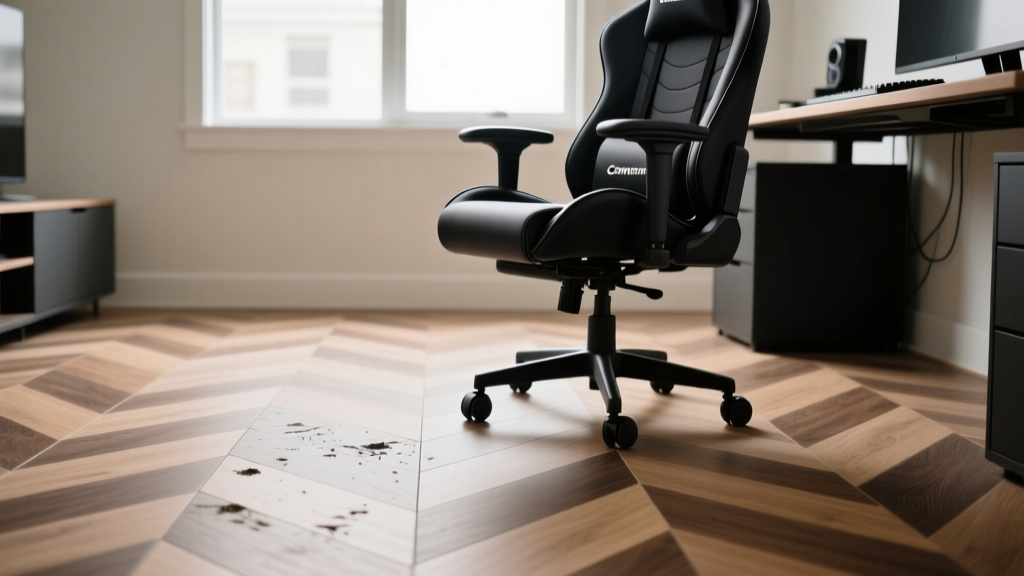
The Biomechanics of Floor Chair Wear: Why Standard Floors Fail
When evaluating flooring for a gaming setup, most guides focus on wheeled office chairs. However, a floor gaming chair—a legless, pedestal-style, or tatami chair that sits directly on the ground—introduces an entirely different set of mechanical stresses. Unlike rolling casters that distribute weight and move linearly, floor gaming chairs rely on a stationary or swiveling base that concentrates dynamic loads and generates severe rotational shear.
Consider the physics: a 200-pound gamer leaning back in a 30-pound floor chair shifts the entire 230-pound load onto the rear edge of the base. This reduces the contact area from roughly 150 square inches to less than 20 square inches, spiking the point load pressure to over 11.5 PSI. On softer flooring materials, this causes immediate micro-indentations. Furthermore, the repetitive swiveling motion grinds the base against the floor, testing the abrasion resistance of the wear layer far beyond standard residential foot traffic.
Floor gaming chairs with exposed metal swivel rings act like mild sandpaper on standard 6-mil to 12-mil luxury vinyl plank (LVP) wear layers. Over 6 to 12 months of daily use, this rotational shear will completely breach the wear layer, exposing the printed design layer to rapid degradation and moisture intrusion.
Top 2026 Flooring Product Lines for Floor Chair Compatibility
To withstand the unique abuse of a floor gaming chair, you must select flooring with high-density cores and commercial-grade wear layers. Based on current 2026 product specifications and ASTM D4060 abrasion testing standards, the following product lines offer the best structural defense.
1. Shaw Floors: Floorté Premier (Rigid Core LVP)
Shaw’s Floorté Premier line remains a top-tier choice for high-friction gaming environments. As of 2026, this line features a 22-mil urethane-coated wear layer and a high-density Stone Plastic Composite (SPC) core. The SPC core boasts a compressive strength that easily resists the 11+ PSI point loads generated when a gamer leans back. Priced between $4.50 and $5.80 per square foot, it includes an attached acoustic pad that prevents the chair base from bottoming out against the subfloor.
- Wear Layer: 22 mil (commercial grade)
- Core Density: High-density SPC (resists point-load denting)
- Best For: Swivel-base floor chairs with felt or padded bottom rings
2. Mohawk: SolidTech Plus (Rigid Core Vinyl)
Mohawk’s SolidTech Plus is engineered with a 22-mil wear layer featuring their proprietary CleanProtect surface technology, which resists both staining and micro-scratching. For floor gaming chairs with flat, unpadded wooden or hard plastic bases, SolidTech Plus provides exceptional rotational shear resistance. According to the Resilient Floor Covering Institute (RFCI), rigid core vinyl products of this caliber maintain structural integrity under continuous static loads far better than traditional flexible LVP. Expect to pay $4.20 to $5.50 per square foot.
3. Cali Bamboo: GeoWood (Engineered Hardwood Alternative)
For gamers who demand the authentic look and feel of real wood without the denting vulnerabilities of traditional hardwood, Cali Bamboo’s GeoWood is the optimal hybrid. It pairs a real hardwood veneer with a limestone composite core. This core is virtually impervious to the point-load indentation that plagues standard engineered wood. With a Janka hardness equivalent that far exceeds traditional oak, it handles the heavy, concentrated weight of floor gaming chairs flawlessly. Pricing ranges from $6.50 to $8.00 per square foot.
Flooring Failure Mode Matrix: Matching Base Types to Materials
Not all floor gaming chairs are built identically. The base type dictates the primary failure mode your flooring will face. Use the matrix below to cross-reference your specific chair type with the appropriate flooring category. For comprehensive guidelines on how point loads affect natural materials, refer to the National Wood Flooring Association (NWFA) technical resources.
| Chair Base Type | Primary Failure Mode | Recommended Flooring Line | Flooring to Avoid |
|---|---|---|---|
| Exposed Metal Swivel Ring | Rotational shear, wear layer breach | 22-mil+ SPC Vinyl (Shaw Floorté) | Standard Laminate, 6-mil LVP |
| Flat Hard Plastic Base | Surface micro-scratching, scuffing | Scratch-resistant Rigid Core (Mohawk SolidTech) | High-gloss finishes, soft pine |
| Padded / Felt Bottom | Point-load denting from leaning | Limestone Composite (Cali GeoWood) | WPC (Wood Plastic Composite) vinyl |
The Plasticizer Migration Warning: Why Chair Mats Can Ruin Floors
Many gamers attempt to solve the floor gaming chair problem by placing a cheap, clear plastic mat over their luxury vinyl or laminate flooring. This often leads to a catastrophic chemical reaction known as plasticizer migration.
"Cheap PVC (polyvinyl chloride) chair mats contain chemical plasticizers to keep the plastic flexible. When placed over LVP or vinyl flooring, these chemicals leach into the floor's wear layer, causing permanent yellowing, staining, and structural softening that cannot be buffed out."
The Fix: If you must use a protective mat under a floor gaming chair, purchase only 100% Polycarbonate or PET (polyethylene terephthalate) mats. These materials are chemically inert and will not react with the urethane or aluminum oxide topcoats on modern flooring. Expect to pay $60 to $120 for a high-quality, non-off-gassing polycarbonate mat.
Subfloor and Underlayment Specs for Gaming Rooms
The durability of your flooring against a floor gaming chair is only as strong as the subfloor and underlayment beneath it. A rigid core LVP might resist denting on its own, but if the underlayment compresses under the chair's point load, the flooring's click-lock joints will eventually snap or separate.
Underlayment Compressive Strength
When installing floating floors in a room dedicated to floor gaming chairs, prioritize underlayment with a high compressive strength (measured in kPa). Standard foam underlayments compress at around 10-15 kPa. For gaming rooms, specify an underlayment with a minimum compressive strength of 40 kPa to 60 kPa (such as high-density cork or specialized rubber-cork blends). This prevents the floor from flexing downward when the gamer shifts their weight aggressively.
Expansion Gap Tolerances
The repetitive swiveling of a floor gaming chair creates lateral drag forces that can literally pull a floating floor apart if the expansion gaps are improperly sized. While standard installation calls for a 1/4-inch expansion gap around the perimeter, rooms with heavy floor chair usage should utilize a 3/8-inch gap covered by a robust baseboard or quarter-round molding. This allows the floor to shift microscopically under lateral shear without buckling in the center of the room.
Maintenance: Preventing Grit-Induced Abrasion
Even a 22-mil wear layer will fail if microscopic silica grit becomes trapped between the floor gaming chair base and the floor. Silica ranks at a 7 on the Mohs hardness scale, making it harder than most flooring topcoats. When the chair swivels, it drives this grit into the floor, creating a sanding effect.
- Daily: Use a dry microfiber dust mop to remove abrasive particulates. Avoid stiff-bristled brooms that can leave micro-scratches.
- Weekly: Clean with a pH-neutral hard surface cleaner (e.g., Bona PowerPlus or Shaw R2X). Never use steam mops, as the forced heat and moisture can degrade the urethane wear layer and compromise the click-lock joints.
- Chair Maintenance: Inspect the bottom of the floor gaming chair monthly. If using a felt pad, replace it the moment it becomes embedded with grit or wears thin. If using a metal swivel base, wipe the contact ring with a damp cloth to remove accumulated floor polish and dust.
By selecting a high-density, commercial-wear flooring product line and pairing it with chemically inert protection and proper subfloor support, your flooring will easily withstand the unique mechanical demands of a floor gaming chair for years to come. For standardized testing metrics on flooring abrasion, consult the ASTM D4060 standard guidelines to verify manufacturer claims before purchasing.