Best Flooring for a Floor Bed Toddler: Safety & Specs Guide
Evaluate flooring performance ratings, impact attenuation, and VOC specs to create a safe, thermally comfortable environment for a floor bed toddler.
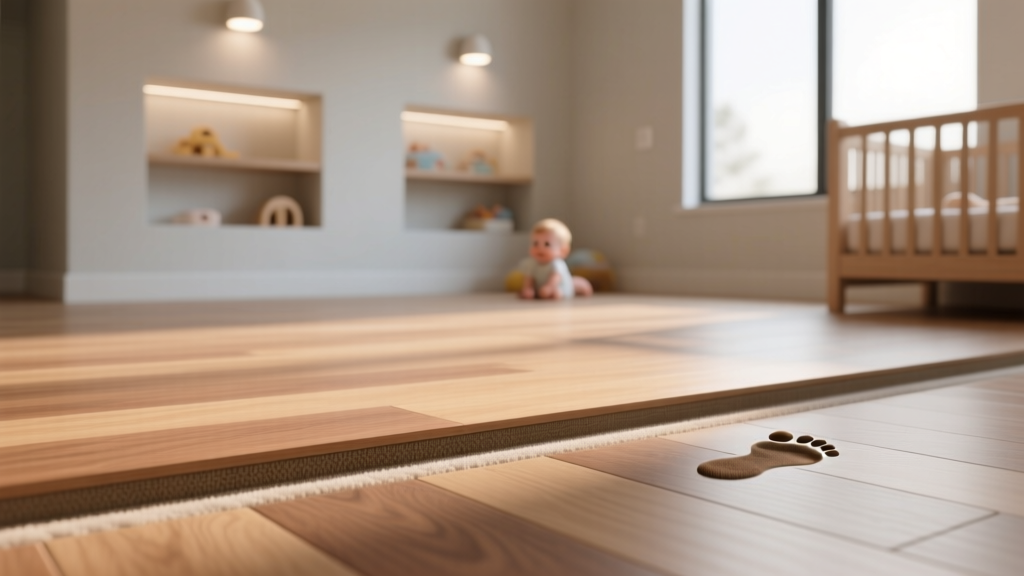
The Biomechanics of Toddler Floor Beds: Why Flooring Specs Matter
Transitioning a child to a Montessori-style floor bed fundamentally alters their spatial relationship with the room. Unlike a traditional crib, a floor bed places the toddler's sleeping surface between 2 and 8 inches above the subfloor. This proximity means the flooring material is no longer just a walking surface; it is an integral component of the child's sleep micro-climate, impact safety zone, and primary respiratory environment.
Standard flooring selection criteria—such as scratch resistance or aesthetic continuity—are secondary when specifying materials for a floor bed toddler. The primary performance metrics must center on impact attenuation (HIC ratings), thermal resistance (R-value), volatile organic compound (VOC) off-gassing at the breathing zone, and dynamic coefficient of friction (DCOF) for safe egress. According to the American Academy of Pediatrics (AAP), creating a safe sleep environment requires mitigating all physical and environmental hazards, which extends directly to the surfacing material immediately surrounding the bed frame.
Impact Attenuation & HIC Ratings: Material Comparison Matrix
Impact attenuation is measured using ASTM F1292, which calculates the Head Injury Criterion (HIC). A HIC score of 1000 is the established threshold for a 50% risk of severe head injury. For a floor bed toddler, the critical fall height is typically between 18 and 30 inches (the height of the mattress top plus the toddler's center of gravity). The flooring must absorb kinetic energy to keep the HIC score well below 1000.
| Flooring Material | Estimated HIC (24" Drop) | ASTM F1292 Compliance | Required Underlayment |
|---|---|---|---|
| Natural Cork (8mm) | 650 - 750 | Pass (with acoustic pad) | 2mm cork or rubber |
| Engineered Hardwood | 950 - 1100 | Fail (without upgrade) | 5mm+ high-density foam |
| Rigid Core LVP (WPC) | 800 - 900 | Marginal Pass | Attached IXPE pad (1.5mm) |
| EVA Foam Tiles (14mm) | 400 - 500 | Pass | None (interlocking) |
| Carpet (Plush, 1/2") | 500 - 600 | Pass | 8lb rebond polyurethane |
Thermal Comfort & Air Quality: The Micro-Climate Factor
A toddler sleeping on a floor bed is situated in the lowest thermal stratum of the room. Heat rises, meaning the floor level is consistently 2°F to 4°F cooler than the ambient room temperature measured at 5 feet. Furthermore, heavier VOCs and particulate matter tend to settle in this lower breathing zone.
Thermal Resistance (R-Value) Specifications
To prevent conductive heat loss from the toddler's body through the mattress and into the subfloor, the flooring assembly must possess a minimum cumulative R-value of 1.5.
- Natural Cork: Yields an R-value of approximately 1.25 per inch. A standard 8mm cork plank with a 2mm cork underlayment provides an R-value of ~0.50, which must be supplemented by a high-R mattress pad.
- WPC (Wood Plastic Composite) LVP: Offers an R-value of ~0.25. While better than stone polymer composite (SPC) which sits near 0.15, WPC requires a specialized thermal underlayment to meet the 1.5 minimum.
- Engineered Hardwood: R-value of ~0.90 for a 5/8" plank. Excellent thermal retention, but requires strict humidity control (35-55% RH) to prevent cupping.
VOC Off-Gassing and the Breathing Zone
Because a floor bed toddler's nose and mouth are often less than 12 inches from the floor surface during sleep, off-gassing from flooring adhesives and synthetic wear layers is a primary health concern. The UL GREENGUARD Certification program sets the gold standard for these emissions. You must specify flooring that holds the GREENGUARD Gold certification, which restricts formaldehyde emissions to less than 7.3 parts per billion (ppb) and total VOCs to under 50 µg/m³. Standard GREENGUARD certification is insufficient for a floor bed setup, as it allows higher thresholds designed for adult standing-height breathing zones.
Detailed Performance Breakdown by Flooring Type
1. Natural Cork: The Optimal Specification
Cork is the undisputed technical leader for floor bed environments. The cellular structure of cork (composed of 50% air) provides natural impact attenuation and acoustic dampening. Procurement Specs: Source floating cork planks with a minimum thickness of 10mm (including a 2mm integrated cork underlayment). Ensure the wear layer is UV-cured polyurethane, not ceramic micro-bead, which can be overly abrasive to bare skin. Edge Case: Cork is susceptible to indentation from heavy, concentrated loads. Use wide-base furniture casters for any dressers or shelving in the room to prevent permanent compression dents.
2. Engineered Hardwood: The Aesthetic Compromise
Hardwood offers superior longevity and high R-values but fails initial impact attenuation tests. To make engineered hardwood safe for a floor bed toddler, the underlayment specification is critical. Procurement Specs: Select a 5/8" or 3/4" engineered plank with a minimum 3mm hardwood veneer. Pair it with a high-density acoustic foam underlayment (minimum 5mm thick, IIC rating of 55+). Safety Add-on: Because hardwood remains a hard surface, you must integrate a secondary impact zone. Specify a low-pile, tightly woven wool area rug (secured with a non-slip natural rubber pad, avoiding PVC-backed pads which off-gas phthalates) to cover the immediate 3-foot perimeter around the bed frame.
3. Rigid Core LVP (WPC): The Waterproof Option
Luxury Vinyl Plank is highly resistant to moisture, making it practical for toddler rooms prone to spills or nighttime accidents. However, SPC (Stone Plastic Composite) is too rigid and brittle for impact safety. Procurement Specs: You must specify WPC (Wood Plastic Composite) core LVP, which incorporates a foaming agent that provides slight cushioning. Minimum thickness: 8mm with an attached 1.5mm IXPE acoustic pad. The U.S. Consumer Product Safety Commission (CPSC) warns against choking hazards; ensure the LVP click-lock mechanism is high-quality (like Uniclic or Valinge 5G) to prevent edge chipping and micro-plastic debris generation over time.
Slip Resistance (DCOF) and Transition Molding Safety
When a toddler climbs out of a floor bed, their initial footing dictates their fall risk. The flooring must meet the ANSI A326.3 standard for slip resistance, requiring a Dynamic Coefficient of Friction (DCOF) of ≥ 0.42 when wet.
- Matte Finishes: Specify matte or satin finishes (gloss level < 20). High-gloss polyurethanes drop the DCOF below 0.35, creating a slip hazard for toddlers in socks or bare feet.
- Embossing: Look for EIR (Embossed in Register) texturing on LVP or wire-brushed textures on hardwood to increase microscopic surface friction.
Transition Molding Specifications
Floor beds require a completely flush transition at the doorway. Standard T-moldings or overlap reducers create a 1/4" to 1/2" lip that acts as a severe tripping hazard for a toddler navigating the room in the dark. Installation Directive: Use flush-mount stair nosing or custom-cut spline transitions to maintain a perfectly zero-elevation threshold between the toddler's room and the hallway. If a height discrepancy exists between subfloors, use a self-leveling compound (like Ardex K-15) to feather the subfloor prior to installation, eliminating the need for raised transition strips entirely.
Procurement & Installation Checklist
- Verify GREENGUARD Gold: Request the specific SKU's UL certificate from the manufacturer before purchase; do not rely on generic brand claims.
- Calculate Cumulative R-Value: Add the R-value of the plank/tile, the underlayment, and the mattress to ensure the total thermal barrier exceeds 1.5.
- Specify Zero-VOC Adhesives: If glue-down installation is required (common for cork and some LVP), use only silane-modified polymer (SMP) adhesives that are 100% solvent-free and isocyanate-free.
- Acclimation Protocol: Allow engineered wood and cork to acclimate in the room for a minimum of 72 hours at 65°F-75°F and 35%-55% relative humidity to prevent post-installation gapping.
- Perimeter Securement: Ensure all baseboards and quarter-round moldings are nailed and caulked with APEO-free, low-VOC acrylic caulk to eliminate gaps where dust, allergens, and small toys can accumulate beneath the floor bed frame.