How to Clean Carpet Stains: Pro Brand Formulas Deep-Dive
Discover how to clean carpet stains using pro-grade brand formulas. We compare Folex, Bissell, and Resolve for specific stain types and failure modes.
The Chemistry of Carpet Stains: Why Brand Formulations Matter
When tackling carpet discoloration, generic home remedies often fail because they ignore the underlying chemistry of both the stain and the carpet fiber. Understanding how to clean carpet stains requires moving beyond basic dish soap and vinegar. Professional-grade formulations utilize specific surfactant charges, enzymatic proteins, or oxidative compounds designed to break molecular bonds without degrading synthetic or natural fibers.
According to the IICRC S100 Standard for Professional Cleaning of Textile Floor Coverings, improper pH levels or residue-heavy cleaners lead to rapid re-soiling and fiber degradation. A cleaner that leaves behind a sticky, alkaline residue will actually attract dirt over the next few weeks, creating a dark ring around the original spot. To avoid this, we must evaluate specific brand product lines and their chemical mechanisms.
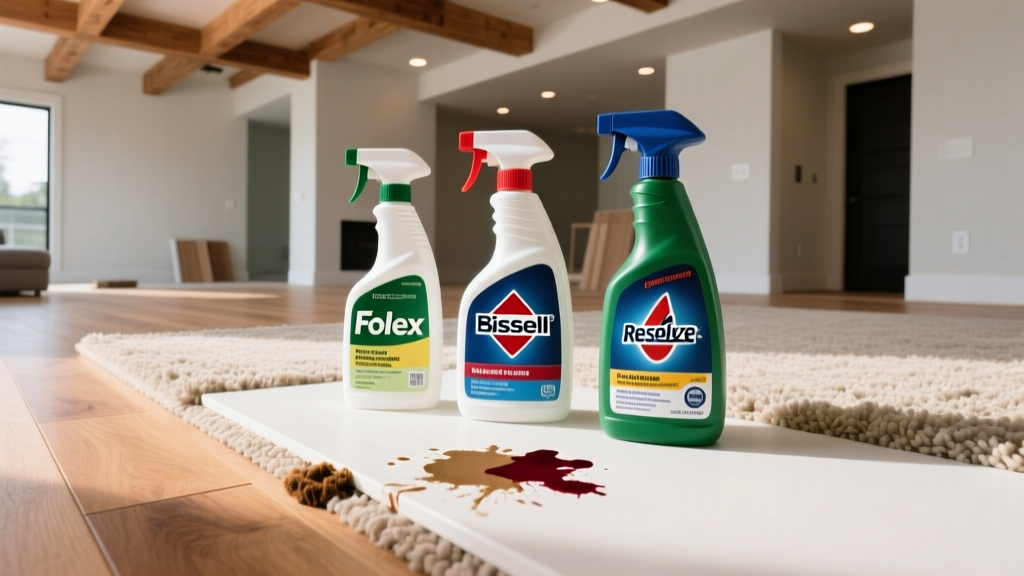
Brand Deep-Dive: Folex Instant Carpet Spot Remover
Folex has maintained a dominant position in the spot-removal market for decades, primarily due to its unique non-ionic surfactant chemistry. Unlike anionic surfactants (found in most household detergents and laundry soaps), non-ionic surfactants do not carry an electrical charge.
Anionic cleaners leave a negatively charged residue that acts like a magnet for positively charged soil particles. Folex’s non-ionic formula rinses clean with zero residue, which is why it is highly recommended by the Carpet and Rug Institute (CRI) Seal of Approval program for preventing recurring stains.
Optimal Use Cases and Limitations
- Best For: Tannin stains (coffee, tea, wine), mud, and water-based food spills.
- Application: Spray heavily to saturate the stain down to the backing. Agitate gently with a soft-bristle brush or microfiber cloth. Blot—do not rub—until the transfer stops.
- Failure Mode: Folex is largely ineffective on lipid (oil/grease) stains and heavy pet urine. Because it lacks enzymatic action, it cannot break down uric acid crystals or animal fats.
- Cost: Approximately $14.98 for a 32 oz trigger bottle, yielding a cost-per-ounce of $0.46.
Enzymatic vs. Oxidative Cleaners: Bissell and Resolve Compared
Biological stains (pet urine, vomit, blood) and heavy organic traffic require fundamentally different chemical approaches. Below is a structural comparison of the leading consumer product lines for these specific challenges.
| Brand & Product Line | Active Chemistry | Target Stain Profile | Required Dwell Time | Avg. Price (32oz Eq) |
|---|---|---|---|---|
| Bissell Pet Urine Eliminator | Enzymatic (Protease/Urease) + Febreze odor neutralizers | Urine, feces, vomit, blood | 10–15 minutes (must stay damp) | $8.50 |
| Resolve High Traffic Foam | Anionic surfactants + mild solvents | Surface dirt, mud, light food grease | 3–5 minutes (dries to powder/crust) | $6.00 |
| Nature’s Miracle Stain Destroyer | Bio-enzymatic bacteria culture | Deep-set pet accidents, skunk spray | Up to 24 hours (air dry naturally) | $9.20 |
| Bissell OxyGenics | Hydrogen peroxide (Oxidative) | Wine, berry juice, coffee, ink | 5–10 minutes | $11.00 |
The Enzymatic Dwell Time Mandate
A critical failure point for consumers using Bissell or Nature’s Miracle enzymatic lines is premature extraction. Enzymes act as biological catalysts; they require moisture and time to cleave the peptide bonds in proteins. If you spray an enzymatic cleaner and immediately blot it up with a towel, you are removing the active enzymes before they can digest the uric acid. For deep pet stains, the product must remain damp in the carpet pad for up to 15 minutes, and in severe cases, the area should be covered with plastic wrap to slow evaporation and allow the bacteria to work overnight.
Heavy-Duty Extraction: Machine and Solution Pairings
Spray-and-wipe methods only address the top 10% of the carpet pile. When stains penetrate the secondary backing or the pad, mechanical extraction is mandatory. The Environmental Protection Agency (EPA) notes that deep extraction is vital not just for stain removal, but for maintaining indoor air quality by removing trapped particulate matter.
Bissell Big Green 86T3 vs. Rug Doctor Pro Deep Cleaner
- Bissell Big Green (86T3): Features a dual-tank system that keeps clean and dirty water completely separate. The rotating DirtLifter PowerBrush is aggressive on synthetic nylons but can fray delicate wool loops. Best paired with Bissell Professional Deep Clean + Oxy formula, which utilizes an oxygenating agent to lift set-in tannins during the hot water extraction pass.
- Rug Doctor Pro Deep Cleaner: Utilizes a single, massive suction motor that provides roughly 75% more suction power than standard consumer models. However, it relies on a single-tank design where the recovery water mixes closer to the extraction head. It excels at pulling high volumes of water out of dense, high-pile carpets, reducing dry times from 12 hours to roughly 4 hours.
When using rental or consumer extraction machines, making too many slow, wet passes can over-saturate the carpet. This leads to delamination (the separation of the primary carpet backing from the secondary latex backing) and promotes subfloor mold growth. Always follow one wet pass with two dry (suction-only) passes.
Step-by-Step Protocol for Set-In Tannin and Protein Stains
For complex stains that have set into the fiber for more than 48 hours, a multi-stage chemical protocol is required. This framework synthesizes professional restoration techniques for residential use.
- Mechanical Agitation: Use a soft-bristle upholstery brush to gently loosen any crusted surface debris. Vacuum thoroughly.
- Primary Solvent Application: Apply Folex Instant Spot Remover to break down water-soluble components. Allow a 5-minute dwell time.
- Blotting Phase: Fold a clean, white microfiber towel into quarters. Press down with your body weight to absorb the suspended soil. Shift to a clean quadrant of the towel and repeat until no color transfers.
- Secondary Enzymatic Treatment (If Biological): If the stain has a biological component (e.g., a coffee stain with milk, or pet urine), apply Bissell Pet Urine Eliminator directly to the damp area. Cover with a damp paper towel and a piece of plastic wrap to maintain humidity.
- Final Extraction: After 15 minutes, remove the plastic wrap and use a wet/dry shop vac or a dedicated carpet extractor on suction-only mode to pull the remaining moisture and dissolved proteins out of the pad.
Chemical Failure Modes: What Destroys Carpet Fibers
Understanding how to clean carpet stains also means knowing which chemicals will permanently ruin your flooring. The most common catastrophic failures occur when consumers misuse high-pH or oxidative products.
Alkaline Hydrolysis in Wool
Natural wool carpets are highly sensitive to alkaline solutions. Cleaners with a pH above 8.5 (which includes many heavy-duty Resolve foams and generic degreasers) will cause alkaline hydrolysis. This chemical reaction breaks down the disulfide bonds in the keratin protein of the wool, resulting in permanent yellowing, fiber brittleness, and a loss of tensile strength. Always verify that a cleaner is pH-neutral (between 6.0 and 7.5) before applying it to wool or silk blends.
Oxidative Bleaching on Natural Dyes
Hydrogen peroxide-based cleaners (like Bissell OxyGenics or OxiClean) are highly effective on synthetic nylon and polyester. However, if applied to carpets dyed with natural, plant-based dyes (common in high-end Oriental or Persian rugs), the oxidative reaction will strip the color entirely, leaving a permanent white bleach spot. For natural dyes, only mild, non-ionic, pH-neutral surfactants should be used, followed by immediate extraction.
"The most frequent cause of irreversible carpet damage during DIY stain removal is not the stain itself, but the uncontrolled application of high-alkaline spot removers and aggressive mechanical scrubbing, which distorts the yarn twist and causes permanent fuzzing." — Adapted from IICRC Textile Cleaning Guidelines.
By matching the specific chemical mechanism of a brand’s product line to the exact molecular structure of the stain, you can achieve professional-grade extraction results while preserving the structural integrity and warranty of your carpet investment.