Affordable Basement Flooring Options: Material Guide
Compare top affordable basement flooring options. We analyze costs, moisture resistance, and installation requirements for concrete subfloors.

The Basement Moisture Reality Check
Before evaluating any affordable basement flooring options, you must address the concrete slab's moisture emission rate. Concrete is inherently porous, and subterranean environments are subject to hydrostatic pressure. Installing a 'waterproof' floor over a damp slab does not solve the problem; it traps moisture against the concrete, creating an incubator for mold and efflorescence.
According to the EPA's Guide to Mold and Moisture, controlling indoor moisture is the primary defense against biological growth. For basement slabs, you must conduct a quantitative moisture test before installation. The industry standard is the Relative Humidity (RH) test per ASTM F2170, which requires drilling holes 40% deep into the slab and inserting in-situ probes. A reading below 75% RH is generally required for adhesive installations, while floating floors can tolerate up to 85% RH if paired with a proper vapor retarder.
Material Matrix: Budget-Friendly Flooring Comparison
The following matrix breaks down the most viable affordable basement flooring options based on material costs, moisture tolerance, and subfloor requirements. Prices reflect 2026 market averages for materials only.
| Material Type | Cost (per sq. ft.) | Moisture Tolerance | Subfloor Required? | Expected Lifespan |
|---|---|---|---|---|
| SPC Luxury Vinyl Plank | $2.50 - $4.50 | 100% Waterproof Core | Optional (Dimpled membrane recommended) | 15 - 25 Years |
| Fiberglass Sheet Vinyl | $1.50 - $3.00 | High (Seamless) | No (Direct glue-down or loose lay) | 10 - 15 Years |
| Interlocking PVC Tiles | $3.00 - $5.50 | 100% Waterproof | No (Allows air flow underneath) | 20+ Years |
| Stained/Sealed Concrete | $1.00 - $2.50 | Depends on Sealer | No (Uses existing slab) | Lifetime (Reseal every 3-5 yrs) |
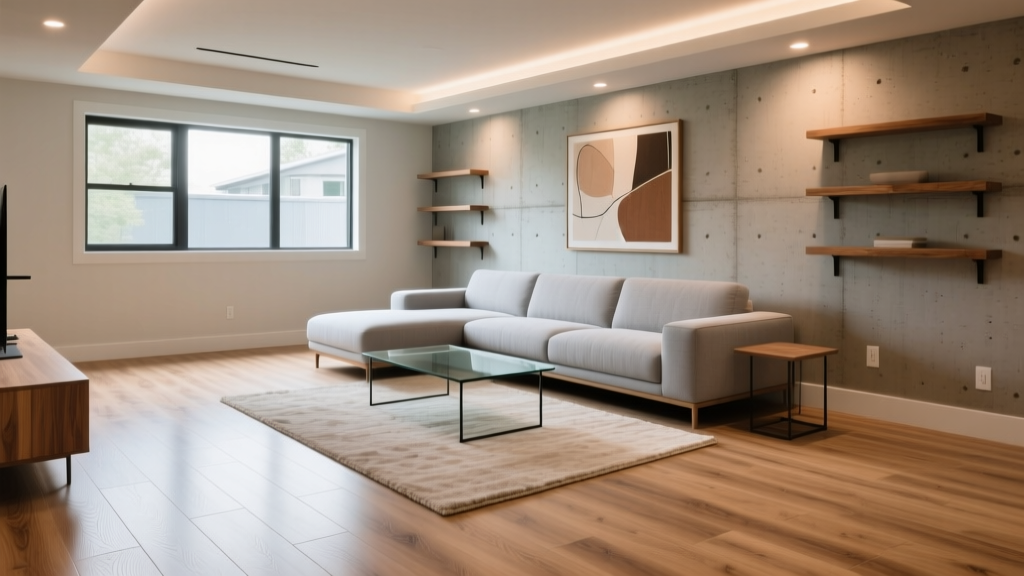
Deep Dive: Top 3 Affordable Basement Flooring Options
1. Rigid Core SPC (Stone Polymer Composite) Vinyl
SPC has largely replaced WPC (Wood Polymer Composite) as the premier choice for below-grade installations. The core is manufactured from limestone dust and polyvinyl chloride resin, making it dimensionally stable and completely impervious to water. Unlike WPC, which features a foamed core that can dent under heavy loads (like a pool table or heavy workbench), SPC's dense core resists indentation.
Installation Specifics: SPC requires a highly flat subfloor. The standard tolerance is 3/16-inch over a 10-foot radius. If your basement slab has significant undulations, the rigid click-lock mechanisms will eventually snap under foot traffic. Use a Portland cement-based self-leveling underlayment (SLU) to correct low spots before installation. Always specify a minimum 20-mil wear layer for residential basements to resist scratching from moving furniture.
2. Fiberglass-Backed Sheet Vinyl
Sheet vinyl is arguably the most budget-friendly option, but material selection is critical. You must specify fiberglass-backed sheet vinyl, not felt-backed. Felt backing acts like a sponge; if moisture vapor migrates through the concrete, the felt will absorb it, degrade, and harbor mold. Fiberglass backing is non-absorbent and allows the floor to be installed as a 'loose lay' or with double-sided perimeter tape, meaning it can be easily pulled up if the slab ever floods, dried out, and re-laid.
Pro-Tip: Minimize seams. In a standard basement, you can often order sheet vinyl in 12-foot or 15-foot widths to cover the space without requiring heat-welded seams, which are potential failure points for water ingress.
3. Interlocking PVC Garage Tiles (The Sleeper Pick)
Often overlooked for finished living spaces, commercial-grade interlocking PVC tiles (such as those manufactured by RaceDeck or SwissTrax) are exceptional for basements. They feature a raised, coin-pattern or diamond-pattern surface that sits on a suspended grid base. This design creates a natural 1/2-inch air gap between the flooring and the concrete slab.
This air gap is a massive advantage: it allows moisture vapor to evaporate and dissipate laterally rather than becoming trapped. Furthermore, if a sump pump fails and the basement takes on an inch of water, you can easily unzip the floor, wash the tiles in the driveway, let the slab dry, and snap them back together. Modern PVC tiles now come in slate and wood-grain textures that look highly appropriate in a finished basement gym, playroom, or utility space.
Materials to Avoid: The Budget Traps
- Solid Hardwood: Will cup, crown, and rot due to seasonal moisture fluctuations in the slab. No exception.
- OSB/Particleboard Subfloors: Never lay plywood or OSB directly on concrete as a subfloor for laminate or carpet. Even with a polyethylene vapor barrier, capillary action will eventually wick moisture into the wood, causing structural failure and mold.
- Carpet with Rubber Padding: Rubber padding traps moisture against the slab. If you must use carpet in a basement, use a synthetic, breathable pad and ensure the basement has an active, high-capacity dehumidifier running year-round.
Subfloor Strategies for Budget Builds
If you want to install laminate or engineered wood in your basement, you need a subfloor that manages moisture while keeping the flooring warm. The Department of Energy's guidelines on moisture control emphasize the need for capillary breaks in below-grade assemblies.
The most cost-effective engineered solution is a dimpled polyethylene membrane (e.g., Delta-FL or Platon). This material rolls out over the concrete like a heavy-duty tarp. The dimples create a 5/16-inch air space, while the high-density polyethylene (HDPE) acts as a Class I vapor retarder. You can either float your flooring directly on top of the membrane or snap a layer of 5/8-inch tongue-and-groove plywood over the membrane to create a nailable surface. This adds roughly $1.50 to $2.00 per square foot to your project but saves the floor from inevitable moisture damage.
Frequently Asked Questions
Can I use a liquid vapor barrier instead of a dimpled membrane?
Yes, but only for glue-down installations. Two-part epoxy moisture mitigation systems (like Mapei Primer WMB or Bostik MVP4) can seal slabs emitting up to 12 lbs of moisture vapor per 1,000 square feet per 24 hours. However, these epoxies cost roughly $3.00 to $4.50 per square foot and require meticulous shot-blasting or diamond-grinding of the concrete beforehand to ensure a mechanical bond. For floating affordable basement flooring options, a dimpled membrane is vastly more cost-effective and forgiving.
Will SPC vinyl flooring feel cold in the winter?
SPC conducts temperature similarly to tile; it will feel cool to the touch in a below-grade environment where ground temperatures hover around 55°F. To add thermal insulation without breaking the budget, use a 1mm to 1.5mm closed-cell IXPE (cross-linked polyethylene) underlayment. Many premium SPC products come with this IXPE pad pre-attached, which provides an R-value of approximately 0.5 and dampens the hollow sound of footsteps on concrete.
Written by
Priya KapoorPriya Kapoor is a real estate market analyst and construction economics researcher with expertise in housing affordability, development feasibility, and infrastructure investment. She holds a Master of Regional Planning from Cornell University and previously worked as a senior analyst at CBRE's Investment Properties group, where she modeled returns for $4B in mixed-use development pipelines. Priya now runs an independent research practice advising developers, municipalities, and REITs on construction cost forecasting and market timing. She publishes the quarterly "BuildMat Market Pulse" report tracking material price indices across 12 commodity categories. Based in Austin, TX, Priya serves on the board of Habitat for Humanity Austin and is a marathon runner.
More from Priya Kapoor
View all
Construction Cost
Cost to Build a 1600 Sq Ft Home in 2026: Full Breakdown
Accurate 2026 cost to build a 1600 sq ft home—material, labor, and regional pricing breakdowns included. Plan your budget with real-time estimates.
Aug 11, 2026

Wood & Lumber
Name the Types of Wood for Pressure Treatment and Preservation
Learn how to name the types of wood best suited for pressure treatment. Compare species treatability, chemical retention levels, and 2026 preservation costs.
Aug 4, 2026

Stone & Masonry
Stone Veneer Suppliers Lindenhurst: 2026 Cost Analysis
Analyze 2026 stone veneer costs in Lindenhurst, NY. Compare local supplier pricing, delivery fees, and Suffolk County installation labor rates.
Aug 4, 2026