Best Insecticide for Carpet Beetles: Flooring Scenario Guide
Match the right insecticide for carpet beetles to your specific flooring. Expert guide on active ingredients, mix rates, and substrate safety.
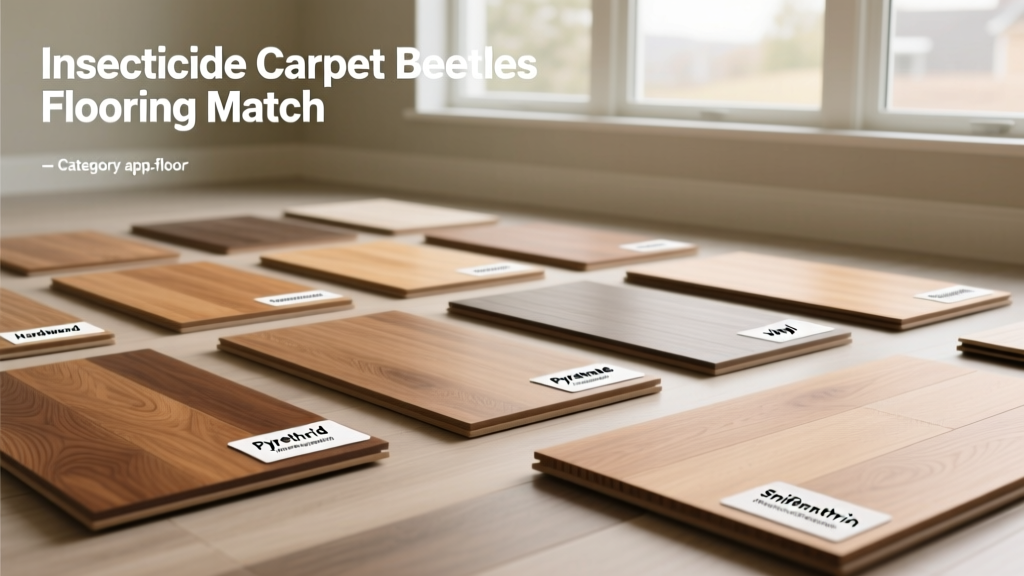
The Biology of the Threat: Why Substrate Matters
Carpet beetles (primarily Anthrenus verbasci and Attagenus unicolor) do not attack flooring randomly. The larvae of these Dermestid beetles require keratin and animal proteins to develop. Consequently, natural fiber floors like wool, silk, and animal hide rugs face direct consumption, while synthetic carpets (nylon, polyester) and hard surfaces (hardwood, luxury vinyl plank) only suffer indirect damage from larvae feeding on trapped organic debris, pet dander, or spilled food.
According to UC Agriculture and Natural Resources, matching your chemical intervention to the specific flooring substrate is critical. Applying the wrong formulation can permanently stain natural fibers, fail to penetrate hardwood expansion gaps, or leave toxic residues on synthetic surfaces where children play. As of 2026, modern pest control relies on non-repellent chemistries and Insect Growth Regulators (IGRs) rather than broad-spectrum pyrethroid bombs, which merely scatter the larvae deeper into the subfloor.
Scenario Matching Matrix: Insecticide Selection by Flooring Material
Use the following decision matrix to select the correct active ingredient and product formulation based on your primary flooring type.
| Flooring Substrate | Primary Threat Profile | Recommended Active Ingredient | Top Product Match (2026) | Application Technique |
|---|---|---|---|---|
| Wool / Natural Fiber | Direct consumption of keratin fibers by larvae. | Dinotefuran (Non-repellent) + Hydroprene (IGR) | Alpine WSG + Gentrol IGR | Broad fan spray; low pressure to avoid driving larvae deep into padding. |
| Synthetic Carpet | Larvae feeding on trapped organic debris and pet hair. | Imidacloprid + Beta-cyfluthrin | Temprid FX | Targeted baseboard and high-traffic zone spray. |
| Hardwood / Laminate | Larvae hiding in expansion gaps and subfloor voids. | Amorphous Silica Gel (Desiccant Dust) | CimeXa Dust | Crack and crevice injection using a bulb duster. |
| Area Rugs (Stored) | Pupae and adults emerging in dark, undisturbed storage. | Pyriproxyfen (Photostable IGR) | NyGuard IGR | Pre-storage misting and sealed encapsulation. |
Deep Dive: Treatments for Natural Fiber and Wool Carpets
Wool carpets are the most vulnerable to carpet beetle larvae. The primary mistake homeowners make is using Emulsifiable Concentrate (EC) pyrethroids on wool. EC formulations contain petroleum distillates that permanently stain natural fibers and leave an oily residue that traps dirt.
The Alpine WSG Protocol
Alpine WSG (Water Soluble Granule) utilizes Dinotefuran (40%), a third-generation neonicotinoid. Because it dissolves completely in water, it leaves zero visible residue on wool fibers and will not alter the carpet's pH or texture. More importantly, it is a non-repellent. Carpet beetles cannot detect it, meaning they will crawl through the treated zone and transfer the chemical to other larvae in the padding via physical contact.
- Mix Rate: 10 grams to 20 grams of Alpine WSG per 1 gallon of water.
- Coverage: 1 gallon per 1,000 square feet.
- Crucial Additive: Always tank-mix with an IGR like Gentrol (Hydroprene 9%) at 1 oz per gallon. The IGR mimics juvenile hormones, preventing larvae from molting into reproductive adults, effectively breaking the breeding cycle.
Wool fibers are naturally slightly acidic (pH 4.5 to 5.5). If you have recently cleaned your wool carpet with a highly alkaline shampoo (pH 9+), the alkaline residue can rapidly degrade the efficacy of Dinotefuran and IGRs. Ensure the carpet is thoroughly rinsed and neutralized before applying any chemical treatment.
Deep Dive: Synthetic Carpets and Hardwood Crevices
Synthetic carpets (nylon, olefin) are immune to direct beetle consumption, but the jute backing and the accumulated detritus within the pile provide ample food. For synthetics, Temprid FX (Imidacloprid 21% + Beta-cyfluthrin 10.5%) offers a dual-mode attack. The beta-cyfluthrin provides a rapid knockdown of active adults, while the imidacloprid leaves a long-lasting residual for emerging larvae.
Hardwood and Laminate Expansion Gaps
Liquid sprays are largely ineffective on hardwood floors because carpet beetle larvae retreat into the microscopic expansion gaps between planks and the subfloor voids beneath. Liquids simply pool on the surface and evaporate. According to Clemson University Extension, desiccant dusts are the superior choice for hard surfaces.
CimeXa Dust (Amorphous Silica Gel) works mechanically, not chemically. When larvae crawl through the dust, the silica particles absorb the waxy cuticle of their exoskeleton, causing rapid dehydration and death. Because it is a physical desiccant, beetles cannot develop genetic resistance to it.
- Application: Use a handheld bulb duster or a bellows duster to inject a barely visible layer of dust into baseboard seams, transition strips, and hardwood expansion gaps.
- Longevity: In dry, undisturbed subfloor voids, CimeXa remains active for up to 10 years.
Cost Analysis: Professional Extermination vs. DIY Chemical Protocols
Understanding the financial commitment helps in deciding whether to hire a licensed operator or execute a DIY protocol. Prices below reflect national averages for 2026.
| Treatment Route | Estimated Cost (per 1,500 sq ft home) | Pros | Cons |
|---|---|---|---|
| DIY Chemical Protocol | $90 - $140 | Complete control over product quality; uses professional-grade non-repellents. | Requires purchasing a pump sprayer, PPE, and precise mixing; labor-intensive. |
| Professional Spot Treatment | $250 - $400 | Guaranteed application; technicians have access to commercial-grade IGRs and dusting equipment. | May require multiple visits; some companies still use outdated, repellent pyrethroids. |
| Whole-Home Heat Treatment | $1,200 - $2,500 | Chemical-free; kills all life stages (eggs, larvae, pupae, adults) in a single day. | Extremely expensive; requires specialized equipment and may damage sensitive hardwood finishes. |
Step-by-Step Application Protocol for Maximum Efficacy
Chemical selection is only 50% of the battle. The application sequence dictates whether the infestation is eradicated or merely suppressed.
- Aggressive Vacuuming (Day 1): Vacuum all carpets, rugs, and baseboards using a beater-bar attachment. This removes up to 40% of the larvae and, crucially, the physical vibration stimulates pupae to emerge into the vulnerable adult stage. Immediately seal and dispose of the vacuum bag outside.
- Preparation and Mixing (Day 2): Mix your chosen liquid insecticide (e.g., Alpine WSG) and IGR in a 1-gallon pump sprayer. Agitate the tank thoroughly. Do not let the mixture sit for more than 24 hours, as IGRs can degrade in standing water.
- Targeted Application (Day 2): Apply the spray to the carpet surface, focusing heavily on the perimeter (the outer 2 feet of the room), under furniture, and in dark closets. Use a fine fan-spray nozzle. Do not soak the carpet; a light, even mist is sufficient.
- Dust Injection (Day 2): While the carpet is damp, apply desiccant dust (CimeXa) into the cracks where the carpet meets the baseboard, and under the edge of the carpet tack strip.
- The Waiting Period (Days 3-14): Allow the treatment to dry completely (usually 2-4 hours). Do not vacuum or wash the treated areas for at least 14 days. Premature vacuuming removes the residual chemical before emerging adults and late-stage larvae can contact it.
Common Failure Modes and Edge Cases
Even with professional-grade chemicals, treatments fail when specific biological or environmental edge cases are ignored.
- The Pupae Immunity Window: Carpet beetle pupae are encased in a protective shell that is virtually impervious to chemical insecticides and IGRs. If a room has a heavy population of pupae, you will continue to see adult beetles emerging for 2 to 4 weeks after treatment. This is not a failure of the chemical; it is a biological reality. The residual insecticide will kill the adults as soon as they emerge and contact the treated surface.
- Ignoring the Source Material: Treating the floor while ignoring a nearby source—such as an abandoned bird nest in the attic, a taxidermy mount, or a bag of dry pet food in the pantry—will result in endless re-infestation. Carpet beetles often originate in these hidden protein sources and migrate to the floors.
- UV Degradation of IGRs: Standard IGRs like Hydroprene break down rapidly under direct ultraviolet light. If treating a sunroom or a floor with heavy, direct sunlight exposure, you must switch to a photostable IGR like NyGuard (Pyriproxyfen 10%), which maintains its molecular integrity under UV exposure for up to 6 months.