High-Traffic Office Flooring Options: A Durability Analysis
Analyze the most durable office flooring options for high-traffic zones. Compare LVT, carpet tile, and concrete wear layers, lifespans, and failure modes.

The Core Metrics of Commercial Flooring Durability
Specifying office flooring requires moving beyond aesthetic samples to evaluate mechanical resilience, rolling load tolerance, and moisture vulnerability. In commercial environments, durability is not a single metric but a composite of standardized performance thresholds. The GSA PBS-P100 Facilities Standards mandate rigorous testing for federal workspaces, establishing benchmarks that private enterprises should adopt to minimize lifecycle replacement costs.
True durability analysis relies on three primary ASTM standards: ASTM F1700 for solid vinyl tile classification, ASTM D2859 for carpet flammability and wear, and ASTM F2170 for subfloor moisture limits. Ignoring these metrics leads to premature failure modes such as edge curling, delamination, and adhesive degradation, which cost facilities managers an average of $4 to $8 per square foot in remediation and downtime.
Material-by-Material Durability Matrix
The following matrix compares the most common commercial office flooring options based on minimum specifications required to withstand heavy caster traffic and static loads typical of modern open-plan workspaces.
| Material | Minimum Commercial Spec | Rolling Load Limit | Expected Lifespan | Primary Failure Mode |
|---|---|---|---|---|
| Luxury Vinyl Tile (LVT) | 28-mil wear layer | 250 lbs | 15-20 years | Edge curling / Plasticizer migration |
| Carpet Tile | 24 oz/yd² Nylon 6,6 | 150 lbs | 10-15 years | Edge ravel / Backing delamination |
| Polished Concrete | Lithium densifier required | Unlimited | 20+ years | Micro-cracking / MVER adhesive failure |
| Ceramic/Porcelain Tile | PEI Rating IV or V | 300+ lbs | 25+ years | Grout degradation / Subfloor deflection |
| Rubber Flooring | 3.0mm homogeneous | 200 lbs | 15-20 years | Surface oxidation / UV yellowing |
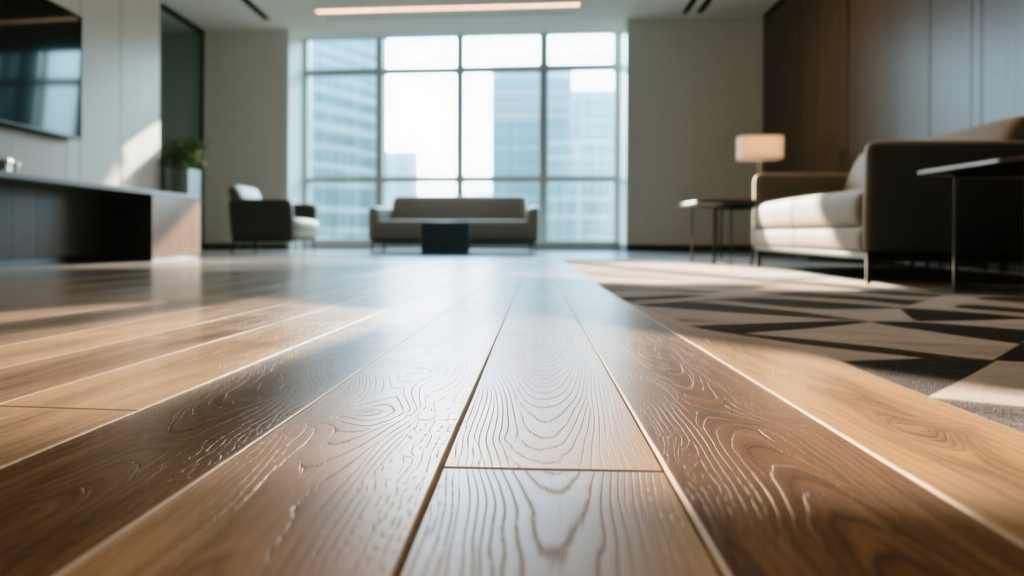
Luxury Vinyl Tile (LVT): The Wear Layer Reality
LVT dominates the commercial sector due to its balance of acoustic dampening and visual versatility. However, durability is strictly dictated by the wear layer thickness and topcoat chemistry, not the overall plank thickness.
Mil Thickness and Caster Traffic
For high-traffic corridors and open-plan desk zones, a 20-mil wear layer is insufficient. The continuous rolling of polyurethane office chair casters generates localized friction that will breach a 20-mil layer within 3 to 5 years, exposing the printed film and causing rapid visual degradation. Specify a minimum 28-mil wear layer for general office use, and a 40-mil wear layer for heavy-traffic lobbies or pathways leading to elevators.
Topcoat Chemistry: Urethane vs. Ceramic Bead
The wear layer must be protected by a high-performance topcoat. Standard urethane coatings require frequent stripping and waxing to maintain scratch resistance. In contrast, ceramic bead or diamond-infused urethane topcoats (often branded as Diamond 10 or similar proprietary technologies) provide a matte finish that resists micro-scratches and eliminates the need for periodic stripping, reducing annual maintenance costs by up to 40%.
Carpet Tiles: Face Weight, Fiber, and Backing Systems
While hard surfaces are trending, carpet tiles remain essential for acoustic control in executive suites and collaborative zones. Durability in carpet is a function of fiber polymer density and backing dimensional stability.
Nylon 6 vs. Nylon 6,6
Always specify Nylon 6,6 over Nylon 6 for commercial applications. Nylon 6,6 possesses a tighter molecular structure and a higher melting point, providing superior resistance to crushing and matting under heavy static loads like conference tables. Furthermore, solution-dyed Nylon 6,6 fibers offer inherent stain and bleach resistance, allowing facilities teams to use aggressive cleaning agents without stripping the color.
Backing Systems and Edge Ravel
The most common failure in carpet tiles is edge ravel and delamination. Avoid standard PVC backings in environments with fluctuating HVAC humidity. Instead, specify polyolefin or engineered cushion backings. Cushion backings not only absorb the impact of foot traffic—extending fiber life by up to 50%—but also provide superior dimensional stability, preventing the tiles from shrinking or expanding and creating trip hazards.
Polished Concrete: The Hidden Moisture Threat
Polished concrete offers an industrial aesthetic and virtually unlimited rolling load capacity. However, its durability is entirely dependent on the subfloor's moisture profile and the densification process.
MVER and Relative Humidity Testing
Before applying any densifier, stain, or topical guard to a concrete slab, you must verify the Moisture Vapor Emission Rate (MVER). According to ASTM F2170 Concrete Moisture Testing Guidelines, in-situ relative humidity (RH) testing using embedded probes is the only reliable method for modern slabs. The RH must read below 75% before proceeding. If moisture levels exceed this threshold, the alkaline salts within the concrete will migrate to the surface, causing efflorescence, white hazing, and eventual peeling of any topical sealers.
Chemical Densification
Mechanical polishing alone does not harden the concrete. You must apply a lithium silicate densifier. Lithium molecules are smaller than sodium or potassium alternatives, allowing them to penetrate deeper into the capillary pores of the concrete. This triggers a pozzolanic reaction that permanently hardens the surface, preventing the micro-cracking and dusting that plagues poorly processed polished concrete floors.
Zone-Specific Decision Framework
Selecting the right office flooring option requires mapping material properties to specific functional zones within the floorplan.
- Main Lobbies and Elevator Corridors: Specify 40-mil LVT with a ceramic bead topcoat or PEI V rated large-format porcelain tile. These areas experience high abrasion from street grit and heavy rolling luggage. Avoid carpet and standard VCT here due to rapid wear patterns.
- Open-Plan Workspaces: Utilize 28-mil LVT for primary walkways to handle caster traffic, transitioning to 24 oz/yd² Nylon 6,6 carpet tiles under desk clusters to dampen acoustic reverberation and provide underfoot comfort for standing desk users.
- Breakrooms and Pantries: Specify homogeneous rubber flooring or slip-resistant ceramic tile. LVT and carpet are highly vulnerable to prolonged water exposure and acidic food spills, which can break down LVT plasticizers and stain carpet fibers permanently.
- Server Rooms and IT Closets: Use static-dissipative (SD) vinyl tile or ESD-rated carpet tiles. Standard flooring materials can generate triboelectric charges that damage sensitive server hardware.
By aligning material specifications with localized traffic and environmental stressors, facilities managers can extend the lifecycle of their flooring investments by 30% to 50%, ensuring the physical workspace performs reliably for decades.
Written by
Elena RodriguezElena Rodriguez is a civil engineer and technical writer specializing in concrete technology, masonry systems, and ASTM/ACI compliance. She earned her B.S. in Civil Engineering from Texas A&M University and spent a decade at a materials testing laboratory, performing over 2,000 concrete compressive strength tests and masonry prism evaluations. Elena is an ACI-certified Field Testing Technician (Grade I) and a member of ASTM Committee C12 on Natural Building Stone. She currently consults on forensic engineering cases involving concrete failures and moisture intrusion. Based in San Antonio, TX, Elena is a proud member of the Society of Women Engineers (SWE) and coaches her daughter's FIRST Robotics team.
More from Elena Rodriguez
View all
Walls & Panels
Cost Analysis: Light Gauge Steel Framing Advantages and Disadvantages
Evaluate light gauge steel framing advantages and disadvantages through a strict cost analysis lens, comparing material, labor, and lifecycle expenses.
Aug 4, 2026

Walls & Panels
Gypsum Board Types: Exact Specifications, Thickness & Dimensions
Compare standard, Type X, and moisture-resistant gypsum board types. Get exact specifications, thicknesses, dimensions, and ASTM standards for your project.
Aug 4, 2026

Fire Resistance
Best Fire-Resistant Outdoor Decking Materials: 2026 Buyer Guide
Discover the best fire-resistant outdoor decking materials for 2026. Compare Class A PVC, aluminum, and hardwood options for WUI compliance and safety.
Aug 4, 2026