Popular Flooring Options: 2026 Room-by-Room Buyer Guide
Compare the most popular flooring options for 2026. Get room-by-room recommendations, exact costs per square foot, and durability ratings for your home.
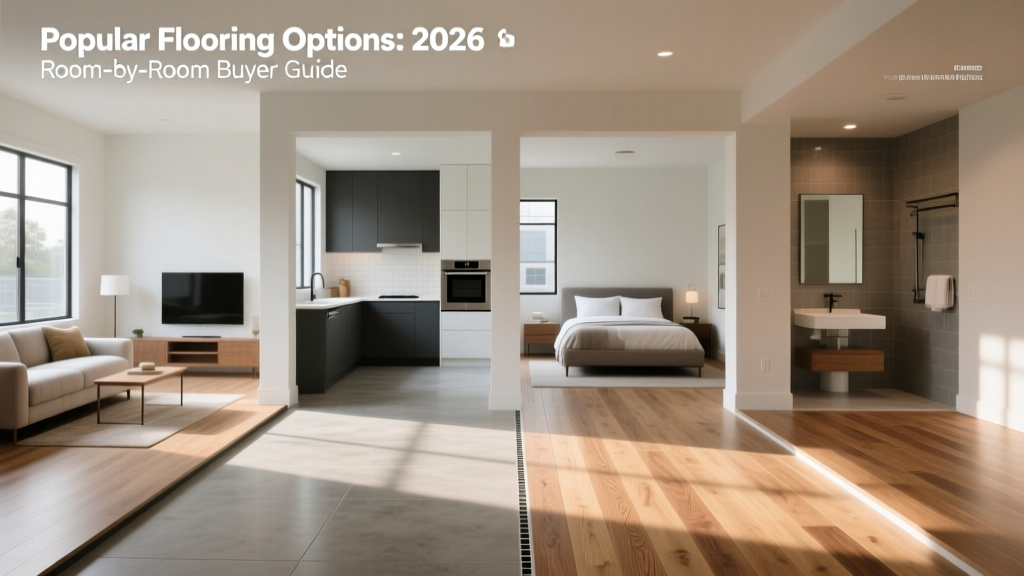
The 2026 Flooring Landscape: What Is Actually Selling
When evaluating popular flooring options for modern renovations, the market has decisively shifted toward high-performance synthetics and engineered naturals. According to recent industry data from Floor Covering News, rigid core luxury vinyl and waterproof laminate now account for over 45% of residential flooring sales, largely displacing traditional sheet vinyl and standard laminate.
Room-by-Room Decision Matrix
Choosing the right material requires matching the floor's physical properties to the room's environmental stressors. Use this matrix to narrow down your selection before looking at specific brands.
| Room / Zone | Primary Stressor | Top Recommendation | Runner-Up |
|---|---|---|---|
| Kitchen | Spills, dropped utensils | Rigid Core LVP (SPC) | Porcelain Tile |
| Living / Dining | Foot traffic, aesthetics | Engineered Hardwood | WPC Luxury Vinyl |
| Bathroom | Standing water, humidity | Porcelain Tile | Sheet Vinyl |
| Bedroom | Comfort, acoustics | Engineered Hardwood | Carpet / Wool Rug |
| Mudroom / Entry | Abrasive dirt, moisture | Slate / Porcelain Tile | Polished Concrete |
Deep Dive: The Big Four Popular Flooring Options
1. Luxury Vinyl Plank (LVP) & Tile (LVT)
LVP remains the undisputed champion of waterproof, budget-friendly flooring. However, not all vinyl is created equal. For 2026 installations, you must differentiate between SPC (Stone Plastic Composite) and WPC (Wood Plastic Composite) cores.
- SPC (Stone Plastic Composite): Features a limestone-dust core. It is highly dense, rigid, and resistant to indentation from heavy furniture (like kitchen islands or pianos). Best for high-traffic commercial or active residential zones.
- WPC (Wood Plastic Composite): Contains a foaming agent that makes the core thicker and softer. It offers superior underfoot comfort and sound dampening, making it ideal for second-story bedrooms or living rooms.
2. Engineered Hardwood
Solid hardwood is highly susceptible to dimensional changes caused by humidity fluctuations. Engineered hardwood solves this by bonding a real wood veneer over a cross-plywood core, providing structural stability that allows installation over concrete slabs and radiant heat systems.
The Veneer Thickness Trap: Many big-box stores sell engineered hardwood with a 1.2mm or 2mm veneer. These cannot be sanded and refinished. To ensure your floor lasts 50+ years, specify a 3mm to 4mm wear layer. Premium brands like Kahrs or Mullican offer 4mm veneers that can be professionally sanded up to three times over the floor's lifespan. European White Oak remains the most requested species due to its tight grain pattern and compatibility with modern matte finishes.
3. Porcelain and Ceramic Tile
Tile is the only truly permanent flooring option on this list. When selecting tile, ignore the marketing names and look for two technical specifications:
- PEI Rating (Porcelain Enamel Institute): Dictates abrasion resistance. Residential floors require a minimum PEI III. For entries and kitchens with heavy foot traffic, specify PEI IV.
- DCOF (Dynamic Coefficient of Friction): Measures slip resistance. According to the Tile Council of North America (TCNA), wet-area tiles (bathrooms, mudrooms) must have a DCOF of 0.42 or higher to meet safety standards.
4. Waterproof Laminate
Traditional laminate swells and ruins when exposed to water. The newest generation of waterproof laminate features tightly locking click-systems and hydrophobic core treatments that prevent water from penetrating the seams for up to 72 hours. While it offers a more authentic wood feel and better scratch resistance than LVP, it is not submersible. It is an excellent choice for living rooms and dining areas where occasional spills occur, but it should not be used in full bathrooms.
2026 Cost Breakdown: Material vs. Installed Pricing
Budgeting requires looking beyond the sticker price of the material. Subfloor preparation, underlayment, and transition moldings typically add 15% to 25% to the total project cost. Below are the average national rates for 2026.
| Material Type | Material Cost (per sq. ft.) | Professional Install (per sq. ft.) | Total Estimated Cost |
|---|---|---|---|
| Rigid Core LVP (20-mil) | $3.50 - $6.50 | $2.00 - $3.50 | $5.50 - $10.00 |
| Engineered Hardwood (3mm+) | $7.00 - $13.00 | $4.50 - $7.00 | $11.50 - $20.00 |
| Porcelain Tile (Large Format) | $4.00 - $9.00 | $6.00 - $12.00 | $10.00 - $21.00 |
| Waterproof Laminate | $3.00 - $5.50 | $2.50 - $4.00 | $5.50 - $9.50 |
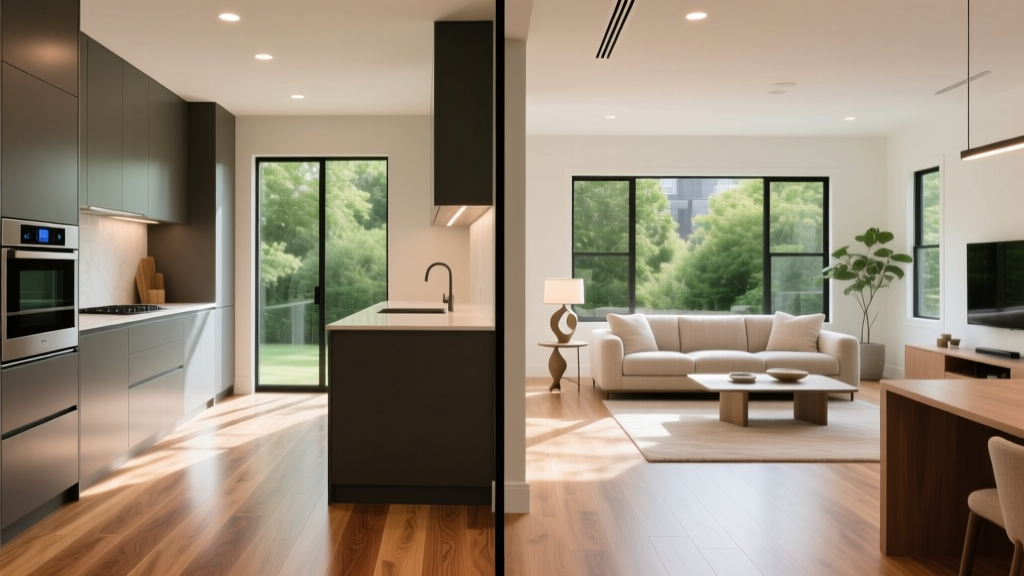
Critical Installation Gotchas & Failure Modes
Even premium materials will fail if installed incorrectly. The National Wood Flooring Association (NWFA) reports that over 80% of wood and laminate flooring failures are moisture-related. Protect your investment by enforcing these site-specific protocols:
- Moisture Vapor Emission Rate (MVER): Before installing any glue-down or floating floor over a concrete slab, the contractor must perform a calcium chloride test or use an in-situ relative humidity (RH) probe. If the slab emits more than 3-5 lbs of moisture per 1,000 sq. ft. per 24 hours, a penetrating epoxy moisture barrier must be applied first.
- Subfloor Flatness for LVP: Rigid core LVP is unforgiving of uneven subfloors. The industry standard requires the subfloor to be flat within 3/16 inch over a 10-foot radius. If your contractor skips self-leveling compound on a wavy subfloor, the locking mechanisms will eventually snap under foot traffic.
- Expansion Gaps: All floating floors (LVP, laminate, engineered wood) expand and contract with temperature changes. A strict 1/4-inch to 3/8-inch expansion gap must be maintained around the entire perimeter, including door jambs and pipes. Failing to undercut door jambs is the leading cause of floor buckling in the summer.
Frequently Asked Questions
Can I install radiant heating under luxury vinyl plank?
Yes, but with strict limitations. You must use LVP specifically rated for radiant heat by the manufacturer. Furthermore, the surface temperature of the floor must never exceed 85°F (29°C). Exceeding this temperature will cause the PVC core to soften, expand, and permanently deform.
Is wide-plank engineered hardwood prone to cupping?
Wide planks (7 inches and wider) are inherently more prone to cupping than narrow strips if the indoor humidity drops below 30% or spikes above 50%. To prevent this, install a whole-home humidification system to maintain a consistent 35%-45% relative humidity year-round.
What is the best underlayment for soundproofing LVP in a condo?
Most premium rigid core LVP comes with an attached cork or IXPE foam pad. If your HOA requires an IIC (Impact Insulation Class) rating of 50 or higher, you may need to add a specialized acoustic underlayment like QuietWalk Luxury Vinyl, ensuring the combined thickness does not compromise the plank's click-lock integrity.
Written by
David NakamuraDavid Nakamura is a licensed architect (AIA) and construction technology writer focused on sustainable building methods, mass timber engineering, and high-performance building envelopes. He holds a Master of Architecture from the University of Washington and is a certified Passive House Consultant (CPHC). David spent eight years at the Seattle firm Mithun, where he led the design of three LEED Platinum projects, before founding his own practice specializing in net-zero residential design. He serves on the editorial advisory board of GreenBuilder Magazine and has authored peer-reviewed papers on cross-laminated timber (CLT) connections for the Journal of Structural Engineering. In his spare time, David teaches woodworking at Pratt Fine Arts Center and kayaks the Puget Sound.
More from David Nakamura
View all
Construction Cost
Labor Cost to Build a Deck Per Sq Ft: 2026 Installation Guide
Discover the exact labor cost to build a deck per sq ft in 2026. This installation guide breaks down contractor rates, complexity factors, and hidden fees.
Aug 4, 2026

Construction Cost
How Much Does It Cost to Build a 3 Bedroom House? Financing Guide
Learn exactly how much it costs to build a 3 bedroom house and explore 2026 financing options, construction loan types, and budget frameworks for your build.
Aug 4, 2026

Construction Cost
Cost to Build a Tennis Court: 2026 Guide
How much does it cost to build a tennis court in 2026? Breakdowns for asphalt, concrete, and synthetic surfaces plus fencing and lighting.
Jul 30, 2026