Low Pile Carpet Cost Calculator & Installation Pricing Guide
Calculate exact low pile carpet costs with our pricing guide. Learn roll-width math, padding density rules, and hidden installation fees.
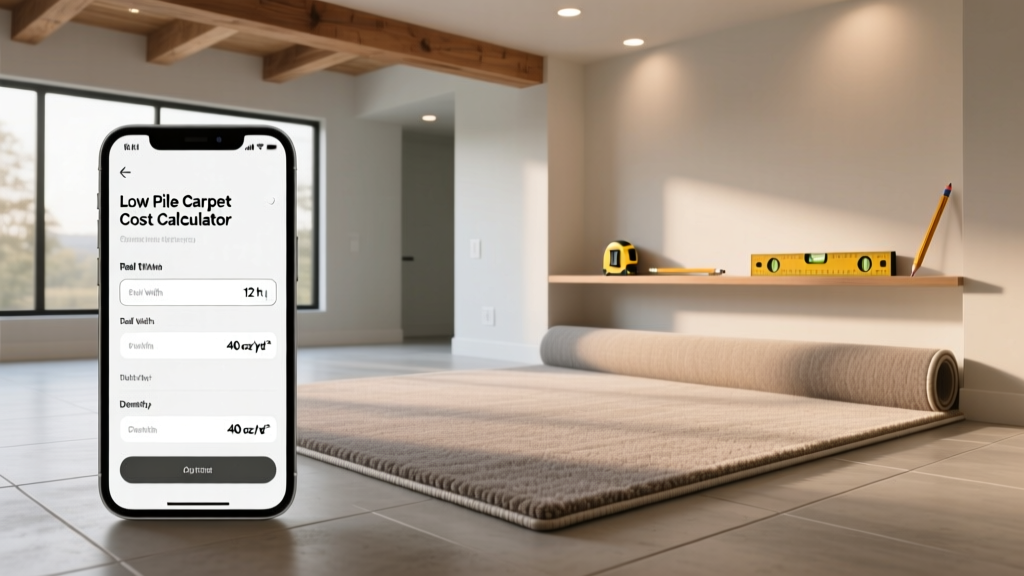
The 'Roll Width' Trap: Why Standard Calculators Fail for Carpet
Most online flooring calculators operate on a simple formula: multiply the room's length by its width and add a 10% waste factor. While this works for hard surface tiles or vinyl planks, applying this logic to low pile carpet (such as Berber, level-loop, or commercial cut-pile) will result in severe material shortages and budget overruns.
Carpet is manufactured in fixed roll widths—almost universally 12 feet wide, with some commercial grades available in 15 feet. You cannot purchase a 10-foot wide strip off a 12-foot roll without paying for the full 12-foot width. If your room is 10 feet by 12 feet (120 square feet), a standard calculator estimates 132 square feet. However, the carpet mill will cut a 12-foot by 12-foot piece, meaning you are actually purchasing and paying for 144 square feet.
Step-by-Step Low Pile Carpet Quantity Calculation
To build an accurate quantity estimate for low pile carpet, follow this sequential logic rather than relying on basic square footage:
- Determine the Primary Run: Measure the longest continuous dimension of the room. If the room is 14 feet wide and 18 feet long, you cannot use a single 12-foot roll without a seam. You will need to map out how the 12-foot strips will lay.
- Map the Seams: Low pile carpets like Berber do not have a directional nap (unlike plush cut-pile), making seams slightly easier to hide. However, you still need a 2-inch overlap for trimming and seaming tape. Add 2 inches to every seam line.
- Calculate the Total Cut: Add the square footage of all required strips based on the 12-foot width constraint.
- Apply the Waste Factor: Add 5% for standard rectangular rooms, or 10-15% for L-shaped rooms, stairs, or spaces with multiple doorways and closets.
2026 Material Cost Matrix: Low Pile Fibers & Backings
Low pile carpets are defined by their short, dense fiber loops or cuts. The fiber material dictates both the price per square foot and the long-term crush resistance. Below is the current market pricing for residential and light-commercial low pile options.
| Fiber Type | Cost per Sq. Ft. | Cost per Sq. Yd. | Best Application & Traits |
|---|---|---|---|
| Solution-Dyed Nylon (e.g., Shaw Anso) | $3.50 - $7.00 | $31.50 - $63.00 | High-traffic hallways, basements. Exceptional crush recovery and stain resistance. |
| Triexta / PTT (e.g., Mohawk SmartStrand) | $4.00 - $8.50 | $36.00 - $76.50 | Pet-heavy homes. Inherent stain resistance without chemical topical treatments. |
| Olefin / Polypropylene | $1.50 - $3.00 | $13.50 - $27.00 | Budget rentals, indoor/outdoor. Highly stain-resistant but prone to oil-based staining and rapid crushing. |
| Wool (Level Loop) | $12.00 - $25.00+ | $108.00 - $225.00+ | Luxury offices, formal spaces. Natural fire resistance, premium aesthetic, requires specialized cleaning. |
The Padding Imperative: Density vs. Thickness
The most frequent failure mode in low pile carpet installation is pairing it with the wrong cushion. Homeowners often assume 'thicker is better' and purchase plush, 1/2-inch foam padding. This is a critical error.
According to the Carpet and Rug Institute (CRI) guidelines, low pile and Berber carpets require a firm, dense cushion to prevent the carpet backing from flexing. Excessive flexing breaks the latex adhesive holding the fibers to the primary backing, leading to delamination, wrinkling, and premature wear.
You must specify a cushion with a maximum thickness of 7/16 inch (3/8 inch is optimal) and a minimum density of 8 pounds per cubic foot for rebond (urethane) foam. If using felt or rubber, ensure it is rated for high-traffic commercial use. Using a soft, thick pad will void most manufacturer warranties.
Premium 8lb rebond padding typically costs between $0.65 and $1.10 per square foot, while high-density synthetic felt (like 40oz or 60oz) ranges from $1.25 to $2.00 per square foot. Do not skimp on this component; a $0.50/sq ft savings on padding will cost you thousands in premature carpet replacement.
Labor, Prep, and Ancillary Cost Estimator
Material costs are only half the equation. Installation labor for carpet is generally priced per square foot, but ancillary prep work is where budgets quietly balloon. Based on current national averages reported by Angi's home cost experts, here is the breakdown of labor and prep fees you must include in your calculator.
- Standard Installation (Includes Pad): $0.50 to $1.25 per sq. ft. (Covers tack strip placement, stretching, and seaming).
- Old Carpet & Pad Tear-Out: $0.25 to $0.75 per sq. ft. (Higher if the old pad is glued to concrete).
- Disposal and Haul-Away: $150 to $300 flat fee per project, or $0.10 per sq. ft.
- Furniture Moving: $50 to $150 per room. (Installers will not move fragile items, electronics, or heavy safes).
- Baseboard / Shoe Molding Removal & Reinstall: $1.50 to $3.50 per linear foot. (Required if existing moldings are too low to tuck the new carpet and pad).
- Concrete Floor Leveling / Patching: $1.50 to $4.00 per sq. ft. for high spots or cracked slabs that could cause the low pile carpet to show imperfections.
Real-World Estimation Scenarios
To demonstrate how the roll-width constraint and ancillary costs impact the final bottom line, let us run two distinct scenarios through our estimation logic.
Scenario A: The Standard 12x15 Bedroom (180 Sq. Ft.)
This room perfectly aligns with a 12-foot roll width, minimizing waste.
- Dimensions: 12' width x 15' length.
- Material Cut: 12' x 15' = 180 sq. ft. (20 sq. yards). No waste factor needed for width.
- Carpet (Mid-grade Nylon): 20 sq yd x $45.00 = $900.00
- Padding (8lb Rebond): 180 sq ft x $0.85 = $153.00
- Install & Tear-out: 180 sq ft x $1.25 = $225.00
- Disposal & Furniture: $200.00 flat
- Total Estimated Cost: $1,478.00 ($8.21 per sq. ft. total project cost)
Scenario B: The 14x18 L-Shaped Basement (Approx. 210 Sq. Ft. Net)
This space requires seaming and generates off-cuts due to the 14-foot width exceeding the 12-foot roll.
- Dimensions: 14' width x 18' length (252 gross sq ft, but 42 sq ft is cut out for the 'L' shape = 210 net sq ft).
- Material Cut: You must buy a 12' x 18' piece (216 sq ft) AND a 12' x 6' piece to fill the remaining 2-foot width gap (72 sq ft). Total purchased = 288 sq. ft. (32 sq. yards).
- Carpet (Solution-Dyed Nylon): 32 sq yd x $55.00 = $1,760.00
- Padding (8lb Rebond): 288 sq ft x $0.85 = $244.80
- Install, Seaming & Tear-out: 288 sq ft x $1.50 (higher due to complex seaming) = $432.00
- Disposal & Furniture: $250.00 flat
- Total Estimated Cost: $2,686.80 ($12.79 per net sq. ft. total project cost)
As demonstrated in Scenario B, the 'net' square footage of the room is highly deceptive. By calculating based on the physical constraints of the 12-foot roll and the necessary seam overlaps, you avoid the common pitfall of under-ordering material and facing costly back-orders or dye-lot mismatches.