LVT Flooring Selection Guide: Taxonomy, Wear Layers & Costs
Master LVT flooring selection with our material taxonomy guide. Compare SPC, WPC, and flexible LVT wear layers, costs, and installation methods.
The Anatomy of LVT: Decoding the Layers
Luxury Vinyl Tile (LVT) is not a single homogeneous material; it is a highly engineered, multi-layered composite. Understanding the exact function of each stratum is critical for predicting long-term performance, especially in high-traffic or moisture-prone environments. According to the Resilient Floor Covering Institute (RFCI), modern LVT generally consists of four primary layers:
- Wear Layer (Top Coat): This is the clear, protective urethane or aluminum oxide shield. Thickness is measured in 'mils' (1 mil = 0.001 inches). For residential applications, a 12-mil to 20-mil wear layer is standard. Light commercial spaces require a minimum of 20 mils, while heavy commercial zones demand 28+ mils. Many premium 2026 product lines incorporate ceramic bead technology or diamond-infused urethane to resist micro-scratches.
- Printed Decorative Film: A high-resolution photographic layer that mimics wood, stone, or concrete. High-end manufacturers now use Embossed-in-Register (EIR) technology, where the physical texture of the wear layer perfectly aligns with the visual grain of the printed film, creating hyper-realistic tactile feedback.
- Core Layer: The structural backbone that dictates dimensional stability, indentation resistance, and waterproofing. This layer defines the material taxonomy (Flexible, SPC, or WPC), which we detail below.
- Backing Layer: Often composed of attached IXPE (cross-linked polyethylene) or natural cork. This layer provides acoustic dampening, minor subfloor forgiveness, and underfoot comfort.
Material Taxonomy Matrix: Flexible vs. Rigid Core
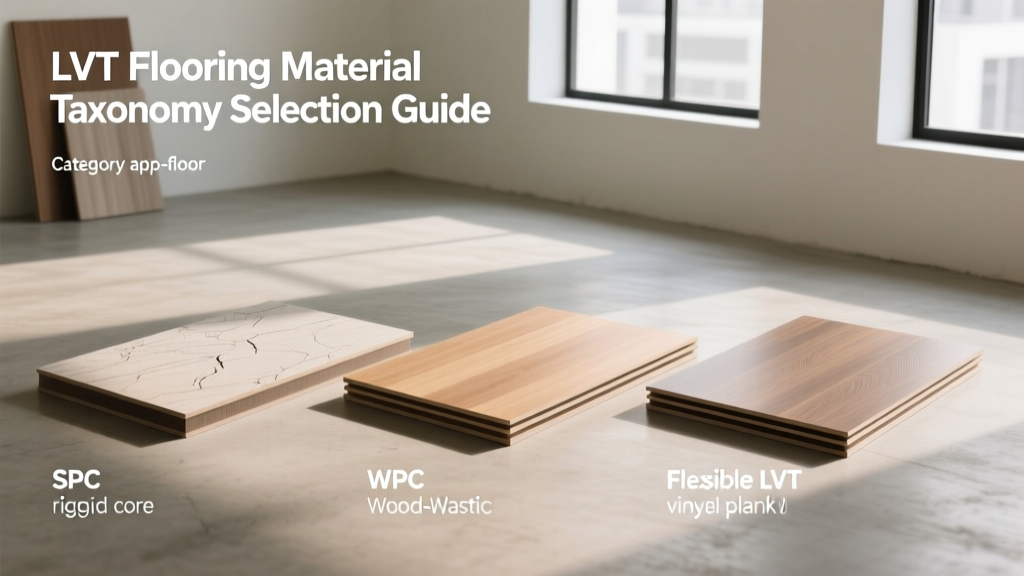
The LVT market has bifurcated into distinct material categories. Selecting the wrong taxonomy for your specific subfloor and traffic profile is the leading cause of premature flooring failure. Below is a comparative matrix of the three primary LVT classifications available on the market today.
| Material Type | Core Composition | Thickness Range | Dimensional Stability | Best Application Scenario |
|---|---|---|---|---|
| Flexible LVT (Dryback/Glue-Down) | PVC vinyl with plasticizers | 2.0mm - 3.0mm | Low (Conforms to subfloor) | Commercial glue-down, perfectly leveled concrete slabs |
| SPC (Stone Plastic Composite) | Limestone powder + PVC + stabilizers | 3.2mm - 7.0mm | Extremely High (Rigid) | High-traffic residential, commercial, areas with temperature fluctuations |
| WPC (Wood Plastic Composite) | Wood-plastic/polymer composite + foaming agents | 5.0mm - 8.5mm | High (Semi-Rigid) | Multi-story residential, bedrooms, areas prioritizing acoustic dampening |
SPC vs. WPC: The Rigid Core Showdown
While both SPC (Stone Plastic Composite) and WPC (Wood Plastic Composite) fall under the 'rigid core' umbrella and feature a floating click-lock installation, their internal chemistry dictates vastly different performance profiles.
SPC: The Indentation Champion
SPC cores are manufactured by combining limestone powder (calcium carbonate) with polyvinyl chloride and stabilizers under extreme heat and pressure. The resulting core is incredibly dense and virtually impervious to indentation. If you are installing flooring in a kitchen where heavy cast-iron appliances rest on small caster wheels, or in a commercial retail space with heavy point-loads, SPC is the mandatory choice. However, its density makes it acoustically 'hard,' meaning footfalls can sound hollow without a high-quality attached IXPE pad.
WPC: The Acoustic and Comfort Leader
WPC incorporates a foaming agent into the polymer composite, creating microscopic air pockets within the core. This makes WPC thicker, warmer underfoot, and significantly better at absorbing impact noise. Industry reports from Floor Trends Magazine consistently highlight WPC as the preferred choice for second-floor condominiums and multi-family dwellings where Impact Insulation Class (IIC) and Sound Transmission Class (STC) ratings are strictly regulated by HOAs. The trade-off is that WPC is more susceptible to heavy point-load indentation than SPC.
Critical Subfloor Tolerances
A common misconception is that rigid core LVT can hide subfloor imperfections. It cannot. While rigid core bridges minor gaps, it will snap or unclick if subjected to vertical deflection. The industry standard tolerance for rigid core LVT is 3/16-inch deviation over a 10-foot radius. Flexible glue-down LVT is far less forgiving, requiring a strict 1/8-inch deviation over a 6-foot radius. Failure to grind high spots or patch low spots will result in 'telegraphing' (where subfloor bumps visibly push through the vinyl) and broken click-lock joints.
2026 Cost Breakdown & ROI Analysis
Budgeting for LVT requires looking beyond the per-square-foot sticker price of the planks. Below is a realistic cost matrix for material and installation, reflecting current market rates. Note that premium brands like Shaw Floorte, Mannington Adura, and USFloors CoreTec command the higher end of these spectrums due to superior wear layer technologies and patented locking mechanisms.
| Cost Component | Flexible (Glue-Down) | SPC (Click-Lock) | WPC (Click-Lock) |
|---|---|---|---|
| Material (per sq. ft.) | $1.50 - $3.50 | $2.50 - $5.50 | $3.50 - $7.00 |
| Adhesive / Underlayment | $0.40 - $0.80 (Adhesive) | Included (Usually attached) | Included (Usually attached) |
| Professional Installation | $1.75 - $3.00 | $1.50 - $2.50 | $1.50 - $2.50 |
| Total Installed Cost | $3.65 - $7.30 | $4.00 - $8.00 | $5.00 - $9.50 |
Note: Always factor in an additional 10% to 15% for material waste, cuts, and matching dye-lot reserves. Transition moldings (T-moldings, stair noses) can add $3 to $8 per linear foot.
Selection Decision Framework
Use this practical decision tree to select the exact LVT taxonomy for your specific project parameters:
- If installing over radiant heating: Choose SPC. Its limestone core resists thermal expansion and contraction far better than WPC or flexible vinyl, preventing seam separation during temperature swings.
- If installing in a sunroom or space with direct, intense UV exposure: Choose SPC with a fiberglass-reinforced core. Standard WPC and flexible LVT can experience thermal bowing or edge-curling when subjected to localized heat from large south-facing windows.
- If installing in a basement with potential hydrostatic pressure: Choose Flexible Glue-Down using a moisture-curing urethane adhesive. While all LVT is waterproof, click-lock rigid core floors can trap moisture vapor beneath the planks, leading to mold growth on the concrete subfloor. Glue-down LVT bonds directly to the slab, eliminating the vapor trap.
- If prioritizing rapid DIY installation over existing tile: Choose WPC or thick SPC (6mm+). The added thickness and rigidity will prevent the grout lines of the underlying tile from telegraphing through the new floor.
Common Installation Failure Modes to Avoid
Even the highest-grade LVT will fail if installation protocols are ignored. The three most common catastrophic failure modes include:
- Edge Curling and Peaking: Rigid core LVT expands and contracts with ambient temperature changes. Installers frequently fail to leave the mandatory 1/4-inch expansion gap around the room's perimeter. When the floor expands, it hits the drywall, compresses, and forces the click-lock joints upward, creating a tripping hazard known as 'peaking.'
- Plasticizer Migration: When flexible LVT or certain rubber-backed rugs sit on top of specific acrylic or polyurethane floor finishes, a chemical reaction occurs. The plasticizers in the vinyl leach into the finish, causing permanent yellow staining. Always verify that area rugs are labeled 'non-staining' or 'vinyl-safe.'
- Moisture Vapor Emission (MVE) Blistering: Concrete slabs emit moisture vapor. Before installing any glue-down LVT, conduct an ASTM F1869 calcium chloride test or an ASTM F2170 in-situ relative humidity test. If the slab exceeds the adhesive manufacturer's MVE limits (typically 3 to 5 lbs per 1,000 sq ft over 24 hours), you must apply a two-part epoxy moisture mitigation sealer before spreading adhesive. Ignoring this will result in the adhesive emulsifying and the tiles blistering within months.
VOC and Indoor Air Quality Verification
When selecting LVT, do not rely solely on manufacturer claims of 'low VOC.' Require third-party certification. Look for products that carry the FloorScore or GREENGUARD Gold certification. These independent lab tests verify that the flooring, including the adhesives and attached underlayment pads, emits volatile organic compounds at levels safe for sensitive environments like schools and healthcare facilities.