Luxury Vinyl Tile/Plank Performance Ratings Explained
Decode luxury vinyl tile/plank performance ratings. Learn wear layer specs, ISO 10874 classes, ASTM testing, and acoustic metrics for procurement.
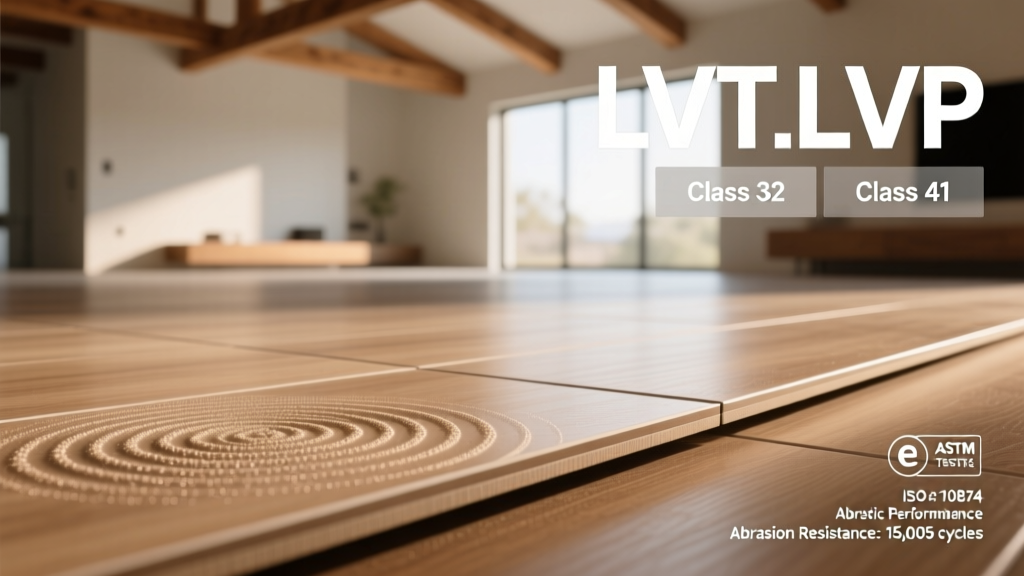
The Anatomy of LVT/LVP: Beyond the Aesthetic
Marketing brochures for luxury vinyl tile (LVT) and luxury vinyl plank (LVP) heavily emphasize visual fidelity and embossed-in-register (EIR) textures. However, for architects, facility managers, and procurement specialists, the true value of the material lies in its engineering specifications. The performance lifespan of LVT/LVP is dictated by its chemical composition, core density, and standardized testing metrics. Understanding these technical parameters is mandatory to prevent premature delamination, edge curling, and surface abrasion in high-traffic environments.
Wear Layer Thickness: The True Measure of Durability
The wear layer is the transparent, protective top coat that shields the printed design film from physical abrasion and chemical stains. Its thickness is measured in mils (thousandths of an inch) or millimeters. Specifying the correct wear layer is the most critical decision in the procurement process.
- 6 to 8 mil (0.15 - 0.20 mm): Light residential. Unsuitable for commercial applications or homes with large pets. Expected lifespan under moderate foot traffic is 3 to 5 years.
- 12 mil (0.30 mm): Standard residential and light commercial. The baseline for most mid-tier LVP products. Withstands standard rolling loads and daily foot traffic.
- 20 mil (0.50 mm): Heavy residential and standard commercial. Required for retail spaces, corporate offices, and high-traffic corridors. Often treated with UV-cured ceramic bead or aluminum oxide finishes to increase scratch resistance.
- 28 to 40 mil (0.70 - 1.00 mm): Heavy commercial and light industrial. Specified for healthcare facilities, airports, and big-box retail. These layers almost exclusively utilize advanced polyurethane (PUR) or diamondized cross-linked chemistry to resist scuffing and chemical degradation from industrial cleaners.
Decoding ISO 10874 and AC Ratings
The ISO 10874 standard classifies resilient floor coverings based on their intended use and expected traffic intensity. This is often translated into the more colloquial Abrasion Class (AC) ratings, originally developed for laminate but widely adopted by LVT manufacturers.
| ISO Class | AC Rating | Application Level | Specific Use Cases & Traffic Profile |
|---|---|---|---|
| Class 21 | AC1 | Residential - Moderate | Bedrooms, low-traffic guest rooms. |
| Class 22 | AC2 | Residential - General | Living rooms, dining rooms, home offices. |
| Class 23 | AC3 | Residential - Heavy | Kitchens, hallways, entryways, stairs. |
| Class 31 | AC3/AC4 | Commercial - Moderate | Boutique retail, hotel rooms, small offices. |
| Class 32 | AC4 | Commercial - General | Restaurants, corporate lobbies, classrooms. |
| Class 33 | AC5 | Commercial - Heavy | Hospitals, airports, department stores. |
| Class 41-43 | N/A | Light Industrial | Warehouses, light manufacturing, laboratories. |
Dimensional Stability and ASTM F2199 Testing
Dimensional stability dictates how much a plank or tile expands or contracts when exposed to temperature fluctuations and moisture. Poor stability leads to gapping at the seams in winter and buckling or peaking in summer. The governing test method in North America is ASTM F2199, which mandates a maximum allowable shrinkage or expansion of 0.020 inches per linear foot (0.16%).
SPC vs. WPC Core Stability Metrics
The core composition heavily influences dimensional stability metrics:
- SPC (Stone Plastic Composite): Formulated from limestone powder (calcium carbonate) and PVC stabilizers. SPC cores possess a high density (approx. 2.0 g/cm³) and exhibit near-zero thermal expansion. Premium SPC products routinely test at <0.05% dimensional change, making them ideal for large-format planks, sunrooms, and spaces with radiant heating systems.
- WPC (Wood Plastic Composite): Blends wood flour or foaming agents with PVC. WPC has a lower density (approx. 1.2 g/cm³), providing superior underfoot comfort and acoustic dampening. However, its dimensional stability is inherently lower, often testing between 0.10% and 0.15% under ASTM F2199. WPC requires stricter adherence to expansion gap perimeters during installation.
Slip Resistance and Static Coefficient of Friction (SCOF)
For commercial and multi-family residential projects, specifying the correct slip resistance is a critical liability and safety requirement. In the United States, the Americans with Disabilities Act (ADA) recommends a Static Coefficient of Friction (SCOF) of 0.6 or greater for flat surfaces, measured via ASTM D2047.
Globally, the DIN 51130 ramp test is the prevailing standard, categorizing floors from R9 to R13 based on the angle at which a slip occurs:
Acoustic Performance: IIC and STC Ratings
In multi-story construction, impact noise transmission is heavily regulated by the International Building Code (IBC), which generally requires a minimum Impact Insulation Class (IIC) and Sound Transmission Class (STC) of 50. Luxury vinyl is inherently dense and reflective, meaning bare LVT/LVP performs poorly acoustically compared to carpet or cork.
To achieve code compliance, manufacturers integrate attached underlayments. The acoustic performance varies drastically by material:
- IXPE Foam (1.0mm - 1.5mm): The most common attached pad. Provides an IIC rating of 50-53. Adequate for standard code compliance but lacks premium acoustic dampening.
- Cork (2.0mm - 3.0mm): Superior acoustic and thermal properties. A 2mm attached cork layer can push the IIC rating to 55-58, significantly reducing heel-click noise in high-end condominiums and luxury apartments.
- Delta IIC (ΔIIC): When evaluating acoustic data, look for the Delta IIC score, which measures the specific acoustic improvement the underlayment provides over a bare concrete slab. A ΔIIC of 15 or higher indicates a high-performance acoustic assembly.
Specification Checklist for Procurement
When drafting project specifications or evaluating supplier bids, mandate the inclusion of the following technical data points to ensure the proposed LVT/LVP meets your performance requirements:
- Total Thickness & Wear Layer: Specify exact mil/mm for both (e.g., 5.0mm total / 20 mil wear layer).
- Core Composition & Density: Require SPC for high thermal fluctuation zones; specify WPC only where acoustic comfort is prioritized over thermal stability.
- ISO 10874 Classification: Mandate the specific class (e.g., Class 33 for heavy commercial) rather than relying on marketing terms like 'commercial grade'.
- ASTM F2199 Results: Require third-party lab reports confirming dimensional stability is ≤ 0.020 in./lin ft.
- Acoustic Assembly: Specify the exact underlayment material, thickness, and the required Delta IIC score for the floor-ceiling assembly.
- Chemical Resistance: For healthcare or laboratory settings, require ASTM F925 testing data to confirm resistance to specific chemicals (e.g., betadine, quaternary ammonium cleaners).
By shifting the evaluation criteria from visual aesthetics to rigorous performance specifications, procurement teams can eliminate the risk of premature flooring failure and ensure the installed LVT/LVP system performs flawlessly under its intended environmental and mechanical loads.