Selecting Marmoleum Flooring: Sheet, Modular, and Click Formats
Compare Marmoleum flooring formats. Learn how to select between sheet, modular tile, and click-lock systems based on budget, subfloor, and traffic needs.
The Material Taxonomy: What Defines Authentic Marmoleum?
When architects and facility managers specify bio-based resilient flooring, the term 'linoleum' is often used as a catch-all. However, Marmoleum is a proprietary, trademarked product manufactured exclusively by Forbo Flooring Systems. Understanding this distinction is the first step in material selection, as it dictates the quality of the raw ingredients, the factory-applied wear layer, and the long-term lifecycle performance of the floor.
True Marmoleum is composed of 97% natural raw materials, with 72% rapidly renewable content and 43% recycled content. The taxonomy of its composition includes:
- Linseed Oil: Cold-pressed from flax seeds, this is the primary binder. It undergoes an oxidation process to form 'linoleum cement'.
- Pine Rosin: Harvested from controlled forestry, mixed with the linseed oil to provide flexibility and tensile strength.
- Wood Flour & Calcium Carbonate: These fillers provide dimensional stability and structural density.
- Jute Backing: A natural, woven fiber membrane that serves as the structural substrate for sheet and modular glue-down formats.
Unlike luxury vinyl tile (LVT) or sheet vinyl, which rely on polyvinyl chloride (PVC) and plasticizers, Marmoleum contains zero phthalates and emits virtually no volatile organic compounds (VOCs) post-installation. According to the U.S. Environmental Protection Agency (EPA), selecting bio-based products with verified eco-labels significantly reduces indoor air quality degradation and lifecycle carbon footprints in commercial and residential builds.
Format Breakdown: Sheet vs. Modular vs. Click
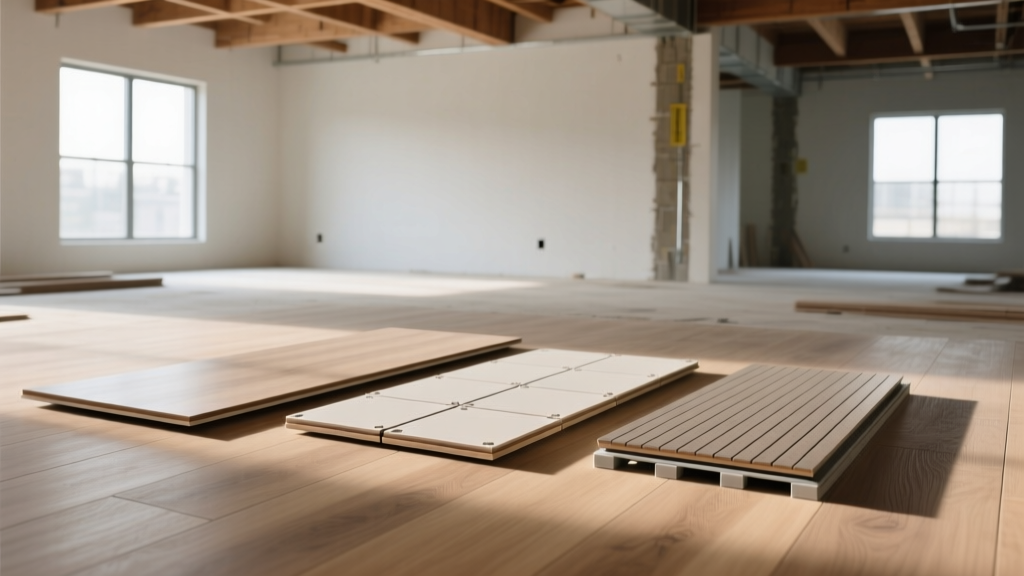
Forbo manufactures Marmoleum in three distinct structural formats. Selecting the correct format depends on subfloor conditions, square footage, moisture exposure, and installation budget.
1. Sheet Marmoleum (Glue-Down)
Sheet Marmoleum is the commercial gold standard, available in 2.0mm and 2.5mm thicknesses, and rolled in 79-inch (2-meter) widths. Because it is installed as a continuous membrane with heat-welded seams, it is completely impervious to surface water penetration. This makes it the mandatory choice for healthcare facilities, laboratories, and cleanrooms where seamless, hygienic surfaces are required to prevent bacterial harboring.
2. Modular Marmoleum (Glue-Down Tiles & Planks)
For projects requiring intricate patterns, borders, or easier localized replacement, Modular Marmoleum is cut into 10x10, 13x13, and 20x20-inch tiles, or 10x40-inch planks. These are 2.5mm thick and feature a polyester backing for dimensional stability. While they offer design versatility, the micro-seams between tiles mean they are not recommended for areas with standing water or heavy rolling cart traffic, which can catch on tile edges over time.
3. Marmoleum Click (Floating System)
Marmoleum Click is engineered for residential and light-commercial retrofits. It consists of a 2.5mm layer of Marmoleum bonded to a high-density fiberboard (HDF) core with a pre-applied cork underlayment. The panels utilize a click-lock mechanism, allowing them to float over the subfloor without adhesive. However, because the HDF core is susceptible to swelling if water penetrates the seams, Click is strictly prohibited for full bathrooms, commercial kitchens, or below-grade basements with high humidity.
All glue-down Marmoleum formats require strict moisture testing before installation. Forbo mandates that concrete subfloors must not exceed a Moisture Vapor Emission Rate (MVER) of 5 lbs per 1,000 sq. ft. per 24 hours (ASTM F1869) or 85% Relative Humidity (ASTM F2170). Furthermore, the concrete pH must fall strictly between 7.0 and 9.0. Exceeding these limits will cause adhesive breakdown and jute backing rot.
Selection Matrix: Matching Format to Project Scope
Use the following decision matrix to align the Marmoleum format with your specific project parameters. Pricing reflects 2026 national averages for material costs.
| Feature | Sheet (2.0/2.5mm) | Modular Tile/Plank | Click (Floating) |
|---|---|---|---|
| Material Cost | $4.50 - $7.00 / sq ft | $5.00 - $8.50 / sq ft | $6.00 - $9.50 / sq ft |
| Install Labor | $4.00 - $6.50 / sq ft | $3.50 - $5.50 / sq ft | $2.00 - $3.50 / sq ft |
| Water Resistance | Excellent (Welded) | Moderate (Micro-seams) | Poor (HDF Core) |
| Subfloor Prep | Extensive (Skim coat) | Moderate (Leveling) | Minimal (Floating) |
| Best Application | Hospitals, Schools, Labs | Offices, Retail, Cafes | Residential, DIY Retrofits |
Installation Realities and Failure Modes
Specifying Marmoleum is only half the battle; improper installation is the leading cause of product failure. When reviewing contractor bids, ensure the following technical protocols are explicitly stated in the scope of work.
Acclimation and Climate Control
Marmoleum is a natural, hygroscopic material. It must be delivered to the job site and allowed to acclimate for a minimum of 48 hours. The ambient room temperature must be maintained between 68°F and 77°F (20°C to 25°C), and the HVAC system must be fully operational. Installing cold material directly from a winter delivery truck will result in adhesive failure and seam shrinking.
Adhesive Selection and Trowel Notch
Forbo requires the use of their proprietary L910 adhesive for most glue-down applications over porous and non-porous subfloors. L910 is a hard-set, bio-based adhesive with ultra-low VOC emissions. Contractors must use a 1/16" x 1/16" x 1/16" square-notched trowel. Using a standard V-notch trowel or a generic acrylic adhesive will result in insufficient coverage, leading to bubbling and telegraphing of subfloor imperfections through the 2.0mm sheet.
Heat Welding Sheet Seams
For sheet installations, seams cannot simply be butt-jointed. A 1/16-inch groove must be routed along the seam after the adhesive has cured (typically 24 hours). A Marmoweld rod (matching or contrasting) is then heat-welded into the groove using a specialized welding gun set between 750°F and 850°F. The weld must be trimmed in two passes: a hot trim while the rod is still pliable, and a cold trim once fully cooled to prevent a concave depression.
Because sheet Marmoleum is relatively thin (2.0mm), it will 'telegraph' or mirror any imperfections in the subfloor below. For concrete slabs, specify a Portland-based self-leveling underlayment (SLU) to achieve a flatness tolerance of 1/8-inch in 10 feet before adhesive application.
Lifecycle Maintenance: The Topshield3 Advantage
Historically, linoleum required an initial application of acrylic wax or polymer finish immediately after installation to protect the surface during the construction phase. Forbo has eliminated this requirement with their latest Topshield3 factory-applied polyurethane dispersion.
Topshield3 provides a dual-layer UV-cured finish that offers superior resistance to micro-scratches, chemical stains, and scuff marks. According to Forbo's technical specifications, floors with Topshield3 require only a dry dust mop and occasional damp mopping with a neutral-pH cleaner (pH 7-8). Avoid high-alkaline strippers or ammoniated cleaners, which will degrade the polyurethane matrix and void the commercial warranty.
Frequently Asked Questions
Can Marmoleum be installed over radiant floor heating?
Yes, but with strict thermal limits. Glue-down sheet and modular formats are compatible with hydronic and electric radiant systems, provided the surface temperature of the floor never exceeds 85°F (29.4°C). The system must be turned down to 65°F for 48 hours before, during, and after installation to prevent rapid adhesive drying and material stress. Marmoleum Click is generally not recommended over radiant heat due to the insulating properties of the cork backing and the risk of HDF core drying and joint separation.
How does Marmoleum handle heavy rolling loads?
Sheet Marmoleum (2.5mm) performs exceptionally well under heavy rolling loads, such as hospital beds and pallet jacks, provided the subfloor is perfectly level and heat-welded seams are used. The 2.0mm thickness is rated for standard commercial rolling loads but may indent under static point loads exceeding 150 PSI. Always specify casters with a minimum 2-inch width and a durometer hardness of 80A or higher to prevent localized compression.
Is Marmoleum flooring antimicrobial?
Yes. The continuous oxidation of linseed oil produces trace amounts of linoleic acid, which naturally inhibits the growth of bacteria, including MRSA and C. difficile. This inherent bacteriostatic property is why Marmoleum sheet remains the dominant specification in surgical suites and isolation wards, requiring no chemical antimicrobial additives to maintain a sterile surface profile.