Room-by-Room Guide: Top Gym Floor Options for Every Workout Zone
Explore the best gym floor options for every workout zone. Compare rubber, turf, and foam materials with costs, specs, and installation tips.

The Biomechanics of Gym Flooring: Why Material Matters
Selecting the right gym floor options requires moving beyond basic aesthetics to evaluate biomechanical performance. Every workout zone imposes distinct mechanical stresses: heavy impact loads from dropped barbells, continuous rolling loads from cardio machines, and high-friction shear forces from agility sleds. According to testing standards outlined by ASTM International (specifically ASTM F2772 for indoor sports floors), a high-performance gym floor must balance Force Reduction (shock absorption) and Vertical Deformation (give) to protect both the athlete's joints and the concrete subfloor.
A single material rarely satisfies the demands of an entire facility. This room-by-room guide breaks down the exact specifications, material compositions, and installation protocols required for distinct workout zones.
Zone 1: Heavy Free Weight and Powerlifting Areas
The free weight zone demands maximum impact resistance and acoustic dampening. Dropping a 300-pound barbell generates localized kinetic energy that can crack an unprotected concrete slab and shatter standard tiles.
Material Specification: Vulcanized Rubber Tiles
For this zone, specify 1/2-inch (12.7mm) thick, 100% vulcanized rubber tiles. Unlike standard recycled crumb rubber, which is bound with polyurethane and prone to flaking under extreme point loads, vulcanized rubber is heat-cured into a single, non-porous matrix. Look for a Shore A hardness rating between 60 and 65, which provides enough density to support heavy squat racks without bottoming out, while still absorbing impact.
- Dimensions: 4 ft x 6 ft straight-edge tiles (interlocking edges tend to separate under heavy lateral sled pushes).
- Installation: Full-spread polyurethane adhesive. Do not use double-sided tape or loose-lay in free weight zones; the repeated impact will cause tiles to migrate and separate.
- Cost: $4.50 to $6.80 per square foot.
Before gluing down rubber in a basement or ground-level gym, conduct a calcium chloride test (ASTM F1869). If MVT exceeds 3 lbs per 1,000 sq ft per 24 hours, the moisture will break down the polyurethane adhesive, causing the rubber to bubble and detach. Apply a two-part epoxy moisture mitigation system before installation.
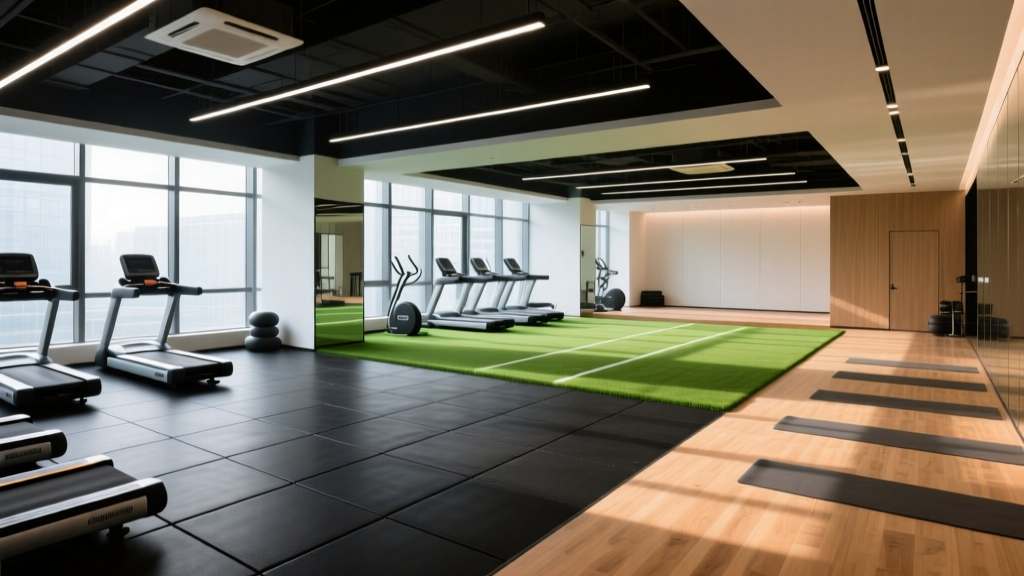
Zone 2: Cardio Corridors and Machine Rows
Treadmills, ellipticals, and cable machines exert continuous static and rolling loads. The primary failure mode here is indentation—where machine feet permanently compress the flooring—and subfloor vibration transfer.
Material Specification: Commercial Rolled Rubber or High-Density LVT
While 3mm to 4mm rolled rubber is the traditional choice, modern commercial facilities are increasingly utilizing Luxury Vinyl Tile (LVT) with a rigid core (SPC) and an attached high-density acoustic underlayment. Rigid core LVT offers superior indentation resistance (withstanding point loads up to 250 psi) and makes cleaning sweat and lubricant drips significantly easier than porous rubber.
- Rolled Rubber Specs: 4mm thickness, minimum 900 kg/m³ density.
- SPC LVT Specs: 5mm core thickness with a 20-mil commercial wear layer.
- Cost: $2.80 to $4.20 per square foot (rolled rubber); $3.50 to $5.50 per square foot (commercial SPC LVT).
Zone 3: Functional Fitness and Sled Turf Zones
Functional training zones require a surface that allows for multidirectional cleat traction, sled pushing, and floor-based movements without causing friction burns.
Material Specification: Padded Nylon Artificial Turf
Specify a non-infilled, textured nylon turf with a pile height of 15mm to 20mm. Nylon is vastly superior to polypropylene for gym environments because it has a higher melting point (resisting friction burns from ropes and sleds) and superior memory, meaning the blades will not permanently mat down under heavy sled tracks. The turf must be installed over a 5mm to 10mm closed-cell foam underlayment to provide the necessary shock absorption for plyometric jumps.
'When selecting turf for sled work, the face weight is critical. A minimum face weight of 40 oz per square yard ensures the fibers are dense enough to grip sled runners without tearing out at the primary backing.' - Facility Design Guidelines, American College of Sports Medicine.
- Infill: Use non-infilled turf for indoor gyms. Sand or crumb rubber infill will migrate, create dust, and interfere with cardio equipment in adjacent zones.
- Cost: $5.50 to $9.00 per square foot (including foam pad and adhesive).
Zone 4: Yoga, Stretching, and Group Studios
Group studios demand a balance of aesthetic warmth, acoustic performance, and joint protection. Hard, unyielding surfaces like rubber or concrete are inappropriate for prolonged barefoot work or floor-based mobility routines.
Material Specification: Engineered Hardwood over a Sleeper System
A floating engineered maple or oak floor, installed over a proprietary foam sleeper or pad system, provides the ideal response. This configuration meets the DIN 18032-2 standard for spring floors, offering optimal area deflection (absorbing impact across a wider area rather than just at the point of contact). For a budget-friendly alternative, high-density EVA (Ethylene-Vinyl Acetate) foam tiles (minimum 40 kg/m³ density) offer excellent barefoot comfort, though they lack the durability of hardwood.
- Hardwood Specs: 3/8-inch engineered plank with a 3mm real wood veneer, floating over 10mm acoustic rubber pads.
- EVA Foam Specs: 1-inch (25mm) thick interlocking tiles, reversible.
- Cost: $9.00 to $14.50 per square foot (engineered hardwood system); $2.00 to $3.50 per square foot (EVA foam).
Comparative Cost and Performance Matrix
| Workout Zone | Recommended Material | Thickness / Spec | Avg. Cost (per sq ft) | Primary Performance Metric |
|---|---|---|---|---|
| Free Weights | Vulcanized Rubber Tile | 1/2' (12.7mm) | $4.50 - $6.80 | Impact Resistance & Acoustic Dampening |
| Cardio / Machines | SPC LVT or Rolled Rubber | 5mm core / 4mm roll | $2.80 - $5.50 | Indentation Resistance (Point Load) |
| Functional Turf | Non-Infilled Nylon Turf | 15mm pile + 5mm pad | $5.50 - $9.00 | Shear Friction & Sled Glide |
| Group Studios | Engineered Hardwood (Floating) | 3/8' plank + 10mm pad | $9.00 - $14.50 | Area Deflection & Joint Protection |
Common Installation Failures and How to Avoid Them
Applying standard rubber flooring adhesive directly over certain types of existing asphalt tiles or unsealed concrete can cause plasticizer migration, turning the glue into a liquid slime. Always use a moisture-curing urethane adhesive specifically rated for rubber-to-concrete applications, and ensure the concrete is fully cured (minimum 28 days) and primed.
Rubber and LVT materials expand and contract with temperature fluctuations. Unbox all flooring materials and let them acclimate in the gym space at a stable 65°F to 85°F (18°C to 29°C) for a minimum of 48 hours before installation. Failing to do so will result in peaked seams and buckling once the material returns to room temperature.
Frequently Asked Questions
Can I use recycled tire rubber for a home garage gym?
Yes, but be aware of the off-gassing. Recycled crumb rubber bound with polyurethane emits volatile organic compounds (VOCs) that smell strongly of tires, especially in warm, unventilated spaces. If installing in a home environment, specify low-VOC, water-bonded recycled rubber or opt for virgin vulcanized rubber to maintain indoor air quality, aligning with EPA guidelines on recycled material safety.
How do I clean and maintain vulcanized rubber floors?
Never use bleach, ammonia, or solvent-based degreasers, as these will break down the vulcanization bonds and cause the surface to chalk. Use a neutral pH cleaner (pH 7.0 to 8.0) diluted in warm water, and mop with a microfiber head. For deep cleaning, use an automatic scrubber with a soft bristle brush attachment, avoiding excessive water pooling at the seams.
Written by
Sarah WhitfieldSarah Whitfield is a chartered quantity surveyor (MRICS) and construction cost analyst with 15 years of experience in material pricing, procurement strategy, and project budgeting. She earned her degree in Construction Management from the University of Reading (UK) and has worked on projects ranging from $2M custom homes to $180M mixed-use developments across North America and Europe. Sarah currently leads cost estimating for BuildMat Insight, maintaining a proprietary database of 4,000+ material price points updated quarterly. She is a frequent contributor to RSMeans cost data panels and has presented at the International Cost Engineering Council (ICEC) congress. Based in Denver, CO, Sarah is an avid trail runner and volunteer mentor for Women in Construction.
More from Sarah Whitfield
View all
Wood & Lumber
What Are the Different Types of Wood? A Builder's Guide
Compare structural softwoods, finish hardwoods, and engineered lumber. Analyze Janka ratings, MOE values, and 2026 pricing for construction.
Aug 4, 2026

Walls & Panels
Steel Framing vs Wood Framing: Corrosion and Moisture Defense
Compare steel framing vs wood framing for moisture resistance. Learn about galvanized coatings, condensation risks, and corrosion protection strategies.
Jul 21, 2026

Stone & Masonry
How to Cut Stone Veneer: Wet Saw vs Grinder Comparison
Compare the best tools for cutting stone veneer. We review wet saws, angle grinders, and chop saws to help you achieve clean, chip-free cuts.
Jul 21, 2026