Flooring Durability: Protecting Surfaces From Heavy Lamp Floor Arc Bases
Analyze flooring durability against heavy lamp floor arc bases. Compare point-load PSI limits for hardwood, LVP, and tile to prevent permanent dents.
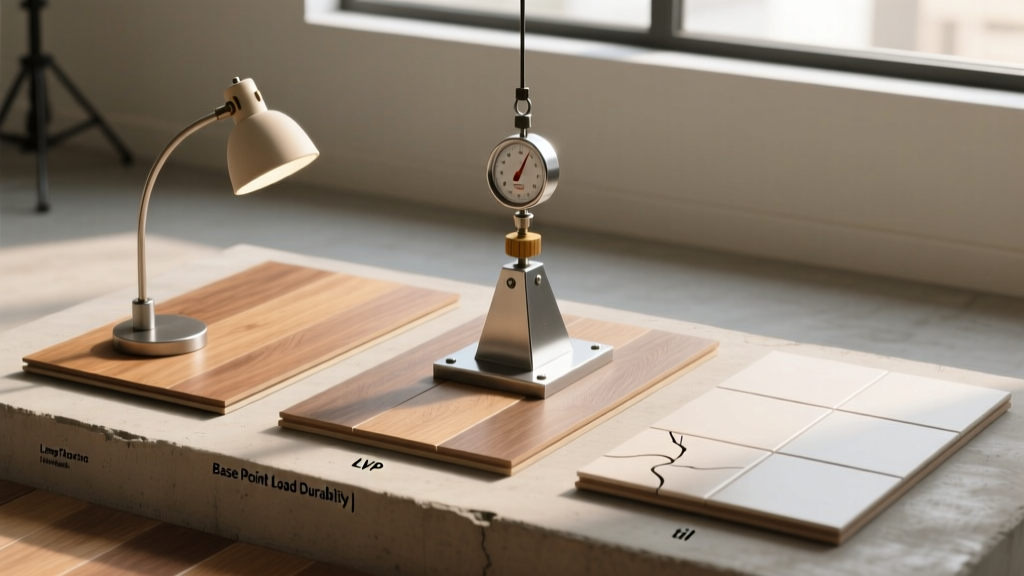
The Physics of Cantilevered Lighting: Point Load Stress
The sweeping silhouette of a lamp floor arc is a staple of mid-century and contemporary interior design. However, the physics that keep these cantilevered fixtures upright pose a severe, often overlooked threat to flooring lifespan. To counterbalance a 6-to-8-foot horizontal reach, the base of a lamp floor arc must be exceptionally heavy. Take the iconic Flos Arco lamp: its solid Carrara marble base weighs roughly 143 pounds. Cheaper, modern replicas typically feature concrete or cast-iron bases ranging from 60 to 90 pounds.
The danger to your flooring lies not just in the total weight, but in the point load pressure (PSI). If a 140-pound marble base rests on four small factory-installed plastic glides (each roughly 0.5 inches in diameter), the total contact area is less than 0.8 square inches. This generates over 175 pounds per square inch (PSI) of continuous, concentrated static pressure. Over time, this localized stress exceeds the yield strength of many residential flooring materials, leading to permanent indentation, joint failure, and structural crushing.
Flooring Material Lifespan & Indentation Resistance Matrix
Not all floors react to static point loads equally. The following matrix compares common flooring types against the specific stress profile generated by a heavy lamp floor arc base.
| Flooring Type | Compressive Limit / Hardness | Susceptibility to Static Creep | Joint Failure Risk | Unprotected Lifespan Reduction |
|---|---|---|---|---|
| Solid Hardwood (Oak) | 1290 lbf (Janka) | Moderate (Denting) | Low | 10-15% (Localized refinishing needed) |
| Engineered Hardwood | Varies by veneer | High (Veneer crushing) | Moderate | 20-30% (Irreparable veneer damage) |
| SPC Rigid Core LVP | ~1000 PSI (Short-term) | Low (Core resists) | High (Click-lock shear) | 5-10% (Joint separation) |
| WPC Rigid Core LVP | ~400 PSI (Short-term) | High (Core compression) | Moderate | 15-25% (Permanent depression) |
| Porcelain Tile | >250 lbf (Breaking) | None | Low (Grout/Thin-set) | Negligible (If subfloor is rigid) |
Material-Specific Vulnerabilities and Failure Modes
Solid & Engineered Hardwood
Wood flooring is highly susceptible to compression set. According to technical guidelines from the National Wood Flooring Association (NWFA), any concentrated static load exceeding the wood's cellular yield point will cause permanent denting. For a lamp floor arc resting on solid Red Oak (Janka hardness of 1290 lbf), the 175 PSI point load will slowly crush the wood fibers. Engineered hardwood is even more vulnerable; if the base crushes through the 2mm to 4mm top veneer layer, the damage is irreparable without replacing the entire plank.
Luxury Vinyl Plank (LVP): SPC vs. WPC
The resilient flooring industry tests indentation resistance using standards like ASTM F2793, which measures recovery after heavy static loads. Stone Plastic Composite (SPC) cores handle vertical compression exceptionally well and will rarely dent under a lamp base. However, SPC is highly rigid. When the heavy base shifts slightly during vacuuming or foot traffic, the sheer force is transferred directly to the fragile click-lock joints, causing them to snap or separate. Wood Plastic Composite (WPC) is softer and more forgiving on joints, but its aerated core will permanently compress (creep) under a 140-pound static load left in place for months.
Porcelain Tile and Polished Concrete
Porcelain tile and concrete are virtually immune to surface indentation from a lamp floor arc. The vulnerability here lies beneath the surface. The Tile Council of North America (TCNA) notes that point loads on tile assemblies can cause micro-fractures in the grout or compress the thin-set mortar if the underlying subfloor experiences any deflection. If your lamp base sits directly over a plywood subfloor seam, the concentrated weight can cause the tile above to crack.
Real-World Failure Mode: The Viscoelastic 'Creep' Effect
Homeowners often assume that because a floor 'feels' hard, it won't dent. However, resilient floors like vinyl and laminate exhibit viscoelasticity. Under a continuous static load (like a heavy arc lamp base left in the same spot for a year), the polymers in the flooring slowly flow and deform. Even if the initial PSI is below the material's breaking point, the prolonged stress causes 'creep'—a permanent depression that only becomes visible when you finally move the lamp to clean or redecorate.
Engineered Load-Dispersal Solutions
To protect your flooring and preserve its lifespan, you must reduce the PSI below the material's yield threshold. Do not rely on the thin felt stickers included by the lamp manufacturer; they compress to zero thickness under 100+ pounds and offer no structural load dispersion.
- The 8x8 Vulcanized Rubber Pad: For hardwood and LVP, place the lamp base on a minimum 8-inch by 8-inch square of 1/4-inch thick vulcanized rubber. This increases the contact area to 64 square inches, dropping the PSI of a 140-pound lamp from 175 PSI down to a highly safe 2.1 PSI.
- Load-Dispersing Plywood Sub-Plate: For tile installations over wood subfloors, use a 12x12 inch piece of 1/2-inch sanded plywood finished with felt on the bottom. This bridges subfloor joists and seams, preventing localized thin-set deflection that leads to cracked grout lines.
- Wide-Stance Caster Cups: If the lamp base features small spherical feet, use heavy-duty polyurethane caster cups with a minimum 3-inch diameter to distribute the weight before it reaches the floor surface.
Frequently Asked Questions
Can I use a rug to protect my floor from an arc lamp base?
A standard woven area rug will not prevent denting. The heavy base will simply push through the rug pile and compress the floor beneath it. If using a rug, you must still place a rigid load-dispersing pad (like vulcanized rubber or a thin acrylic sheet) between the lamp base and the rug to distribute the weight.
Will moving the lamp frequently prevent floor damage?
Yes, breaking the static load prevents viscoelastic creep in LVP and laminate. However, dragging a 140-pound marble base across hardwood or LVP will cause severe horizontal scratching. Always lift the base entirely or slide it on a dedicated moving sled when repositioning.
Are there lightweight lamp floor arc options that won't damage floors?
True cantilevered arc lamps require heavy bases for safety. However, some modern designs use a low-profile, wide-footprint base (e.g., 24x24 inches) made of thinner steel rather than a compact marble block. A wider footprint drastically reduces PSI, making it much safer for engineered hardwood and WPC vinyl floors without requiring aftermarket pads.