The Complete Parquet Floor Taxonomy: Selecting Patterns, Species, and Construction
Navigate the parquet floor taxonomy to select the ideal wood species, geometric pattern, and engineered construction for your specific space and budget.
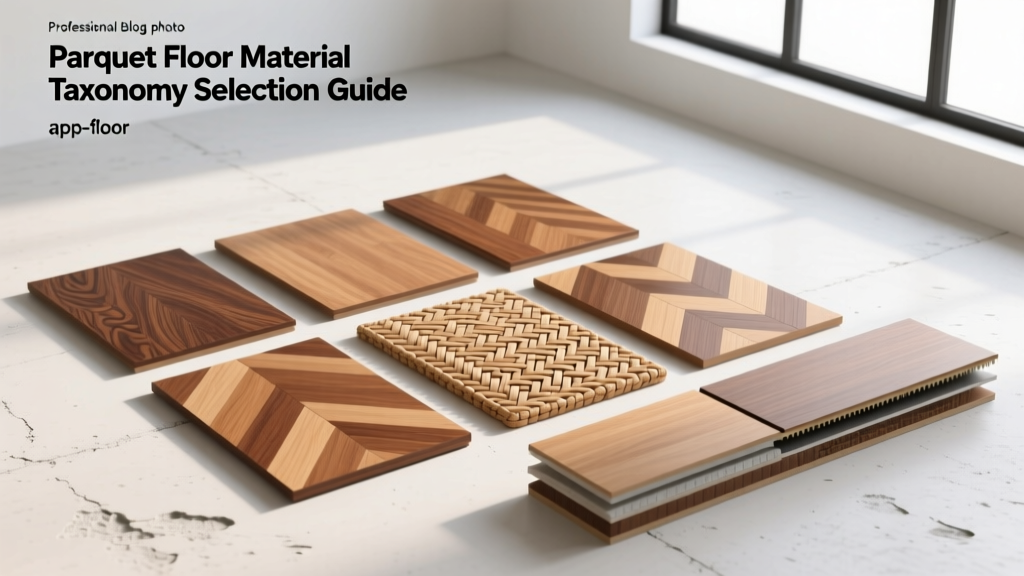
The Modern Parquet Floor: Beyond the 1970s Revival
Parquet flooring has evolved far beyond the thin, acrylic-coated solid wood tiles of the mid-20th century. Today, a parquet floor represents a highly engineered, geometrically precise flooring system that merges structural stability with architectural artistry. Selecting the right parquet requires navigating a complex taxonomy of construction methods, geometric patterns, wood species, and finish chemistries. This guide breaks down the material classifications and provides a concrete decision framework for specifying parquet in residential and commercial environments.
Construction Taxonomy: Solid vs. Engineered Parquet
The fundamental split in parquet manufacturing is between solid and engineered construction. While solid parquet is still manufactured for specialized historical restorations, engineered parquet commands over 95% of the modern market due to its dimensional stability.
| Feature | Solid Parquet | Engineered Parquet (Modern Standard) |
|---|---|---|
| Core Composition | Single piece of hardwood (typically 5/16" to 3/4" thick) | Multi-ply hardwood or HDF core with a 3mm-6mm top wear layer |
| Dimensional Stability | Low; expands/contracts significantly with humidity shifts | High; cross-grain ply construction restricts lateral movement |
| Installation Method | Glue-down or blind-nail (requires wood subfloor) | Glue-down, floating, or staple (compatible with concrete) |
| Refinishing Cycles | 4 to 6 times over its lifespan | 2 to 4 times (dependent on wear layer thickness) |
| Radiant Heat Compatibility | Not recommended (high risk of cupping and gapping) | Highly compatible (verify manufacturer specs for max surface temp) |
When specifying engineered parquet, prioritize a top wear layer of at least 4mm. This allows for a minimum of two full sand-and-refinish cycles using a drum sander, which is critical for repairing localized damage in high-traffic geometric patterns.
Geometric Pattern Classification and Waste Factors
The visual taxonomy of parquet is defined by its geometric layout. The pattern you select directly impacts material waste, installation labor, and the optical scale of the room.
Herringbone vs. Chevron: The Critical Distinction
Often confused by consumers, these two patterns require entirely different plank milling and installation techniques.
- Herringbone: Planks are cut at 90-degree angles and interlock in a staggered, broken zigzag pattern. The end of one plank meets the side of the adjacent plank. This requires standard square-end milling.
- Chevron: Planks are milled with precise 45-degree or 60-degree angled ends. When joined, they form a continuous, unbroken V-shape down the center seam. This requires specialized factory pre-cutting.
Advanced Modular Patterns
For large-scale architectural projects, modular parquet panels offer intricate designs pre-assembled on flexible backing meshes.
- Versailles: Large, square panels (typically 24"x24" or 36"x36") featuring a central geometric motif surrounded by a border. Historically used in grand foyers and ballrooms.
- Chantilly: Similar to Versailles but utilizes a more complex, interwoven central star pattern with contrasting wood species inlays.
- Brick/Weave: Planks are laid in a staggered, overlapping bond pattern, mimicking traditional masonry. Excellent for hiding subfloor undulations compared to rigid geometric patterns.
Wood Species and Finish Selection Matrix
The longevity of a parquet floor depends heavily on the Janka hardness rating of the species and the chemical composition of the factory-applied finish. According to the National Wood Flooring Association (NWFA), species selection must account for both localized traffic loads and ambient humidity fluctuations.
| Wood Species | Janka Hardness (lbf) | Dimensional Stability | Best Application |
|---|---|---|---|
| White Oak | 1,360 | Excellent | High-traffic residential, commercial, kitchens |
| Hard Maple | 1,450 | Average | Low-moisture residential, formal dining rooms |
| Black Walnut | 1,010 | Excellent | Low-traffic luxury spaces, master bedrooms |
| Hickory | 1,820 | Poor | Rustic aesthetics; requires strict climate control |
Finish Chemistries: Polyurethane vs. Hardwax Oil
The finish dictates the maintenance protocol and visual depth of the parquet.
- UV-Cured Aluminum Oxide Polyurethane: Creates a hard, impermeable plastic shell on top of the wood. Highly resistant to scratches and spills, but when damaged, the entire floor must be screened and recoated. Offers a slightly artificial, reflective sheen.
- Hardwax Oil (e.g., Rubio Monocoat, Osmo Polyx): Penetrates the wood fibers and cures to a matte, natural-feeling surface. It is highly susceptible to water spotting if not maintained, but localized scratches can be spot-repaired by the homeowner without sanding the entire floor. This is the dominant finish choice for high-end modern parquet installations.
Subfloor Preparation and Installation Variables
Parquet flooring is notoriously unforgiving of subfloor imperfections. Because the planks are short and laid in opposing directions, any subfloor deflection will immediately telegraph through the floor as squeaks, micro-gaps, or sheen variations in the finish.
The NWFA mandates that for parquet and geometric wood flooring installations, the subfloor must be flat to within 3/16 of an inch over a 10-foot radius, and 1/8 of an inch over a 6-foot radius. This is a stricter tolerance than standard strip flooring.
Moisture Mitigation and Adhesive Selection
When installing engineered parquet over concrete slabs, moisture testing is non-negotiable. Use in-situ relative humidity (RH) probes (ASTM F2170 standard) rather than surface calcium chloride tests, which only measure the top inch of the slab. If RH levels exceed the adhesive manufacturer's limit (typically 75-85%), a two-part epoxy moisture mitigation primer must be applied before the flooring adhesive.
For the adhesive itself, specify a high-solids, urethane-based wood flooring adhesive (such as Bona K850 or STAUF SPU-460). These adhesives provide a tenacious bond while retaining a slight elastomeric flexibility, allowing the parquet to undergo seasonal micro-movements without delaminating from the substrate.
2026 Cost Breakdown and Budgeting Framework
Pricing for parquet flooring varies wildly based on the complexity of the pattern and the origin of the manufacturing. Below is a current market breakdown for material and professional installation costs.
| Parquet Category | Material Cost (per sq. ft.) | Installation Labor (per sq. ft.) | Total Installed Cost (per sq. ft.) |
|---|---|---|---|
| Standard Herringbone (Engineered Oak) | $9.00 - $14.00 | $6.00 - $8.50 | $15.00 - $22.50 |
| Chevron (Pre-cut Engineered Oak) | $12.00 - $18.00 | $7.50 - $10.00 | $19.50 - $28.00 |
| Modular Versailles Panels | $22.00 - $45.00+ | $10.00 - $15.00 | $32.00 - $60.00+ |
| Solid Unfinished Parquet (Site-Finished) | $6.00 - $10.00 | $12.00 - $18.00 (includes sanding/staining) | $18.00 - $28.00 |
Note: Installation labor costs assume a properly prepared, level subfloor. Subfloor leveling, moisture mitigation, and old floor demolition will add $2.00 to $5.00 per square foot to the labor total.
Decision Framework: Selecting Your Parquet
Use this rapid decision matrix to narrow down your parquet specifications based on your project constraints:
- Evaluate the Subfloor: If installing over concrete or radiant heat, you must select Engineered Parquet. Solid parquet is immediately disqualified.
- Assess the Room Scale: For rooms under 200 square feet, avoid large modular patterns like Versailles, which will look truncated and require excessive cutting. Opt for a 5"x20" Herringbone to maintain visual flow.
- Determine Maintenance Tolerance: If the space is a high-spill zone (kitchen, mudroom) and the owner refuses to perform annual maintenance, specify a UV-Cured Polyurethane finish. If the owner prioritizes a natural, matte aesthetic and accepts spot-oiling protocols, specify a Hardwax Oil finish.
- Verify Sustainability: For commercial projects or eco-conscious residential builds, require Forest Stewardship Council (FSC) certification to ensure the hardwood veneers and plywood cores are sourced from responsibly managed forests, mitigating the risk of illegal logging supply chains.
By treating parquet not merely as a decorative surface, but as a complex, multi-layered structural system, you can specify a floor that delivers both immediate architectural impact and multi-generational durability.