PVC Flooring Applications: Best Room Scenarios & Fit Guide
Match PVC flooring types to specific room scenarios. Compare homogeneous, interlocking, and SPC vinyl for moisture, heavy loads, and residential traffic.
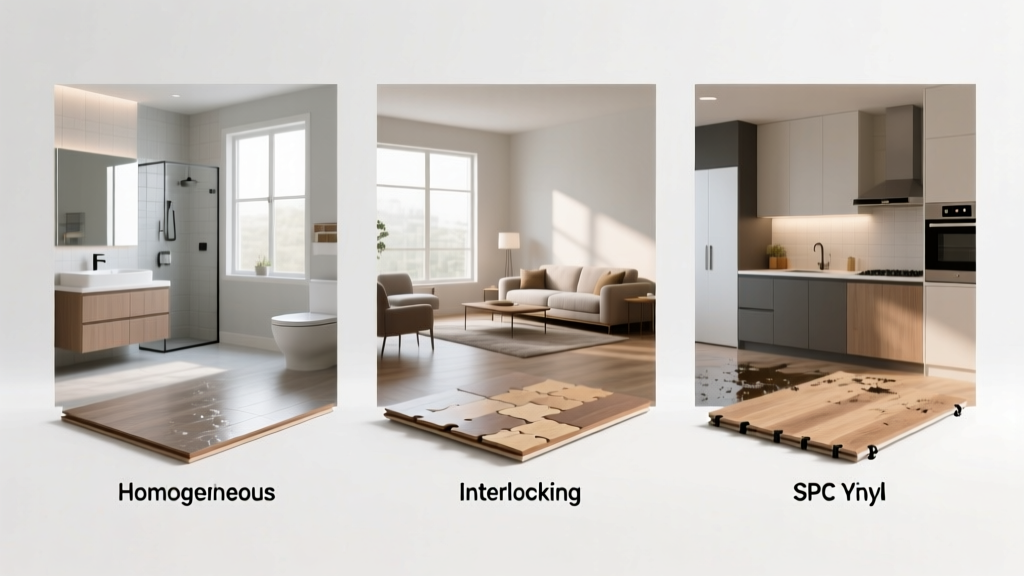
The PVC Flooring Spectrum: Clarifying the Categories
Polyvinyl Chloride (PVC) is the foundational polymer for the entire resilient flooring industry. However, specifying 'PVC flooring' for a project without defining the structural format is a critical error. The material behaves entirely differently depending on its manufacturing process. To correctly match PVC flooring to your specific application, you must first distinguish between the four primary structural categories available on the market today.
- Homogeneous PVC Sheet: A single-ply, uniform layer where the color and pattern extend through the entire thickness. Ideal for extreme wear environments.
- Heterogeneous PVC Sheet: Multi-layer construction with a distinct photographic design layer and a clear polyurethane (PUR) wear layer. Best for aesthetic-heavy commercial spaces.
- Interlocking Rigid PVC Tiles: Thick (5/16' to 1/2'), solid PVC tiles with puzzle-piece edges. Designed for heavy rolling loads and industrial use.
- SPC/WPC Vinyl (LVP/LVT): A PVC wear layer bonded to a Stone Polymer Composite (SPC) or Wood Polymer Composite (WPC) rigid core. The standard for modern residential and light commercial applications.
Application-Fit Matrix: Matching PVC Types to Scenarios
Selecting the wrong PVC format leads to premature failure, seam separation, or surface staining. Use this matrix to align your environmental requirements with the correct material specification.
| PVC Format | Optimal Scenario | Wear Layer / Thickness | Key Performance Trait | Expected Lifespan |
|---|---|---|---|---|
| Homogeneous Sheet | Healthcare, Cleanrooms, Wet Labs | 0.080' (Solid through-body) | Heat-weldable seams; chemical resistance | 20-30 Years |
| Heterogeneous Sheet | Education, Retail, Light Commercial | 0.5mm - 1.0mm PUR topcoat | Aesthetic versatility; scuff resistance | 10-15 Years |
| Interlocking Rigid | Garages, Workshops, Manufacturing | 5/16' to 1/2' Solid PVC | Rolling load capacity; impact absorption | 15-25 Years |
| SPC Core (LVP) | Residential, Sunrooms, Commercial Kitchens | 0.5mm (20 mil) wear layer | Dimensional stability; 100% waterproof | 15-20 Years |
| WPC Core (LVP) | Bedrooms, Living Rooms, Upper-Level Condos | 0.3mm - 0.5mm wear layer | Underfoot comfort; acoustic dampening | 10-15 Years |
Scenario 1: High-Moisture & Healthcare Environments
In environments where moisture intrusion or biological contamination is a primary concern—such as hospital operating rooms, commercial kitchens, and pharmaceutical cleanrooms—homogeneous PVC sheet is the undisputed standard. Products like Forbo Sphera or Armstrong Medintech are engineered specifically for these spaces.
The Welded Seam and Flash Coving Advantage
The critical advantage of PVC sheet in wet environments is not just the material's inherent water resistance, but the installation methodology. Unlike tile or plank flooring, PVC sheet can be heat-welded. Installers rout a 2mm groove between sheets and melt a matching PVC weld rod at 400°F to 500°F, creating a monolithic, watertight surface. Furthermore, PVC sheet can be 'flash coved'—turned up the wall 4 to 6 inches to form a seamless integral baseboard. This eliminates the 90-degree corner where dirt, moisture, and bacteria typically accumulate, a requirement strictly enforced by the Resilient Floor Covering Institute (RFCI) guidelines for healthcare installations.
Scenario 2: Heavy-Duty Industrial & Residential Garages
Standard epoxy coatings often peel under hot tire pressure, and residential LVP will crush under the point-load of a hydraulic floor jack. For garages and workshops, interlocking rigid PVC tiles (such as RaceDeck or SwissTrax) are the correct application fit.
A common failure in garage PVC flooring is yellow or brown staining caused by car tires. This is not a defect in the PVC; it is a chemical reaction. The 'antiozonants' used in tire rubber manufacturing react with the plasticizers in standard PVC, causing permanent staining. The Fix: For garage applications, you must specify 100% virgin PVC tiles with a factory-applied Polyurethane (PUR) topcoat, or apply a two-part aliphatic polyurethane sealant post-installation to block the chemical migration.
When specifying interlocking PVC for heavy loads, verify the compressive strength. Look for tiles rated for a minimum of 25,000 PSI compressive strength per ASTM F1700 standards to prevent permanent indentation from heavy toolboxes or vehicle jacks.
Scenario 3: High-Traffic Residential & Light Commercial
For homes, retail spaces, and offices, the aesthetic and acoustic requirements shift the focus to SPC (Stone Polymer Composite) and WPC (Wood Polymer Composite) vinyl planks. While both feature a PVC wear layer, their core compositions dictate their specific room applications.
- Use SPC in High-Heat/High-Sun Areas: SPC cores are made of limestone powder and PVC. They are incredibly dense and highly resistant to thermal expansion. If you are installing flooring in a sunroom, a room with floor-to-ceiling south-facing windows, or over radiant heat, SPC is mandatory. WPC will expand and buckle under intense, localized UV heat.
- Use WPC in Bedrooms and Multi-Story Dwellings: WPC cores contain a foaming agent that creates microscopic air pockets. This makes WPC softer underfoot and significantly better at dampening impact noise (IIC/STC ratings). It is the superior choice for second-story condos or bedrooms where acoustic transfer is a concern.
Critical Failure Modes: Where PVC Flooring Fails
Even when the correct PVC type is selected, environmental and subfloor variables can cause catastrophic failure. Avoid these three common pitfalls:
1. Subfloor Telegraphing (Sheet PVC)
Homogeneous and heterogeneous PVC sheets are highly flexible. Unlike rigid SPC planks that bridge minor gaps, PVC sheet will 'telegraph' (mirror) every imperfection in the subfloor. A 1/16-inch dip in the concrete will appear as a visible depression in the finished floor. Subfloors must be prepped to a tolerance of 3/16-inch over a 10-foot radius. Always use Portland-cement-based leveling compounds; gypsum-based patches can react chemically with PVC adhesives, breaking down the bond over time.
2. UV Degradation in Unconditioned Spaces
While SPC is dimensionally stable, the PVC wear layer and photographic film beneath it are susceptible to UV degradation. In unconditioned spaces like enclosed porches or sunrooms without UV-blocking window treatments, prolonged direct sunlight will cause the PVC polymers to become brittle and the print layer to fade. Always specify products with a UV-inhibitor warranty if direct sunlight exceeds 4 hours daily.
3. Indoor Air Quality and Off-Gassing
Low-quality PVC flooring can off-gas volatile organic compounds (VOCs) and ortho-phthalate plasticizers. To ensure indoor air quality, particularly in schools and healthcare facilities, mandate that all specified PVC flooring carries a FloorScore certification from SCS Global Services, which verifies compliance with strict VOC emission limits.
2026 Cost & Installation Breakdown
Budgeting for PVC flooring requires looking beyond the material cost. The preparation and installation labor vary wildly depending on the format chosen. Below is a realistic cost matrix for professional-grade installations.
| PVC Format | Material Cost (per sq. ft.) | Prep & Install Labor (per sq. ft.) | Total Installed Cost | Primary Labor Driver |
|---|---|---|---|---|
| Homogeneous Sheet | $3.50 - $6.00 | $4.00 - $7.50 | $7.50 - $13.50 | Heat-welding and flash coving |
| Heterogeneous Sheet | $2.50 - $4.50 | $3.00 - $5.00 | $5.50 - $9.50 | Subfloor leveling and seam sealing |
| Interlocking Rigid | $4.00 - $9.00 | $1.00 - $2.00 | $5.00 - $11.00 | Minimal prep; DIY-friendly snapping |
| SPC / WPC Plank | $2.50 - $5.50 | $2.00 - $3.50 | $4.50 - $9.00 | Floating click-lock installation |
Final Decision Framework
When evaluating PVC flooring for your next project, run your scenario through this quick checklist:
- Is the space wet or subject to strict hygiene codes? Use Homogeneous PVC sheet with heat-welded seams and flash coving.
- Will the floor support heavy rolling loads or vehicle traffic? Use Interlocking Rigid PVC tiles with a PUR topcoat to prevent tire staining.
- Is the space residential with high direct sunlight or radiant heat? Use SPC core vinyl plank for maximum dimensional stability.
- Is acoustic dampening and underfoot comfort the priority? Use WPC core vinyl plank with an attached acoustic underlayment pad.
By matching the specific structural format of PVC to the mechanical and environmental demands of the room, you ensure a flooring system that performs flawlessly for decades, avoiding the costly tear-outs associated with misapplied materials.