Tileable Carpet Cost Calculator: Estimate Material and Layout Prices
Calculate exact tileable carpet costs for your project. Learn material pricing, layout waste factors, adhesive options, and carton quantity formulas.
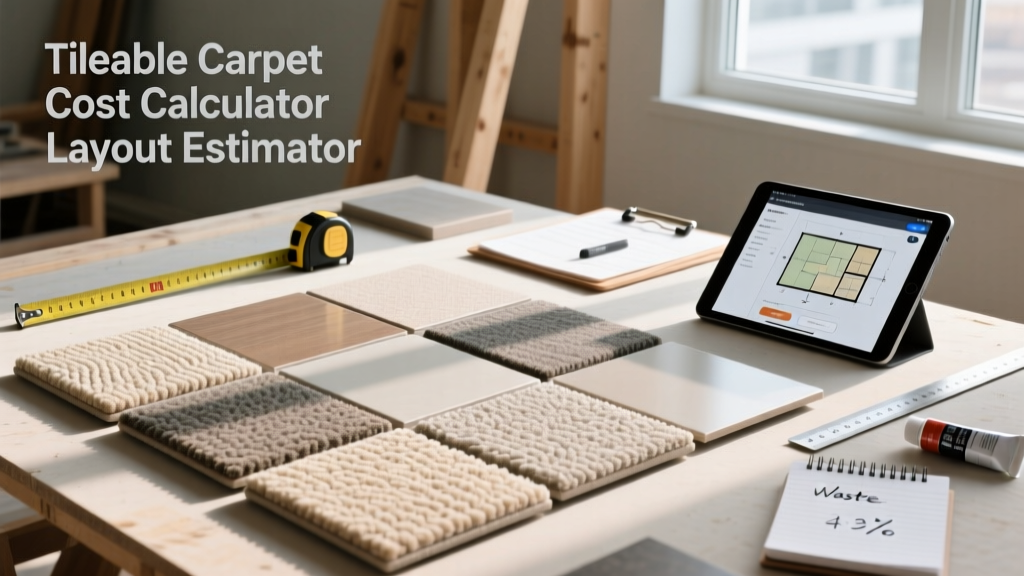
The True Cost of Tileable Carpet: Beyond the Price Tag
Estimating the cost of tileable carpet (often referred to as modular carpet or carpet tiles) requires more than multiplying room square footage by a per-yard price. Unlike broadloom carpet, tileable carpet is sold in cartons, governed by strict dye-lot matching rules, and heavily influenced by your chosen installation pattern. A miscalculation in layout waste or adhesive selection can inflate your budget by 15% to 20%.
This guide provides a precise framework for calculating material, waste, and labor costs for commercial and high-end residential tileable carpet projects. Whether you are specifying Interface glass-backed tiles or Shaw Contract polyurethane modules, the math below will ensure your estimate aligns with reality.
Material Cost Matrix: Face Fiber and Backing Types
The base material cost of tileable carpet is dictated by the face fiber (the visible yarn) and the backing system (which provides dimensional stability and acoustic dampening). Nylon 6,6 remains the gold standard for high-traffic commercial spaces due to its superior crush resistance, while solution-dyed PET is gaining traction for budget-conscious, low-traffic areas.
| Material Composition | Avg. Cost (per sq. ft.) | Best Application | Weight / Density |
|---|---|---|---|
| Nylon 6,6 with PVC Backing | $3.50 - $5.50 | Standard commercial offices | Heavy (requires strong adhesive) |
| Nylon 6,6 with Polyurethane Cushion | $5.00 - $8.50 | Healthcare, education, executive suites | Medium (superior acoustics) |
| Solution-Dyed PET with Bitumen Backing | $2.25 - $4.00 | Retail, light-traffic residential | Very Heavy (brittle in cold temps) |
| Recycled Nylon with Glass-Stratified Backing | $4.50 - $7.00 | Tech campuses, sustainable builds | Lightweight (ideal for TacTiles) |
The Quantity Calculator: Factoring in Layout Waste
The most common error in tileable carpet estimation is applying a flat 10% waste factor. Your waste factor is entirely dependent on the installation pattern and the room's geometry. Because tiles must be cut to fit perimeter walls, the visibility of the cut edges dictates how much material you discard.
Layout Pattern Waste Factors
- Monolithic (All tiles facing the same direction): 2% to 4% waste. The pile direction is uniform. Cut pieces from the perimeter cannot be easily rotated to the opposite wall without breaking the visual grain.
- Quarter-Turn (Adjacent tiles rotated 90 degrees): 4% to 6% waste. This creates a subtle checkerboard effect. Perimeter cuts can sometimes be reused on adjacent walls if the room is perfectly square.
- Ashlar / Brick (Staggered seams): 6% to 9% waste. Tiles are offset by half a module. This pattern generates the most offcuts, as the staggered edges rarely align with opposite wall dimensions.
- Random (Non-directional textures): 1% to 3% waste. Tiles have no pile direction or pattern match. Offcuts can be freely rotated and reused anywhere in the field.
Step-by-Step Calculation Framework
Tileable carpet is typically packaged in cartons. The industry standard for 50cm x 50cm (19.7" x 19.7") tiles is 20 tiles per carton, yielding 53.82 square feet per carton. For 24" x 24" tiles, cartons usually contain 15 tiles (60 square feet). Here is the exact formula to determine your order volume:
- Calculate Gross Area: Measure the maximum length and width of the space, including closets and alcoves. (e.g., 45 ft x 30 ft = 1,350 sq. ft.).
- Apply the Waste Factor: Multiply the gross area by your layout waste percentage. For a quarter-turn layout (5% waste): 1,350 x 1.05 = 1,417.5 sq. ft.
- Add the Dye-Lot Buffer: Add an additional 2% to 3% for future replacements and attic stock. This ensures you have exact-match tiles for future repairs. 1,417.5 x 1.02 = 1,445.85 sq. ft.
- Convert to Cartons: Divide the final square footage by the carton yield. For 50cm tiles: 1,445.85 / 53.82 = 26.86 cartons.
- Round Up: Always round up to the nearest full carton. You must order 27 cartons.
Hidden Costs: Adhesives, TacTiles, and Subfloor Prep
The adhesive system you choose dramatically impacts both material costs and labor timelines. According to guidelines from the Carpet and Rug Institute (CRI), the subfloor must be properly prepared to prevent adhesive failure and microbial growth.
Adhesive Options and Pricing
| Adhesive Type | Material Cost (per sq. ft.) | Installation Speed | VOC Emissions |
|---|---|---|---|
| Pressure-Sensitive Adhesive (PSA) | $0.10 - $0.18 | Moderate (requires drying to tack) | Low to Medium |
| Wet-Set / Epoxy (for high moisture) | $0.35 - $0.60 | Slow (strict open-time limits) | Medium |
| Dry Adhesive Tabs (e.g., Interface TacTiles) | $0.15 - $0.22 | Very Fast (no drying time) | Zero VOC |
| Pre-Applied Peel-and-Stick Backing | $0.00 (Included in tile) | Fast (but unforgiving) | Zero VOC |
Before applying any wet-set or PSA adhesive to a concrete slab, you must conduct moisture testing per EPA indoor air quality guidelines and ASTM standards. If a calcium chloride test (ASTM F1869) exceeds 3 lbs per 1,000 sq. ft. per 24 hours, or if relative humidity (ASTM F2170) exceeds 75%, standard adhesives will emulsify and fail. You will be forced to purchase moisture-mitigating epoxy primers, adding $1.50 to $2.50 per square foot to your subfloor prep budget.
Regional Labor Rates and Installation Variables
Labor for tileable carpet is generally priced per square foot or per yard. Unlike broadloom, which requires heavy stretching tools and knee kickers, tileable carpet is laid using the 'floating' or 'tack-down' method, making it less physically demanding but more time-consuming to detail.
- Standard Commercial Union Labor (Prevailing Wage): $3.50 - $5.50 per sq. ft. Includes subfloor sweeping, primer application, snapping chalk lines, and precise cutting.
- Non-Union / Open Shop Commercial: $1.75 - $3.00 per sq. ft.
- Residential / Small Office Retrofit: $2.50 - $4.00 per sq. ft. (Higher per-foot cost due to mobilization fees and smaller economies of scale).
'The biggest labor trap in tileable carpet is floor flatness. If the concrete slab has a variance of more than 1/8 inch over a 10-foot radius, the tile edges will 'lip' or telegraph through the seams. Budget $0.75 per square foot for self-leveling underlayment (SLU) if you are working in older buildings.' — Senior Flooring Estimator, Commercial Interiors Division
Frequently Asked Calculations
How do I calculate the cost of removing old carpet tiles?
Removal and disposal of existing tileable carpet typically costs between $0.40 and $0.85 per square foot. If the old tiles were installed with a heavy wet-set epoxy or bitumen adhesive, expect to add $0.50 to $1.00 per square foot for mechanical scraping and shot-blasting to prepare the slab for new adhesive. Always factor in local landfill tipping fees, which average $45 to $80 per ton for carpet waste.
Can I mix dye lots if I run short on material?
No. Even with solution-dyed fibers, slight variations in the manufacturing batch (dye lot) will create visible shading lines where the lots meet. If your calculation shows you need 27 cartons, and you only have 26 on site, you must order a full carton from the original dye lot. If the original dye lot is discontinued, you must transition the new lot at a natural break point, such as a doorway or a transition strip, never in the middle of an open field.
Does the weight of the tile affect the adhesive budget?
Yes. Bitumen-backed tiles are exceptionally heavy (often over 1.5 lbs per tile) and rigid. They require a high-tack, aggressive PSA or a full-spread wet-set adhesive to prevent the edges from curling up over time. Conversely, lightweight glass-stratified backings (like those used in high-end sustainable lines) can be secured using dry adhesive tabs, saving money on chemical adhesives and reducing subfloor prep requirements.