Ceramic Tile Backsplash Selection: A Material Taxonomy Guide
Explore our ceramic tile backsplash material taxonomy. Compare porcelain, glazed, and artisan ceramics for kitchen walls with expert selection tips.
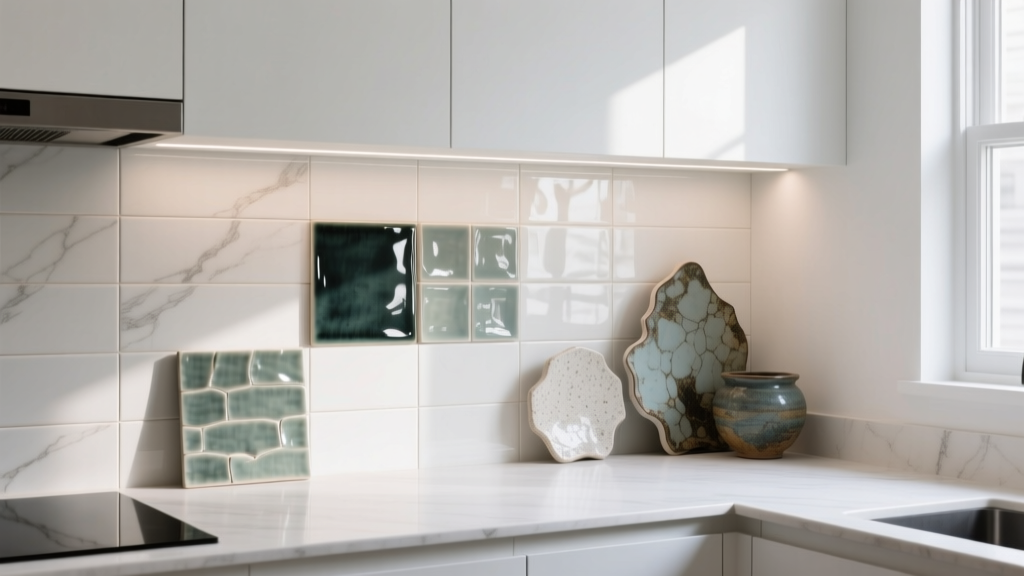
The Core Taxonomy of Ceramic Tile for Vertical Applications
While ceramic tile is primarily classified within flooring taxonomies, its migration to vertical backsplash applications requires a specialized selection framework. The structural and environmental demands of a kitchen or bathroom splash zone differ vastly from a residential floor. Selecting the right material hinges on understanding the formal classifications established by the Tile Council of North America (TCNA) under the ANSI A137.1 standard. This taxonomy divides ceramic tile into distinct categories based on raw material composition, firing temperature, and water absorption rates.
- Non-Vitreous: Water absorption > 3.0%. (Typically standard wall tiles).
- Semi-Vitreous: Water absorption 3.0% to 7.0%.
- Vitreous: Water absorption 0.5% to 3.0%.
- Impervious (Porcelain): Water absorption < 0.5%.
Non-Porcelain Ceramic (Standard Glazed)
Traditional ceramic wall tiles, such as classic 3x6 subway tiles, are typically non-vitreous or semi-vitreous. They are fired at lower temperatures than porcelain, resulting in a softer, more porous clay body. However, because they are almost always coated with an impermeable glass-like glaze, their surface water resistance is excellent. These tiles are lightweight (averaging 2.5 to 3.5 lbs per square foot), making them ideal for standard drywall substrates without requiring extensive structural reinforcement. The primary limitation is edge chipping; the softer bisque body is vulnerable to impact damage during installation or from heavy cookware.
Porcelain Ceramic (Dense & Impervious)
Porcelain is a highly refined subset of ceramic tile, composed of fine kaolin clay and feldspar, fired at extreme temperatures (up to 2,500°F). With a water absorption rate of less than 0.5%, porcelain is virtually waterproof throughout its entire body, not just on the surface. While historically reserved for high-traffic floors, through-body and color-body porcelain tiles are increasingly specified for backsplashes due to their extreme durability and resistance to staining from acidic foods like tomato sauce or lemon juice.
Artisan and Specialty Ceramics
The 2026 design landscape heavily favors artisan ceramics, particularly Zellige (hand-chiseled Moroccan clay tiles) and modern terracotta. These materials are inherently non-vitreous and highly porous. Unlike factory-glazed ceramics, Zellige tiles feature surface pitting, micro-cracks, and intentional shade variations. When selecting these for a backsplash, mandatory pre-installation sealing with a penetrating impregnator (such as Miracle Sealants 511) is required to prevent permanent staining from cooking oils and hard water.
Bridging the Gap: Using Floor-Rated Ceramic on Backsplashes
A dominant trend in contemporary architecture is the continuous material flow—using the exact same large-format porcelain floor tile on the kitchen backsplash to eliminate visual boundaries. However, migrating floor-rated ceramic to a vertical plane introduces severe mechanical challenges.
Large-format tiles (LFT), defined by the National Tile Contractors Association (NTCA) as any tile with one edge longer than 15 inches, carry significant weight. A 24x48 porcelain plank can weigh over 5 lbs per square foot. Standard 1/2-inch drywall, which is perfectly adequate for lightweight subway tile, has a maximum safe load-bearing capacity of roughly 15 lbs per square foot when factoring in the weight of the mortar and grout. Installing heavy floor tiles directly onto drywall risks catastrophic substrate deflection, leading to bond failure and tiles peeling off the wall.
Material Suitability Comparison Matrix
| Material Type | Avg. Weight (lbs/sq ft) | Standard Substrate | Mortar Requirement | Stain Resistance |
|---|---|---|---|---|
| Glazed Non-Porcelain (Subway) | 2.5 - 3.5 | 1/2' Drywall (Moisture Resistant) | ANSI A118.4 Modified | High (Glaze dependent) |
| Large Format Porcelain (Floor-to-Wall) | 4.5 - 6.0 | Cement Backer Board | ANSI A118.15 Non-Sag | Exceptional |
| Handcrafted Zellige / Terracotta | 3.0 - 4.5 | Cement Backer Board | ANSI A118.4 Modified | Low (Requires Sealing) |
| Ceramic Mosaic (Mesh-Mounted) | 2.0 - 3.0 | 1/2' Drywall or Backer Board | ANSI A118.4 Modified | Moderate (Grout lines) |
Critical Selection Metrics and Technical Thresholds
When evaluating ceramic tile for a backsplash, look beyond the aesthetic and verify the following technical specifications on the manufacturer's data sheet:
- Dynamic Coefficient of Friction (DCOF): While critical for flooring (requiring >0.42 for slip resistance), DCOF is entirely irrelevant for backsplashes. Do not pay a premium for high-traction textured finishes unless you specifically want the tactile aesthetic.
- PEI (Porcelain Enamel Institute) Wear Rating: A PEI rating measures glaze abrasion resistance. For a backsplash, a PEI I or II rating is perfectly adequate, as vertical surfaces experience zero foot traffic. Specifying PEI IV or V for a kitchen wall is an unnecessary expenditure.
- Facial Dimension Variance: For artisan ceramics, check the manufacturer's allowable size variation. Handmade tiles can vary by up to 3mm per piece. This dictates your grout joint width; attempting a tight 1/16-inch joint with high-variance Zellige will result in alignment failure. A minimum 1/8-inch or 3/16-inch joint is mandatory.
- Thermal Shock Resistance: If the backsplash is located directly behind a high-BTU commercial-style gas range, the tile must possess a high thermal shock rating to prevent glaze crazing (micro-cracking) from rapid temperature fluctuations.
2026 Cost Breakdown and Installation Variables
Material costs for ceramic tile backsplashes vary wildly based on the manufacturing process and origin. However, the installation labor often eclipses the material cost, particularly when dealing with floor-to-wall LFT transitions or intricate mosaics.
- Standard Glazed Ceramic (e.g., 3x6 Subway): $3.00 – $8.00 per sq. ft.
- Domestic Large Format Porcelain: $6.00 – $12.00 per sq. ft.
- Imported Artisan Zellige: $18.00 – $35.00 per sq. ft.
Common Failure Modes and Edge Cases
Even premium materials will fail if the installation methodology ignores the physics of vertical ceramic applications. The most frequent failure modes include:
1. Mortar Sagging and Lippage on LFT:
When installing heavy 24x48 floor tiles on a wall, standard thinset mortar will slump under the tile's weight before it cures, causing the bottom edge to protrude (lippage). Installers must use a high-performance, non-sag modified mortar (ANSI A118.15) and employ a mechanical lippage control system (wedge and clip) adapted for vertical use.
2. Efflorescence in Unglazed Ceramics:
If unglazed terracotta or natural clay tiles are installed using a standard cementitious mortar over a moisture-prone substrate, water-soluble salts can migrate through the porous clay body and crystallize on the surface as a white, powdery residue (efflorescence). To prevent this, use a latex-modified mortar and apply a high-quality penetrating sealer to the tile face before grouting.
'When migrating heavy floor ceramics to a vertical backsplash, the weakest link is rarely the tile itself; it is the shear bond strength between the mortar and the substrate. Never trust standard drywall paper to hold 50 pounds of porcelain.' — Senior Technical Advisor, National Tile Contractors Association Guidelines
Final Selection Framework
To finalize your ceramic tile backsplash selection, apply this decision matrix: If your priority is budget and classic aesthetics, select glazed non-porcelain subway tile and install directly over moisture-resistant drywall with standard modified thinset. If your design demands a seamless, modern continuation from your kitchen floors, select large-format porcelain, but budget for the mandatory demolition of drywall and installation of cement backer board. Finally, if you desire organic, tactile character, choose artisan Zellige, but commit to the rigorous maintenance protocol of pre-sealing and using wide, contrasting grout joints to accommodate dimensional variances.