Top Ceramic Floor Tiles Brands & Product Lines for 2026
Explore the top ceramic floor tiles brands for 2026. We deep-dive into Daltile, Emser, and MSI product lines, PEI ratings, and real-world pricing.
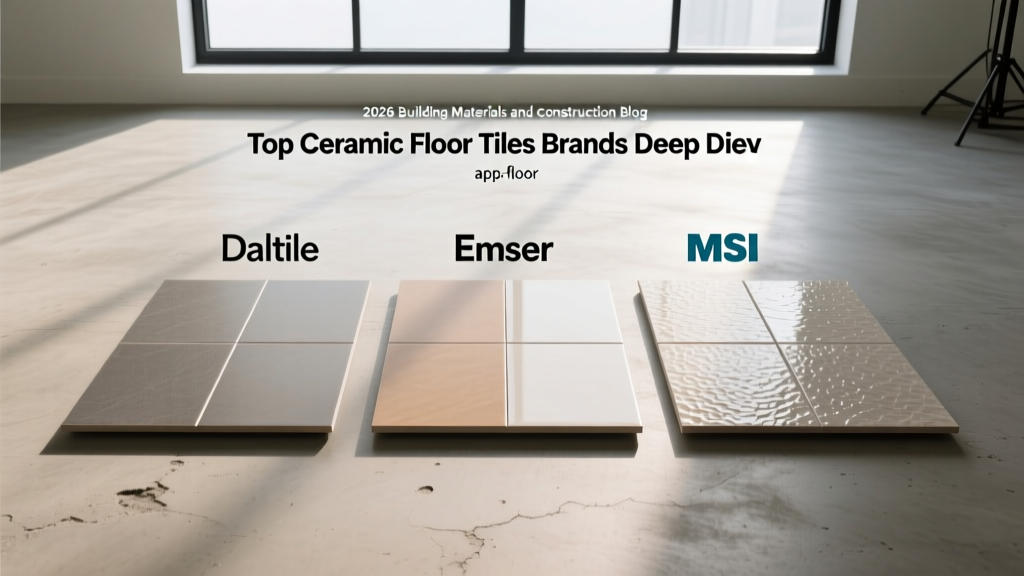
The 2026 Landscape: Non-Porcelain Ceramic vs. Porcelain
When sourcing materials for residential and light-commercial projects, understanding the distinction between true non-porcelain ceramic and porcelain is critical. While porcelain is technically a subcategory of ceramic, the building materials industry classifies 'ceramic tile' as non-porcelain clay products. These tiles are fired at lower temperatures, resulting in a softer body that is easier to cut on-site but inherently more porous. According to ASTM International standards (specifically ASTM C373), non-porcelain ceramic tiles exhibit a water absorption rate greater than 0.5%. This physical property dictates their application: they are ideal for interior residential bathrooms, bedrooms, and low-traffic kitchens, but they will fail prematurely if installed in freeze-thaw environments or heavy commercial corridors.
Expert Definition: The 0.5% Rule
Any tile with a water absorption rate of 0.5% or less is classified as porcelain (impervious). True ceramic floor tiles sit between 0.5% and 3.0% absorption (vitreous to semi-vitreous). Always verify the manufacturer's spec sheet for the exact ASTM C373 test result before specifying ceramic for wet areas.
Brand Deep-Dive: Daltile’s Quarry & San Marcus Collections
Daltile remains a dominant force in the North American market, offering distinct ceramic lines tailored to different traffic profiles and aesthetic requirements.
Daltile Quarry Tile (Unglazed Heavy-Duty)
Unlike standard glazed ceramics, Daltile’s Quarry line is an unglazed, extruded ceramic tile. Because the color runs through the entire body of the tile, surface scratches and edge chips are virtually invisible.
- Formats: 6x6, 8x8, and 4x8 inches.
- Thickness: A robust 1/2 inch (12.7mm), requiring transition moldings when abutting standard 3/8-inch flooring.
- PEI Rating: Unclassified by PEI (as it is unglazed), but it carries a Class 6 abrasion resistance rating under the Taber test.
- 2026 Pricing: $3.50 to $5.50 per square foot for materials.
Best Application: Commercial kitchens, mudrooms, and high-traffic residential entryways where slip resistance and impact durability outweigh the need for large-format aesthetics.
Daltile San Marcus (Glazed Residential)
For standard residential floors, the San Marcus collection offers a classic glazed ceramic surface with a slight texture to improve wet-traction.
- Formats: 12x12 and 18x18 inches.
- DCOF Rating: Meets the ANSI A326.3 standard with a Dynamic Coefficient of Friction ≥ 0.42, making it safe for interior wet areas.
- 2026 Pricing: $2.00 to $3.20 per square foot.
Brand Deep-Dive: Emser Tile’s Patterned & Wood-Look Ceramics
Emser Tile has aggressively expanded its decorative ceramic offerings, capitalizing on the demand for artisanal aesthetics without the artisanal price tag.
Emser Memoir Collection (Patterned Encaustic-Look)
True encaustic tiles are made of poured cement, which requires sealing and is prone to staining. Emser’s Memoir line replicates these complex geometric and floral patterns using glazed ceramic. The glaze is baked onto a standard ceramic bisque, providing the visual warmth of cement with zero maintenance requirements.
- Format: 8x8 inches with a pressed (rounded) edge, requiring a minimum 3/16-inch grout joint.
- Limitation: The glazed surface is rated PEI III. It will show wear patterns if used in high-pivot areas (like directly in front of a kitchen sink or exterior door).
- 2026 Pricing: $4.50 to $6.80 per square foot.
Brand Deep-Dive: MSI’s Piazza & Kenzzi Series
MSI (M S International) bridges the gap between big-box availability and designer-grade aesthetics, maintaining deep inventory levels that prevent project delays.
MSI Piazza (Rustic Stone Replication)
The Piazza line utilizes high-definition inkjet printing on a semi-vitreous ceramic body to mimic the cleft and texture of natural slate and travertine.
- Format: 16x16 inches.
- Edge Profile: Rectified edges are rare in non-porcelain ceramic due to the softer bisque chipping during the grinding process. Piazza uses a standard cushioned edge, meaning installers must use a 1/4-inch or 3/8-inch grout joint to accommodate size calibrations.
- 2026 Pricing: $2.25 to $3.75 per square foot.
Technical Specification Matrix: What the Labels Actually Mean
Specifying ceramic floor tiles requires looking past the marketing brochure and verifying the technical data sheet. Use this matrix to decode manufacturer specifications against American National Standards Institute (ANSI) and Tile Council of North America (TCNA) benchmarks.
| Specification | Industry Standard / Test | Acceptable Floor Rating | Real-World Translation |
|---|---|---|---|
| Abrasion Resistance | PEI (Porcelain Enamel Institute) | Class III or Class IV | Class II is for walls only. Class III handles normal residential foot traffic. Class IV handles light commercial. |
| Slip Resistance | ANSI A326.3 (DCOF) | ≥ 0.42 | Values below 0.42 are a severe slip hazard in wet areas (bathrooms, laundry rooms). |
| Breaking Strength | ASTM C648 | ≥ 250 lbs | Ensures the tile will not crack under standard point-loads (e.g., a heavy appliance leg). |
| Chemical Resistance | ASTM C650 | Class A or B | Crucial for bathroom floors exposed to acidic cleaning agents and cosmetics. |
Installation Edge Cases & Subfloor Deflection
The most common cause of ceramic floor tile failure is not the tile itself, but inadequate subfloor preparation. Non-porcelain ceramic tiles have lower breaking strength than porcelain, making them highly susceptible to cracking if the subfloor flexes under load.
Critical Deflection Warning: The L/360 Rule
According to the Tile Council of North America (TCNA) Handbook, the structural framing beneath any ceramic tile installation must not deflect more than L/360 under a 300-pound concentrated load. If your floor joists are spaced 19.2 inches on-center and span 14 feet, standard 3/4-inch plywood alone will fail this requirement. You must install a secondary layer of 1/2-inch exterior-grade plywood or a cementitious backer board (like HardieBacker or Durock) decoupled with an uncoupling membrane (like Schluter-Ditra) to absorb lateral movement.
Thinset Selection for Ceramic Bisque
Because ceramic tiles are more porous than porcelain, they absorb moisture from the thinset mortar rapidly. If using a standard unmodified thinset, the ceramic bisque can 'burn' the mortar (drawing the water out before hydration is complete), resulting in a weak bond. For large-format ceramics (any side over 15 inches), use a modified thinset mortar meeting ANSI A118.4 or ANSI A118.15 standards, and always back-butter the tile to ensure 95% mortar coverage in wet areas and 80% in dry areas.
Cost Breakdown: Material vs. Labor in 2026
Budgeting for ceramic floor tiles requires factoring in the hidden costs of preparation and finishing. While the tiles themselves are often cheaper than natural stone or luxury vinyl plank, the labor intensity of cementitious installations drives up the total project cost.
- Material Costs: $1.50 to $6.80 per sq. ft. (Tile, thinset, grout, and sealer).
- Subfloor Prep: $1.50 to $3.00 per sq. ft. (Adding a second layer of plywood or uncoupling membrane).
- Installation Labor: $5.50 to $9.50 per sq. ft. (Varies heavily by region and tile format; 8x8 patterned tiles cost 20-30% more to lay than 12x12 standard grids due to alignment complexity).
- Demo & Disposal: $1.00 to $2.50 per sq. ft. (Removing existing tile and hauling heavy debris).
Total Installed Cost Expectation: $9.50 to $21.80 per square foot for a professionally installed, code-compliant ceramic floor.
Final Decision Framework
Select the right ceramic product line based on your project's specific traffic and moisture profile:
- Choose Daltile Quarry if the project is a mudroom, commercial kitchen, or high-traffic entryway where impact resistance and unglazed durability are non-negotiable.
- Choose Emser Memoir if you are designing a primary bathroom or powder room where decorative, encaustic-style aesthetics are the focal point, and foot traffic is minimal (bare feet or socks).
- Choose MSI Piazza for budget-conscious whole-home renovations (bedrooms, living areas) where a rustic stone look is desired, but the substrate cannot support the extreme weight of thick natural stone or large-format porcelain.