Glass Tile Selection: Floor Ratings vs Glass Tile Backsplash Options
Explore the glass tile material taxonomy. Compare ANSI floor ratings with glass tile backsplash options for proper selection, installation, and cost.
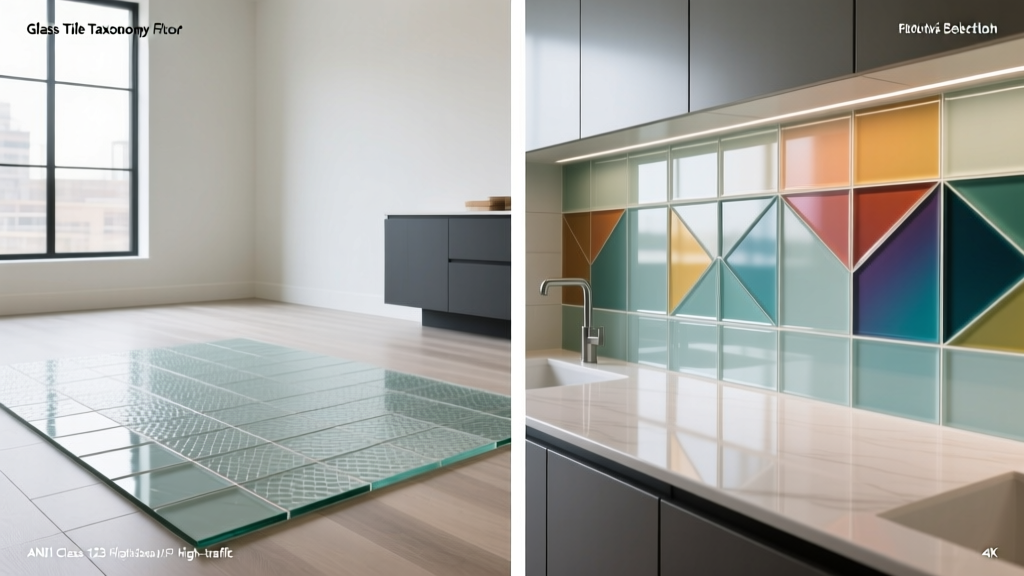
The Glass Tile Material Taxonomy
Glass tile represents one of the most optically dynamic surfacing materials in modern construction, but treating all glass tile as a monolith leads to catastrophic installation failures. To specify correctly, builders and designers must understand the manufacturing taxonomy defined under Tile Council of North America (TCNA) guidelines and ANSI A137.2. The material is broadly classified into three distinct manufacturing categories, each with unique structural and optical properties.
Cast, Fused, and Coated Glass
- Cast Glass: Formed by pouring molten glass into molds at temperatures exceeding 2,500°F. This process yields a solid, through-body color with a naturally undulating surface texture. Cast glass is highly durable and frequently used in heavy-traffic commercial flooring and exterior cladding due to its thickness (often 3/8" or greater) and structural density.
- Fused Glass: Created by layering multiple sheets of glass and firing them in a kiln. Fused glass allows for intricate, multi-dimensional color variations and patterns trapped between the layers. It is typically thinner than cast glass and is predominantly utilized for feature walls and low-traffic residential floors.
- Coated (Back-Painted) Glass: The most common material for a glass tile backsplash. This consists of a clear, flat sheet of glass (often 5/16" or 8mm thick) with a colored or metallic coating fired onto the back surface. The optical depth is achieved by light passing through the clear glass, hitting the pigment, and reflecting back. Because the color is only on the back, the edges of chipped or improperly cut coated glass will reveal clear, unpigmented margins.
Floor-Rated Glass vs. Glass Tile Backsplash: The ANSI A137.2 Divide
While a building materials taxonomy often centers on flooring, the physical properties of glass require a strict bifurcation between floor-rated products and wall-rated products like a glass tile backsplash. Glass has a naturally low Coefficient of Friction (COF). When wet, smooth glass becomes exceptionally hazardous. Therefore, the American National Standards Institute (ANSI) enforces rigorous testing parameters to separate these applications.
| Specification Metric | Floor-Rated Glass Tile | Wall-Rated Glass (Backsplash) |
|---|---|---|
| DCOF Rating (ANSI A326.3) | Must achieve ≥ 0.42 (Level Interior) | No minimum DCOF requirement |
| Surface Texture | Acid-etched, abrasive frit, or heavily textured | Smooth, polished, or lightly textured |
| Standard Thickness | 3/8" (10mm) to 1/2" (12mm) | 5/16" (8mm) or thinner (4mm mosaics) |
| Point Load Resistance | High (engineered for concentrated weight) | Low (designed for sheer wall adhesion) |
| Primary Mounting | Loose lay or heavy-duty polyurethane mesh | Paper-faced, film-faced, or light mesh |
Attempting to install a standard glass tile backsplash product on a bathroom or kitchen floor is a severe code violation and safety hazard. Conversely, installing heavy, acid-etched floor glass on a vertical backsplash creates unnecessary dead load and adhesion challenges, often requiring expensive epoxy mastics to prevent slippage during the curing phase.
Critical Selection Metrics for Glass Tile Backsplashes
When selecting materials specifically for a kitchen or bathroom backsplash, the focus shifts from slip resistance to optical clarity, mounting integrity, and cutting precision. The National Tile Contractors Association (NTCA) highlights several edge cases that frequently compromise backsplash installations.
Mounting Substrates: Mesh vs. Paper-Faced
Most glass mosaics are sold in 12x12 inch sheets for rapid installation. The backing material is critical for translucent glass:
- Polyurethane Mesh: The most common factory mounting. However, if the glass is highly translucent (like clear or lightly frosted coated glass), the grid pattern of the mesh and the adhesive dots will telegraph through the face of the tile, ruining the aesthetic.
- Paper-Faced (Front-Mounted): The paper is applied to the face of the tile using a water-soluble glue. The back is completely bare, allowing 100% thinset coverage and eliminating telegraphing. This is the superior choice for high-end, translucent backsplashes, though it requires washing and scrubbing the paper off after the mortar sets.
- Film-Faced: A clear plastic film applied to the face. Offers the same optical benefits as paper-faced but is easier to remove.
If your backsplash utilizes large-format glass panels (e.g., 12x24 inches or larger) rather than mosaics, the wall substrate must be perfectly plumb and flat. Glass is completely rigid and will not conform to undulating drywall. Any variance greater than 1/8" in 10 feet will result in lippage, hollow spots, and eventual cracking under minor structural deflection. Always install a cement backer board or a specialized uncoupling membrane over the drywall before setting large-format glass.
Installation Chemistry: Thinset and Grout Specifications
The chemical compatibility of setting materials is where most glass tile failures occur. Glass is non-porous, meaning it does not absorb water from the mortar to facilitate the hydraulic curing process. Furthermore, its translucency dictates the color and consistency of the adhesive.
Mortar Selection (ANSI A118.15)
Never use standard gray thinset for a glass tile backsplash. The gray pigment will muddy the color of the glass, particularly with whites, light blues, and metallic finishes. You must specify a bright white, polymer-modified dry-set cement mortar that meets ANSI A118.15 (Improved Modified Dry-Set Cement Mortar for Glass Tile).
Because glass is impervious, the mortar must rely entirely on mechanical interlock and polymer adhesion. Ensure 100% coverage by using the correct trowel. For standard 8mm backsplash mosaics, a 1/8" x 1/8" square-notch trowel is required. Larger notches will leave thick ridges of mortar that remain visible through the translucent glass face.
Grout Joint Sizing and Scratch Prevention
Glass is highly susceptible to micro-scratching. The rule for grout selection is dictated by the joint width:
- Joints under 1/8": You must use unsanded grout (or a specialized non-sanded epoxy). The silica sand in standard sanded grout will permanently scratch the surface of the glass during the packing and tooling process.
- Joints 1/8" and wider: Sanded grout is permissible and recommended for structural integrity, but the installer must use a hard rubber float rather than a standard stiff rubber or plastic float to minimize abrasive friction against the glass edges.
2026 Cost Breakdown and Procurement Data
Procurement costs for glass tile vary wildly based on the manufacturing taxonomy and origin. Mass-produced, mesh-backed coated mosaics from overseas dominate the lower end of the market, while domestic, paper-faced, and cast glass products command premium pricing.
- Entry-Level Coated Mosaics (Mesh-Backed): $6.00 – $11.00 per square foot. Typically 2mm to 4mm thick. Prone to telegraphing if not installed with meticulous thinset control.
- Mid-Tier Back-Painted & Fused Glass: $14.00 – $24.00 per square foot. Often features beveled edges, linear formats (like 3x12 subway), or complex color blending. Usually 8mm thick.
- Premium Cast & Architectural Glass: $35.00 – $85.00+ per square foot. Includes thick, solid-body cast glass, custom kiln-fired patterns, and specialized recycled glass aggregates.
When budgeting a backsplash project, factor in an additional 15% for waste. Unlike ceramic or porcelain, glass tile cannot be easily snapped or scored; it requires continuous-rim diamond blades and specialized wet saws to prevent blowout and chipping on the delicate coated backing. Blade replacement costs and specialized cutting labor should be integrated into the overall installation estimate.