Best Floating Floor Brands & Product Lines for 2026
Compare top floating floor brands for 2026. Deep-dive into COREtec, Shaw, and Cali product lines, pricing, SPC vs WPC cores, and installation specs.
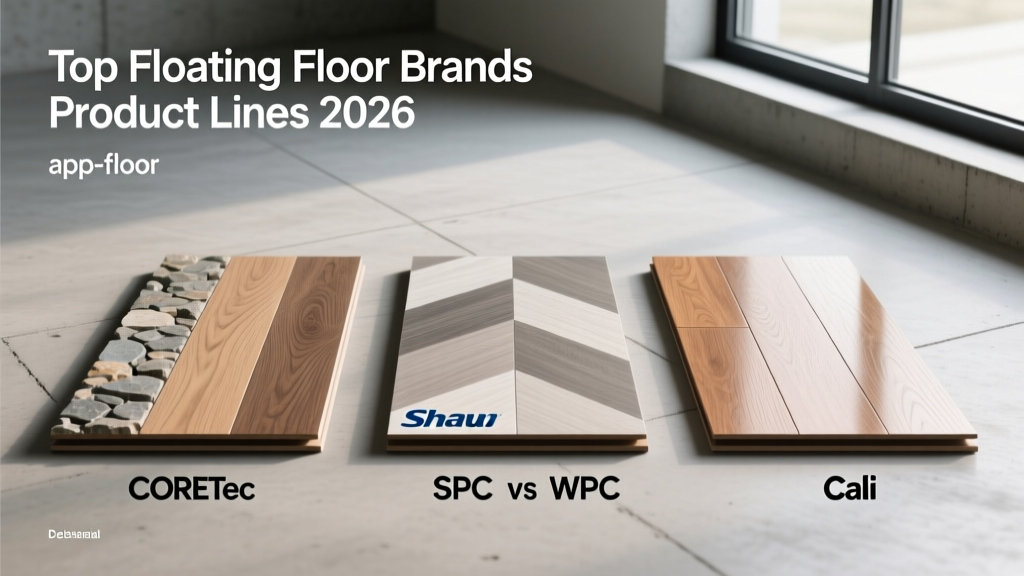
The Anatomy of a Premium Floating Floor in 2026
The floating floor market has evolved far beyond the early laminate click-lock systems of the 2010s. Today, the category is dominated by rigid core luxury vinyl plank (LVP) and engineered wood alternatives that utilize advanced extrusion technologies. A true floating floor relies entirely on its perimeter expansion gaps and the mechanical interlock of its click-system—typically Unilin (Uniclic) or Välinge (5G/T5G)—rather than adhesive bonding to the subfloor.
Understanding the core composition is critical for product selection. The two primary rigid core technologies are:
- SPC (Stone Plastic Composite): Formulated with limestone powder and PVC stabilizers. SPC cores are incredibly dense, highly resistant to indentation from heavy furniture, and dimensionally stable under temperature fluctuations. However, their rigidity makes them harder underfoot and more demanding on subfloor flatness.
- WPC (Wood Plastic Composite): Incorporates a foaming agent and wood-plastic polymers. WPC cores are thicker, softer, and provide superior acoustic dampening and underfoot comfort, though they are slightly more susceptible to heavy point-load indentation than SPC.
According to the Resilient Floor Covering Institute (RFCI), proper subfloor preparation remains the leading variable in floating floor performance, regardless of core type. Industry standards mandate a flatness tolerance of 3/16-inch over a 10-foot radius to prevent joint failure.
Tier 1 Deep-Dive: COREtec (USFloors)
Product Line Focus: COREtec Pro Plus & Original
COREtec pioneered the WPC category and remains a benchmark for dimensional stability. In 2026, their product segmentation clearly divides the market into residential comfort (Original) and high-traffic durability (Pro Plus).
COREtec Pro Plus (SPC): Utilizes a high-density stone core with a 20-mil to 30-mil wear layer. Designed to withstand heavy rolling loads and commercial traffic. Pricing: $4.50 – $5.90 per sq. ft.
Edge Case & Failure Mode: COREtec's patented cork underlayment (pre-attached on most lines) provides excellent sound absorption but can compress unevenly if installed over a subfloor with debris or high spots. Installers must sweep and vacuum the subfloor to a surgical degree; a single 1/8-inch pebble under a WPC plank will eventually cause the Uniclic joint to snap under dynamic foot traffic.
Tier 2 Deep-Dive: Shaw Floors
Product Line Focus: Floorté Premier & Repel Laminate
Shaw Floors leverages massive manufacturing scale to offer highly competitive mid-tier floating options. Their Floorté line utilizes a WPC core branded as 'HydroCore', while their Repel line pushes the boundaries of water-resistant laminate.
The Floorté Premier series features a 7.5mm overall thickness and a 20-mil wear layer. Shaw integrates a painted bevel edge that closely mimics the micro-bevels found in site-finished hardwood. Pricing: $3.60 – $4.80 per sq. ft.
The Repel Water-Resistant Laminate is a critical distinction. Unlike LVP, this is a high-density fiberboard (HDF) core treated with hydrophobic edge sealants. While it resists topical spills for up to 72 hours, it is not waterproof. If a dishwasher leaks and water pools beneath the planks, the HDF core will swell and destroy the click-lock mechanism.
Eco-Conscious Contender: Cali (formerly Cali Bamboo)
Product Line Focus: Cali Vinyl Pro & GeoWood
Cali has carved out a niche by focusing on ultra-dense SPC formulations and sustainable sourcing. Their floating floor lines are heavily weighted toward the contractor and custom-home market.
- Cali Vinyl Pro (SPC): Features a 5.5mm thickness with a commercial-grade 20-mil wear layer and an attached IXPE cork pad. The limestone core is exceptionally rigid, requiring strict adherence to subfloor flatness tolerances. Pricing: $4.20 – $5.40 per sq. ft.
- Cali GeoWood: A hybrid floating floor featuring real bamboo or eucalyptus veneers bonded to a waterproof SPC core. This provides the authentic tactile feel of wood with the dimensional stability of stone plastic composite. Pricing: $6.50 – $8.20 per sq. ft.
Comparative Matrix: Core Density, Wear Layers, and Pricing
| Brand & Line | Core Type | Wear Layer | Click System | Avg. Price (SqFt) |
|---|---|---|---|---|
| COREtec Original | WPC | 20 mil | Uniclic | $5.50 |
| COREtec Pro Plus | SPC | 20-30 mil | Uniclic | $5.20 |
| Shaw Floorté Premier | WPC | 20 mil | Angled Drop-Lock | $4.20 |
| Shaw Repel Laminate | HDF (Treated) | AC4 Rating | Uniclic | $3.10 |
| Cali Vinyl Pro | SPC | 20 mil | Välinge 5G | $4.80 |
| Cali GeoWood | SPC + Wood Veneer | UV Aluminum Oxide | Välinge T5G | $7.35 |
Critical Installation Failure Modes & Edge Cases
Floating floors do not fail because of the material; they fail because of the installation environment. When specifying these product lines, contractors and homeowners must account for the following physical realities:
1. The Subfloor Flatness Imperative
SPC cores like Cali Vinyl Pro and COREtec Pro Plus are unforgiving. If the subfloor dips 1/4-inch over a 6-foot span, the rigid plank will bridge the gap. When weight is applied, the mechanical click-lock joint experiences sheer stress it was not engineered to handle, leading to 'zippering' (where a seam splits open and propagates across the room). Always use a self-leveling compound (SLU) to achieve the 3/16-inch over 10-foot tolerance before laying the underlayment.
2. Moisture Vapor Emission Rates (MVER)
While the SPC/WPC planks themselves are 100% waterproof, the subfloor beneath them is not. Trapping moisture vapor against a concrete slab can lead to mold growth and alkaline salt efflorescence that degrades the pre-attached cork or IXPE pads. For concrete slabs, perform a Relative Humidity (RH) test using in-situ probes per ASTM F2170. If RH exceeds 75-80% (check specific manufacturer specs), a 6-mil polyethylene vapor retarder or a roll-on epoxy moisture mitigation system is mandatory beneath the floating floor.
A floating floor expands and contracts as a single unified raft. You must maintain a strict 1/4-inch to 3/8-inch expansion gap around the entire perimeter, including at door jambs, pipes, and cabinetry islands. Never pin the floor down by driving nails through baseboards into the floor itself, and never install heavy, fixed cabinetry directly on top of a floating floor, as this restricts movement and causes buckling in the center of the room.
3. Thermal Expansion in Sunrooms and Solariums
Floating LVP is highly sensitive to direct, concentrated UV heat. In south-facing rooms with massive glass facades, localized surface temperatures can exceed 120°F. While SPC handles this better than WPC, prolonged thermal shock can cause the planks to expand beyond the capacity of the perimeter gap, resulting in 'peaking' at the seams. For these specific environments, specify a glue-down LVP rather than a floating system.
Decision Framework: Which Line Fits Your Project?
Use this matrix to finalize your product selection based on the specific demands of your space:
- For Multi-Family Residential & Second-Story Condos: Choose COREtec Original (WPC). The foamed core and attached cork provide the acoustic decoupling required to meet strata HOA sound transmission codes (STC/IIC ratings).
- For Heavy Commercial or Kitchen/Dining Zones: Choose COREtec Pro Plus or Cali Vinyl Pro (SPC). The high-density limestone core prevents permanent indentation from heavy kitchen islands, commercial refrigerators, or concentrated furniture legs.
- For Budget-Conscious Dry Areas (Living Rooms, Bedrooms): Choose Shaw Repel Laminate. You achieve the authentic visual depth and scratch resistance of an AC4 laminate at a fraction of the cost of rigid core vinyl, provided moisture is strictly controlled.
- For High-End Custom Builds Demanding Authenticity: Choose Cali GeoWood. The real wood veneer over an SPC core satisfies the aesthetic and tactile demands of luxury buyers while eliminating the seasonal gapping and cupping associated with traditional solid hardwood.