Kitchen Flooring Options: Brand & Product Deep-Dives
Compare top kitchen flooring brands for 2026. Deep-dive into COREtec LVT, Daltile porcelain, and Shaw laminate specs, costs, and failure modes.
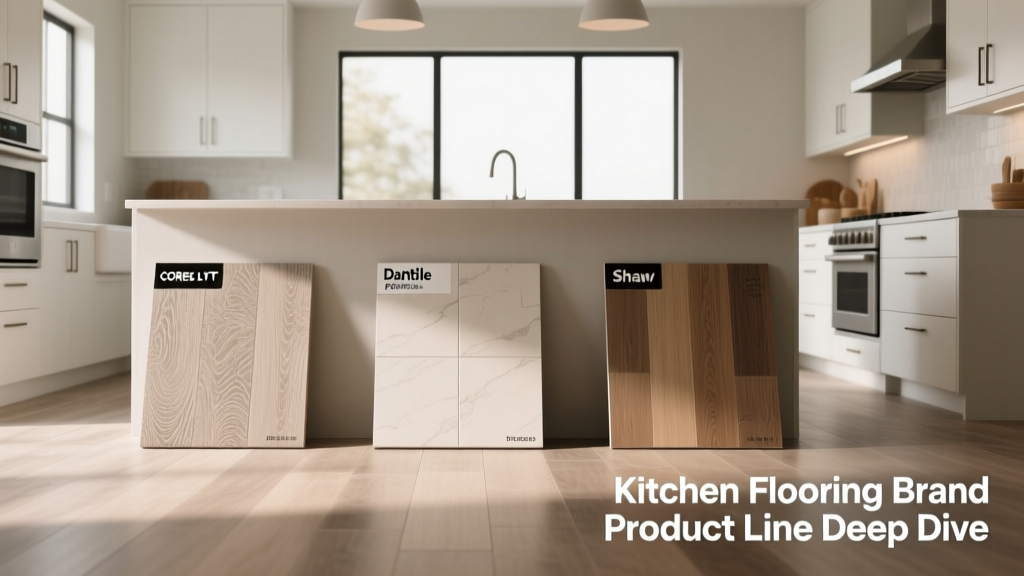
The Anatomy of Premium Kitchen Flooring
Kitchens demand a triad of performance from flooring materials: hydrostatic resistance, impact tolerance, and abrasion resilience. Unlike living rooms or bedrooms, kitchen floors must withstand dropped cast-iron cookware, prolonged exposure to standing water, and heavy point-loads from appliances like commercial-grade refrigerators. When evaluating kitchen flooring options, generic material categories are insufficient; performance is dictated by specific product lines, core compositions, and manufacturing tolerances.
This guide bypasses surface-level material comparisons to provide a technical deep-dive into three dominant 2026 product lines: COREtec Pro Plus (Rigid Core LVT), Daltile Large-Format Porcelain, and Shaw Repel (Water-Resistant Laminate). We analyze their exact specifications, real-world pricing, and the specific installation edge cases that lead to catastrophic failures.
Brand Deep-Dive: COREtec Pro Plus Rigid Core LVT
Technical Specifications & Core Composition
COREtec Pro Plus utilizes a Stone Plastic Composite (SPC) core, engineered from a limestone and PVC dust matrix compressed under high heat. This composition yields a dimensional stability that traditional Wood Plastic Composite (WPC) cannot match. The product features a 20-mil commercial-grade urethane wear layer, certified under Resilient Floor Covering Institute (RFCI) standards for heavy commercial traffic, making it virtually impervious to pet claws or dragged barstools.
- Material Cost (2026): $5.50 – $7.50 per square foot.
- Attached Underlayment: 1.5mm cork, providing an IIC (Impact Insulation Class) rating of 52, crucial for sound dampening in open-concept kitchens.
- Water Tolerance: 100% waterproof core; can withstand indefinite submersion without swelling.
Installation Edge Cases & Subfloor Tolerances
The most common failure mode with SPC rigid core flooring is telegraphing and joint shear. Because SPC is incredibly rigid but inherently brittle, it does not conform to subfloor imperfections. The manufacturer mandates a strict subfloor tolerance of 3/16-inch deviation over a 10-foot radius. If installed over an uneven OSB subfloor, the heavy point-load of a kitchen island will cause the microscopic fiberglass locking mechanisms to snap, leading to peaking seams and water infiltration into the cork underlayment.
Brand Deep-Dive: Daltile Large-Format Porcelain
Glaze vs. Through-Body Composition
For homeowners prioritizing absolute scratch and heat resistance, Daltile’s large-format porcelain lines (such as the Panoramic Porcelain Panels and Urban Concrete collections) remain the benchmark. Porcelain is fired at temperatures exceeding 2,200°F, resulting in a water absorption rate of less than 0.5% per ASTM C373. When selecting kitchen flooring options in porcelain, always specify through-body or color-body porcelain rather than standard glazed. If a heavy pot chips a glazed tile, the contrasting clay body beneath is exposed; a color-body tile masks the chip seamlessly.
Mortar Coverage and Lippage Prevention
According to guidelines from the Tile Council of North America (TCNA), large-format tiles (any tile with one edge longer than 15 inches) require a minimum of 95% mortar coverage in wet areas and 80% in dry areas. Kitchen floors frequently experience moisture from spills and mopping, necessitating the 95% threshold.
Large-format porcelain tiles often exhibit a slight factory bow. If installed in a standard brick (50% offset) pattern, the high center of one tile aligns with the low edge of the next, creating severe lippage. Always install large-format kitchen tiles in a 1/3 offset or stacked (grid) pattern, and utilize a mechanical lippage leveling system (like Tuscan Leveling System) to ensure a flush surface that won't trip homeowners or chip under foot traffic.
- Material Cost (2026): $4.00 – $9.00 per square foot (Installation adds $6.00 – $11.00/sq ft).
- Grout Specification: Use rectified tiles to allow for 1/16-inch grout lines, minimizing the surface area of porous grout that can stain from kitchen oils and wine.
Brand Deep-Dive: Shaw Repel Water-Resistant Laminate
HydroShield Technology and AC Ratings
Shaw’s Repel line addresses the historical weakness of laminate: High-Density Fiberboard (HDF) core swelling. The Repel line utilizes a proprietary hydrophobic surface treatment and tight-click locking system that repels surface water for up to 24 hours. It carries an AC4 (Abrasion Class 4) rating from the North American Laminate Flooring Association (NALFA), indicating suitability for general commercial and heavy residential traffic.
- Material Cost (2026): $3.50 – $5.00 per square foot.
- Water Tolerance: Water-resistant (surface only). Prolonged standing water or flooding will compromise the HDF core.
- Acclimation: Requires 48 to 72 hours of acclimation in the kitchen environment (60-80°F, 35-65% humidity) prior to installation to prevent post-installation expansion gaps.
2026 Product Line Comparison Matrix
| Feature | COREtec Pro Plus (SPC LVT) | Daltile Large-Format Porcelain | Shaw Repel (Laminate) |
|---|---|---|---|
| Core Material | Stone Plastic Composite (Limestone/PVC) | Fired Ceramic Clay (Feldspar/Quartz) | High-Density Fiberboard (HDF) |
| Wear Layer / Rating | 20-mil Urethane | PEI Class IV / V (Glaze hardness) | AC4 Abrasion Class |
| Water Tolerance | 100% Waterproof (Indefinite) | 100% Waterproof (Tile body) | Water-Resistant (24-hour surface) |
| Subfloor Tolerance | 3/16" over 10' radius | 1/8" over 10' radius (requires leveling) | 3/16" over 10' radius |
| Material Cost (2026) | $5.50 - $7.50 / sq ft | $4.00 - $9.00 / sq ft | $3.50 - $5.00 / sq ft |
| Impact Resistance | Moderate (Dents under extreme point-load) | High (Shatters only under severe blunt force) | Low-Moderate (Chips on sharp impacts) |
Real-World Failure Modes in Kitchen Environments
Even premium products fail when installation protocols ignore environmental variables. Based on forensic flooring inspections, here are the most common kitchen-specific failure modes:
- Moisture Vapor Emission Rates (MVER) in Concrete Slabs: Installing LVT or Laminate directly over a below-grade or on-grade concrete slab without a calcium chloride test (per ASTM F1869) is a critical error. If MVER exceeds 3-5 lbs per 1,000 sq ft per 24 hours, the alkaline moisture will break down the adhesive and cause the LVT to delaminate or the laminate to cup. Solution: Apply a two-part epoxy moisture mitigation primer before installing the underlayment.
- Grout Efflorescence and Hazing: Using standard cementitious grout in a kitchen prone to acidic spills (lemon juice, vinegar, wine) leads to etching and staining. Solution: Specify high-performance or single-component urethane grout (e.g., QuartzLock2 or Spectralock), which is chemically inert and does not require sealing.
- Perimeter Expansion Starvation: Kitchens experience high thermal fluctuations from ovens and dishwashers. Laminate and LVT require a strict 3/8-inch expansion gap at all vertical terminations (cabinetry, islands, walls). Failing to maintain this gap results in "tenting," where the floor buckles upward in the center of the room.
The Kitchen Flooring Decision Framework
Use this diagnostic flow to select the optimal product line based on your specific kitchen conditions:
- Scenario A: Concrete slab subfloor with unknown moisture history and heavy appliance traffic.
Decision: Daltile Large-Format Porcelain. Utilize an uncoupling membrane (like Schluter-Ditra) to prevent crack transmission from the slab, and set with a polymer-modified thinset. Porcelain is the only material completely immune to alkaline moisture degradation. - Scenario B: Plywood/OSB subfloor over a crawlspace, requiring DIY-friendly installation and high moisture resistance.
Decision: COREtec Pro Plus SPC LVT. The floating angle-drop installation bypasses the need for messy mortars, and the SPC core will not warp if crawlspace humidity fluctuates and permeates the subfloor. - Scenario C: Strict budget constraints, above-grade wood subfloor, and a desire for the authentic tactile warmth of hardwood.
Decision: Shaw Repel Laminate. Ensure all perimeter gaps are sealed with 100% silicone caulk beneath the baseboards to create a waterproof "bathtub" effect, preventing surface spills from migrating beneath the planks and reaching the HDF core.
For further insights on kitchen design trends and material longevity, consult the annual market reports published by the National Kitchen & Bath Association (NKBA), which consistently highlight the shift toward large-format, low-maintenance surfaces in high-traffic culinary spaces.