AFS Foundation Repair Cost Guide: 2026 Pricing & Methods
Analyze 2026 AFS foundation repair costs, comparing push piers, helical piers, and foam jacking. Learn pricing variables and avoid common quoting traps.

The True Cost Spectrum of Professional Foundation Repair
When homeowners research the afs foundation repair cost, they are typically evaluating premium, engineer-backed stabilization services provided by top-tier regional contractors like AFS (Advanced Foundation Services) or similar national franchises. In 2026, foundation repair pricing has shifted due to fluctuations in structural steel costs, specialized hydraulic equipment demand, and stricter municipal engineering requirements. Unlike general contractors who may offer superficial cosmetic patches, certified foundation specialists address the underlying soil-structure interaction.
The total investment for a comprehensive foundation stabilization project generally ranges from $8,500 for minor slab lifting to over $45,000 for full-perimeter deep foundation underpinning. Understanding where your money goes—and why premium contractors charge 15% to 20% more than localized handyman operations—is critical for protecting your home's structural integrity and resale value.
2026 Pricing Matrix: Premium Contractor Methods
The following table outlines the current market rates for primary foundation repair techniques utilized by certified specialists. These costs include materials, heavy equipment mobilization, labor, and standard engineering oversight.
| Repair Method | Primary Application | 2026 Average Cost | Longevity / Warranty |
|---|---|---|---|
| Push Piers (Galvanized Steel) | Heavy load-bearing walls, deep bedrock | $1,800 - $2,600 per pier | Lifetime Transferable |
| Helical Piers | Lighter loads, unstable topsoil, new construction | $2,300 - $3,400 per pier | Lifetime Transferable |
| Polyurethane Foam Jacking | Sunken concrete slabs, driveway, garage floors | $16 - $28 per sq. ft. | 10 to 25 Years |
| Carbon Fiber Straps (Kevlar blend) | Bowing basement walls, minor shear cracks | $900 - $1,400 per strap | Lifetime (Structural) |
| Wall Anchors (Earth/Plate) | Severe lateral wall bowing (>2 inches) | $1,100 - $1,600 per anchor | Lifetime Transferable |
Push Piers vs. Helical Piers: Soil-Dependent Pricing
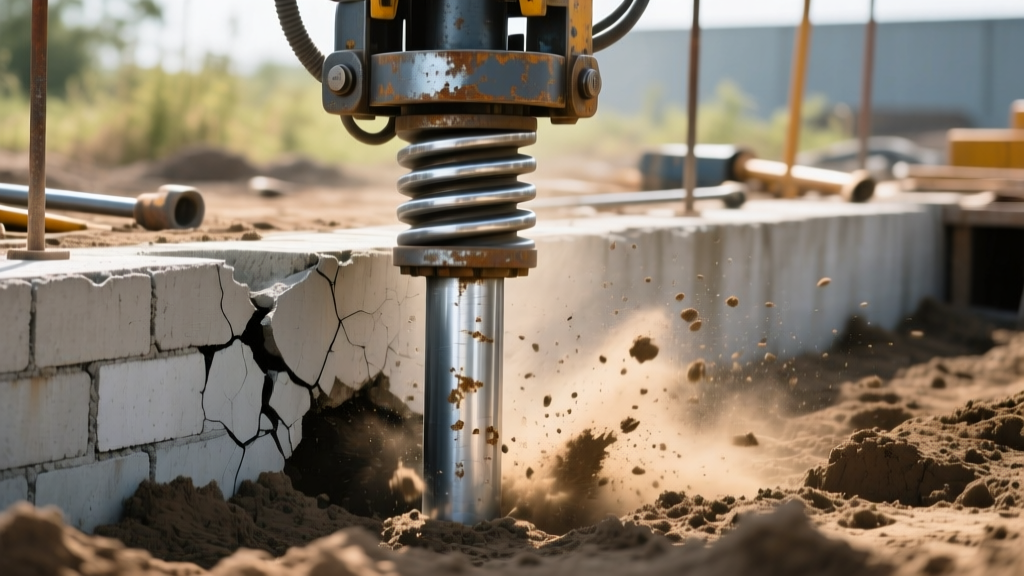
The choice between push piers and helical piers is rarely a matter of homeowner preference; it is dictated by geotechnical realities. Push piers rely on the weight of the structure to drive a steel shaft through unstable soil until it refuses on load-bearing bedrock or dense glacial till. Because they utilize the house's mass for resistance, they are ideal for heavy masonry structures.
Helical piers, conversely, are mechanically screwed into the ground using high-torque hydraulic drive heads. The installation torque (typically measured between 4,000 and 6,000 ft-lbs) directly correlates to the pier's load-bearing capacity. According to InterNACHI's guide on foundation defects, helical piers are mandatory for lighter structures (like porches or single-story wood-frame additions) where the building's weight is insufficient to drive a push pier. The higher cost of helical piers reflects the specialized torque-monitoring equipment and the larger surface area of the helical bearing plates required to distribute loads in expansive clays.
Polyurethane Foam vs. Traditional Mudjacking
For slab-on-grade foundations experiencing differential settlement, polyurethane foam jacking has entirely superseded traditional cementitious mudjacking in the professional sector. High-density structural polyurethane (typically 2.5 to 4.0 lbs per cubic foot) is injected through 5/8-inch ports. It expands up to 20 times its liquid volume, compacting loose subgrades and lifting the slab with millimeter precision. While mudjacking costs slightly less upfront ($9-$12 per sq. ft.), it requires massive 2-inch drill holes, adds thousands of pounds of water-logged cement to already failing soil, and frequently re-settles within five years.
⚠️ The "Pier Spacing" Quoting Trap
When comparing an AFS foundation repair cost against a budget contractor's bid, scrutinize the pier spacing. Budget firms frequently quote 8-foot or 10-foot pier spacing to artificially lower the total pier count and win the bid. However, standard structural engineering practice dictates a maximum 7-foot spacing for load-bearing masonry walls to prevent differential settlement between piers. A premium contractor's higher initial bid often reflects the correct, code-compliant pier count necessary for permanent stabilization.
Hidden Variables That Inflate Your Final Invoice
The base per-pier or per-square-foot metrics rarely tell the whole story. Site-specific logistical challenges can add 10% to 30% to your final contract price. Anticipate surcharges for the following conditions:
- Interior Excavation & Concrete Breaking: If piers must be installed from inside a finished basement or crawl space, contractors must jackhammer the concrete floor, manually excavate the soil, and pour new concrete caps. Expect an additional $400 to $700 per interior pier location.
- Landscaping and Hardscape Restoration: Removing and replacing HVAC units, concrete patios, or mature shrubbery to access the foundation footer adds significant labor time. Premium firms often include basic restoration, while others charge a $1,500+ site-prep fee.
- Geotechnical Engineering Stamps: In regions with highly reactive soils (such as the expansive clays of Texas or the Carolinas), municipalities may require an independent structural engineer to review and stamp the repair plan. This third-party engineering fee typically ranges from $800 to $1,500.
- Water Management Integration: Foundation repair is futile without hydrostatic pressure management. Upgrading or installing interior French drains, sump pumps, and exterior grading corrections can add $3,000 to $8,000 to the overall project scope.
Evaluating the ROI of a Lifetime Transferable Warranty
A defining characteristic of the AFS foundation repair cost structure—and that of similar top-tier firms—is the inclusion of a lifetime, transferable warranty. This is not merely a marketing perk; it is a vital financial instrument. When you sell your home, foundation repairs without a transferable warranty are treated as unresolved liabilities by home inspectors and buyers, often resulting in renegotiated sale prices that exceed the original repair cost.
"A true performance warranty guarantees that the repaired section of the foundation will not experience further differential settlement beyond standard construction tolerances (typically 1/4 inch over 10 feet). Ensure your contract explicitly defines 'performance' rather than relying on vague 'workmanship' guarantees, which only cover the physical installation of the steel, not the soil's future behavior."
Furthermore, as noted in InterNACHI's standards for bowing wall reinforcement, structural reinforcements like carbon fiber and wall anchors must be monitored over time. Premium contractors include annual or bi-annual warranty inspections in their pricing, allowing for minor hydraulic adjustments to push piers at no extra cost before minor shifts become major structural failures.
Decision Framework: Repair, Reinforce, or Replace?
Not every foundation anomaly requires deep underpinning. Use this diagnostic framework to determine the appropriate intervention level based on your structural symptoms:
- Cosmetic / Minor Shrinkage Cracks: Vertical hairline cracks (less than 1/8 inch wide) in poured concrete are typically thermal shrinkage. Action: Epoxy or polyurethane crack injection ($400 - $800). No underpinning required.
- Moderate Differential Settlement: Sticking doors, diagonal drywall cracks emanating from window corners, and slab slopes exceeding 1 inch per 10 feet. Action: Targeted push piers or polyurethane slab lifting. Address the specific failing zone rather than the entire perimeter.
- Severe Lateral Bowing / Shear Failure: Basement walls bowing inward more than 2 inches, horizontal cracking along mortar joints, or stepped cracking in brick veneer. Action: Wall anchors or heavy-duty carbon fiber straps combined with exterior waterproofing membranes. Immediate intervention is required to prevent catastrophic wall collapse.
- Total Footer Degradation: Crumbling concrete footers (common in pre-1940s homes) or severe termite/water damage to wood pilings. Action: Full foundation replacement or complete structural jacking and footer repouring. This is the most expensive scenario, often exceeding $60,000.
Frequently Asked Questions
Is the AFS foundation repair cost negotiable?
While the per-pier material and labor costs are generally fixed based on engineering requirements, you can often negotiate the ancillary costs. Ask the contractor to waive the initial $300-$500 structural inspection fee (which is standard practice if you proceed with the work) or request that basic landscaping restoration be included in the base price rather than billed as an hourly add-on.
How long does a typical underpinning project take?
A standard 10-to-15 pier installation on an exterior-accessible foundation takes 3 to 5 days. If interior concrete breaking and crawl-space excavation are required, the timeline extends to 7 to 10 days. Polyurethane slab jacking, by contrast, is usually completed in a single day, with the slab ready for immediate foot and vehicular traffic.
Will foundation repair fix my drywall cracks?
Lifting and stabilizing the foundation will prevent new cracks from forming and may close existing gaps slightly. However, drywall and masonry are rigid materials that have fractured under stress. You must budget for a professional drywall contractor and mason to tape, mud, and repaint the interior cosmetic damage after the foundation has been permanently stabilized and allowed to cure for 30 days.
Written by
Priya KapoorPriya Kapoor is a real estate market analyst and construction economics researcher with expertise in housing affordability, development feasibility, and infrastructure investment. She holds a Master of Regional Planning from Cornell University and previously worked as a senior analyst at CBRE's Investment Properties group, where she modeled returns for $4B in mixed-use development pipelines. Priya now runs an independent research practice advising developers, municipalities, and REITs on construction cost forecasting and market timing. She publishes the quarterly "BuildMat Market Pulse" report tracking material price indices across 12 commodity categories. Based in Austin, TX, Priya serves on the board of Habitat for Humanity Austin and is a marathon runner.
More from Priya Kapoor
View all
Construction Cost
Cost to Build a 1600 Sq Ft Home in 2026: Full Breakdown
Accurate 2026 cost to build a 1600 sq ft home—material, labor, and regional pricing breakdowns included. Plan your budget with real-time estimates.
Aug 11, 2026

Wood & Lumber
Name the Types of Wood for Pressure Treatment and Preservation
Learn how to name the types of wood best suited for pressure treatment. Compare species treatability, chemical retention levels, and 2026 preservation costs.
Aug 4, 2026

Stone & Masonry
Stone Veneer Suppliers Lindenhurst: 2026 Cost Analysis
Analyze 2026 stone veneer costs in Lindenhurst, NY. Compare local supplier pricing, delivery fees, and Suffolk County installation labor rates.
Aug 4, 2026